
A few days before Thanksgiving in 2009, John Edward Jones set out with his brother and several friends to explore Utah’s Nutty Putty Cave, roughly 55 miles south of Salt Lake City.
Jones wasn’t new to caving. An experienced spelunker and a medical student, he was also a young father with one child at home and another due soon. During the trip, he decided to push into a section known as the “birth canal” — a tight, twisting passage that eventually opens into a larger chamber, The Salt Lake Tribune reported.
But as he moved deeper, Jones realized he wasn’t where he thought he was. Instead of the correct route, he had entered an unmapped area even narrower than the “birth canal.”
Trying to turn around inside the confined space, the 6-foot-tall, 190-pound caver became stuck headfirst in an L-shaped crevice reported to be only about 18 inches high and 10 inches wide. There was no room to shift, breathe comfortably, or reverse course.
With each breath, Jones slipped farther into the passage. He couldn’t back up, and the tighter the space became, the harder it was for him to move at all.
His brother, Josh Jones, was the first to understand how serious the situation was. “Seeing his feet and seeing how swallowed he was by the rock — that’s when I knew it was serious,” he told The Salt Lake Tribune. “It was really serious.”
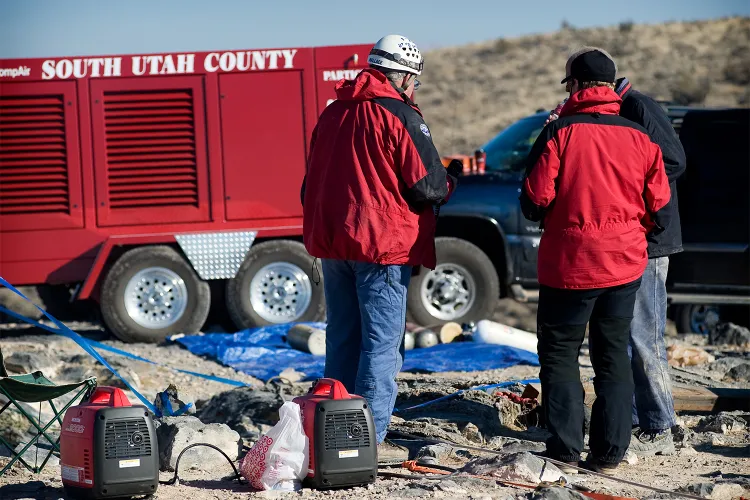
Josh tried to pull his brother free but couldn’t. He then raced to alert authorities. Nutty Putty — named for the soft, claylike material found in its tunnels — quickly became the site of an escalating rescue effort.
:max_bytes(150000):strip_icc():focal(532x0:534x2):format(webp)/nutty-putty-cave-111825-e6418e84c7a84c2db5e994242f70894d.jpg)
Rescuers soon discovered how brutal the location was. Shawn Roundy of the Utah County Sheriff’s Office later described it to Deseret News as “absolutely the worst spot in the cave.” The passage was cramped, awkwardly angled, and so narrow that getting trained responders down to Jones was itself risky.
Still, teams managed to reach him. They squeezed into position, held his hand, gave him an IV, and passed him food and water. Jones was able to speak with his pregnant wife over a police radio — a small, hopeful sign amid the chaos underground.
For a while, it looked like the rescue might succeed. A rope-and-pulley system was set up to take some of Jones’s weight as he tried to inch upward.
But by then, he had already been suspended headfirst at nearly an 80-degree angle for more than eight hours. The strain on his body was extreme, and time was running out.
Then came the turning point. What had seemed like steady progress collapsed when a vital piece of equipment failed. The rope system slipped, and Jones fell back into the same narrow gap — about 125 feet below the surface and roughly 700 feet into the cave, Deseret News reported.
After 27 hours of nonstop effort, authorities said Jones was no longer responsive. He died just minutes before Thanksgiving Day began.
“Due to the circumstances with his body being held the way it was and being wedged, it was most likely difficult to get a full, deep breath,” Sgt. Spencer Cannon told Deseret News. “It would have affected his ability to breathe adequately.”
In the aftermath, Jones’s family released a statement remembering him for his kindness, humor, devotion to his faith, and deep love for his wife, children, parents, and siblings. They said they didn’t understand why his life ended that day, but took comfort in believing they would be reunited again.
The tragedy raised a difficult question: should his body be recovered? After assessing the dangers, officials concluded a retrieval attempt would put more lives at risk. Instead, the cave was sealed permanently. Explosives narrowed the passage, and the entrance was filled with concrete, leaving Jones entombed inside, The Salt Lake Tribune reported.
:max_bytes(150000):strip_icc():focal(479x0:481x2):format(webp)/Utah-County-Sheriff-car-111825-4d47d8c7a44c46d79ba6157db9f8ef72.jpg)
Today, the sealed cave effectively serves as a memorial. Locals sometimes refer to the site as “John Jones Hill.” A bronze plaque bearing his face is mounted nearby, marking the place where an ordinary family outing turned into one of the most heartbreaking cave rescues in U.S. history.
:max_bytes(150000):strip_icc():focal(749x0:751x2):format(webp)/nutty-putty-cave-2-070925-4d0749d6eb194643885f6777413a48b8.jpg)
Five years later, Jones’s widow, Emily Jones-Sanchez, told Deseret News that the early months after his death felt strangely carried by faith — until the long reality set in. She described the weight of losing not only her husband, but the future they had planned: medical school together, raising their children side by side, and building a life that vanished overnight.
In 2016, the documentary The Last Descent was released, retracing the event and the rescue effort — and preserving the story of a man who went underground one November morning and never came back.