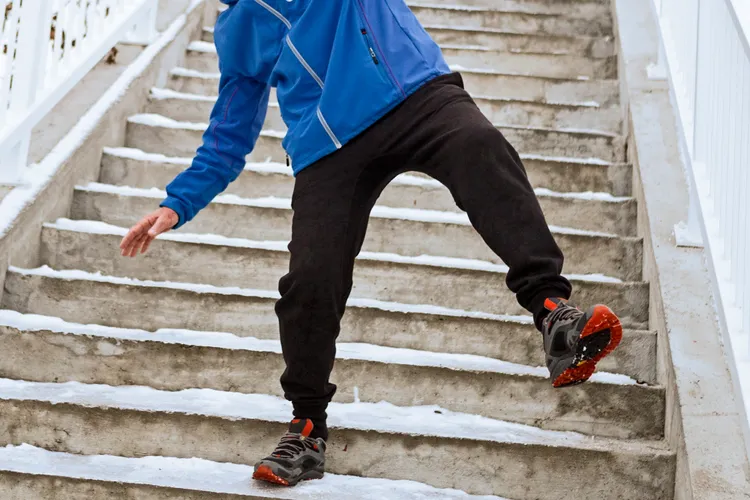

A Washington state healthcare professional narrowly avoided a debilitating injury this month after a harrowing encounter with “black ice” was captured by his home security system. The incident, which occurred as the man was departing for a shift at a regional spine surgery center, underscores the persistent winter hazards facing Pacific Northwest commuters during early morning hours.
On the morning of March 10, a Ring doorbell camera in Puyallup recorded the unidentified man exiting his residence for his morning commute. As he stepped onto the outdoor staircase, he immediately lost traction on a transparent layer of ice. The footage shows the man sliding uncontrollably down more than seven steps before coming to a sudden halt at the concrete base.
The victim, who was heading to work to assist in spinal procedures, described the event as a “startling and abrupt” ordeal.
“I slipped and slid down more than seven steps before reaching the bottom,” he stated in a report via ViralHog. “The fall happened suddenly and was completely unexpected.”
Despite the visual severity of the tumble, the man reported that he was able to stand unassisted and did not sustain serious injuries. The irony of the situation—nearly suffering a spinal injury while en route to a spine surgery clinic—highlights the indiscriminate nature of weather-related accidents.
Medical experts and meteorologists frequently warn that black ice is among the most dangerous road and walkway hazards because it lacks the visible sheen or bubbles found in traditional ice. It often forms when light rain or melted snow freezes rapidly on surfaces as temperatures drop, creating a “clear” glaze that is nearly impossible to detect with the naked eye under low-light conditions.
The incident serves as a critical case study in public safety for regions experiencing freeze-thaw cycles. According to data from the Centers for Disease Control and Prevention (CDC), falls are a leading cause of unintentional injury in the United States, with weather-related slips contributing significantly to emergency room visits during the transitional months of late winter and early spring.
Property owners are encouraged to utilize sand, grit, or non-corrosive de-icing agents on outdoor transit points, particularly during the pre-dawn hours when temperatures are at their lowest.