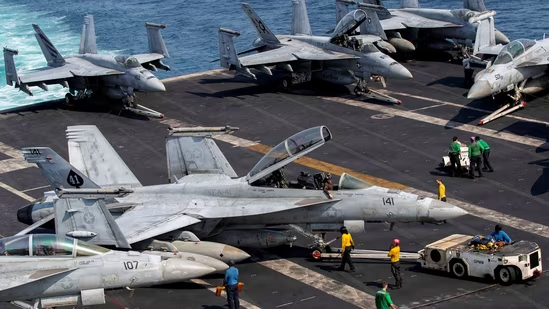

While President Donald Trump has officially paused offensive operations against Tehran until April 6 to prioritize diplomatic channels, the Pentagon has completed one of the largest naval mobilizations in recent history. A massive American armada, led by three aircraft carriers and a formidable amphibious assault force, is now positioned across the Middle East and Indian Ocean, awaiting final orders from U.S. Central Command.
A Global Strike Force in Position
The current U.S. posture suggests a multi-front readiness strategy. The USS Gerald R. Ford and its strike group remain stationed in the Mediterranean, while the USS George H.W. Bush monitors the Atlantic gateway off the coast of Gibraltar. Closer to the theater of operations, the USS Abraham Lincoln is patrolling the Gulf of Oman in the Arabian Sea.
Supplementing this carrier power is a significant ground-ready force. The amphibious assault ships USS Tripoli and USS New Orleans, carrying approximately 4,000 Marines, are currently stationed in the southern Indian Ocean Region (IOR). Strategic logistics and surveillance vessels, including the USS Alan Shepard, Ocean Titan, and John L. Canley, are positioned near the Malacca Straits, ready for rapid induction into the combat theater.
Strategic Objectives and Regional Alliances
White House officials indicate that President Trump retains the option to deploy up to 10,000 ground troops to the Persian Gulf. The primary mission: ensuring “freedom of navigation” in the volatile Strait of Hormuz and providing a security shield for Sunni Gulf allies.
These regional partners have grown increasingly belligerent, citing the Iranian Revolutionary Guard Corps (IRGC) for the deliberate destruction of critical oil and military infrastructure. Intelligence suggests that if Washington fails to provide a decisive military deterrent, Gulf powers may pursue independent, offensive security measures to neutralize the Iranian threat.
Superiority in the Air and Undersea
The scale of the “half-time” buildup is unprecedented:
- Surface Power: 11 Arleigh Burke-class destroyers are currently operating in Middle Eastern waters.
- Air Supremacy: Over 1,000 fighters, bombers, and interdictors are stationed across the three carrier groups and regional bases.
- Subsurface Dominance: Los Angeles-class nuclear-powered fast-attack submarines are stalking the IRGC Navy, prepared to eliminate Tehran’s remaining maritime capabilities.
While critics warn of a prolonged quagmire, the sheer volume of the U.S. arsenal—bolstered by Israel’s significant regional military assets—suggests a strategy aimed at a swift, overwhelming transformation of the Persian Gulf power balance. As the April 6 deadline approaches, the global community remains on high alert; for the U.S. military, the current calm is merely the preamble to a potential second act.