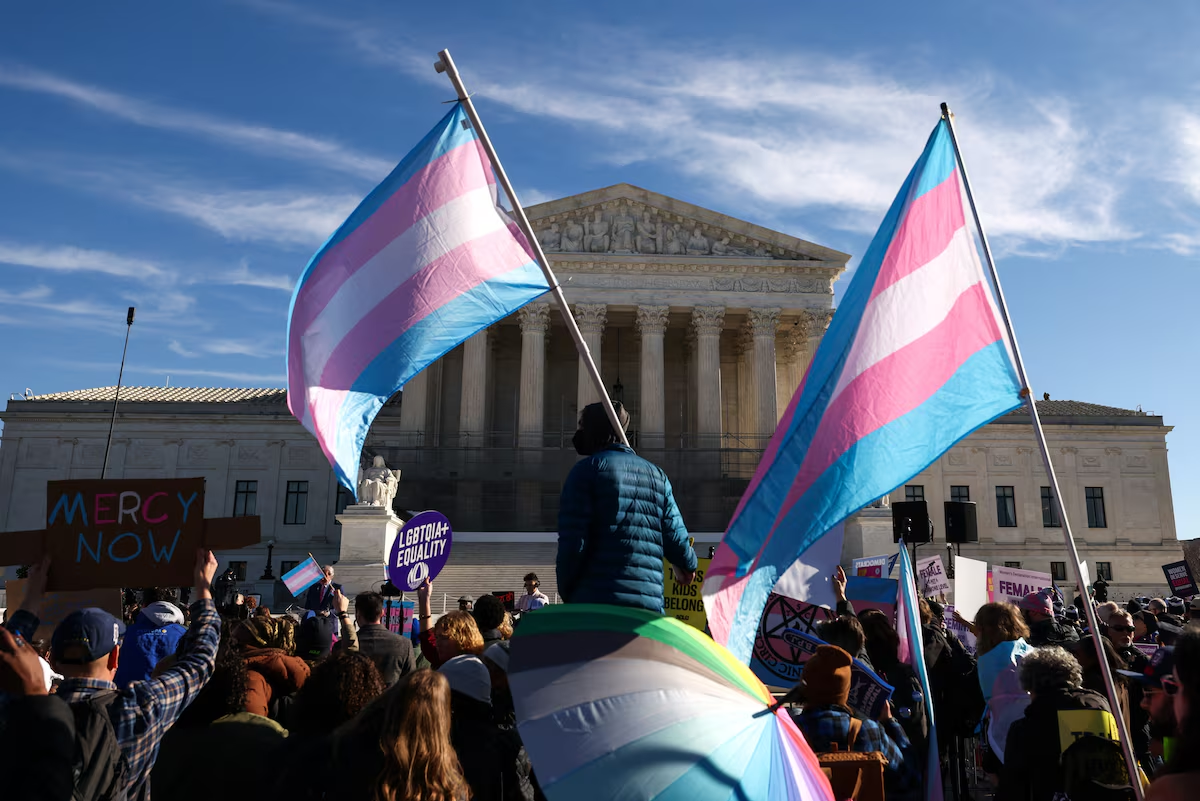

WASHINGTON — The U.S. Supreme Court on Monday intervened in a high-stakes battle over student privacy, blocking California regulations that prevented school districts from disclosing a student’s gender identity to parents without the child’s explicit consent.
In a 6-3 decision along ideological lines, the conservative majority granted an emergency request from Christian parents and educators. The move reinstates a lower court injunction against California’s privacy protections while legal challenges proceed, effectively pausing state measures intended to shield transgender and gender-nonconforming students from involuntary “outing” at school.
Conflict Between Parental Rights and Student Privacy
The ruling centers on a contentious legal debate: whether a school’s duty to protect a student’s privacy overrides a parent’s constitutional right to direct their child’s upbringing.
The emergency request followed a lawsuit brought by Catholic parents and Christian teachers from the Escondido Union School District. The plaintiffs argued that California’s policies—which the state claims protect students from potential hostility or rejection at home—violate the First and 14th Amendments.
The Legal Timeline
| Date | Action | Entity |
| Dec 2025 | Ruled state privacy measures unconstitutional. | U.S. District Judge Roger Benitez |
| Jan 5, 2026 | Stayed Benitez’s ruling, siding with the state. | 9th U.S. Circuit Court of Appeals |
| March 2, 2026 | Blocked the stay; reinstated the injunction. | U.S. Supreme Court |
The Core Arguments: Religious Liberty vs. Child Safety
At the heart of the litigation are California’s “anti-discrimination” provisions. The state maintains these laws do not strictly forbid sharing information with parents but provide a necessary shield when a student fears their safety may be compromised by disclosure.
The Plaintiff’s Case:
The challengers alleged that the state was facilitating a “secret gender transition” by allowing students to use different names or pronouns at school without parental notification. They argued this policy forces teachers to be “dishonest” and infringes upon the religious and due process rights of parents.
The State’s Defense:
California officials argued the 9th Circuit was correct in its initial assessment that the state does not “categorically forbid” disclosure. They emphasized that existing protocols allow for sharing information when it is vital to a student’s physical or mental health, seeking to balance privacy with emergency care.
“A child’s gender incongruity is a matter of health,” wrote U.S. District Judge Roger Benitez in the original ruling now reinstated by the Supreme Court. “Matters of a child’s health are matters over which parents have the highest right and duty of care.”
A Growing Trend in the Conservative Majority
This decision marks another significant moment for a Supreme Court that has increasingly signaled a readiness to curb transgender rights and expand religious exemptions.
The court is currently managing several similar dockets:
- Medical Care: Last year, the court upheld Tennessee’s ban on gender-affirming care for minors.
- Athletics: Justices recently heard arguments concerning Idaho and West Virginia’s bans on transgender athletes in female sports.
- Education: A separate challenge regarding a Massachusetts school district’s gender identity support policy is currently under consideration for review.
The three liberal justices—Sotomayor, Kagan, and Jackson—dissented from Monday’s decision, though the court did not release a full formal opinion alongside the emergency order.
What’s Next for California Schools?
The immediate effect of the Supreme Court’s order is that California schools can no longer rely on state privacy mandates to withhold information regarding a student’s gender presentation from their parents.
The case now returns to the 9th U.S. Circuit Court of Appeals for a full hearing on the merits. However, the Supreme Court’s willingness to intervene at this stage suggests a skeptical view of the state’s privacy protections, potentially setting a precedent that could affect similar “privacy-first” policies in Democratic-led states nationwide.