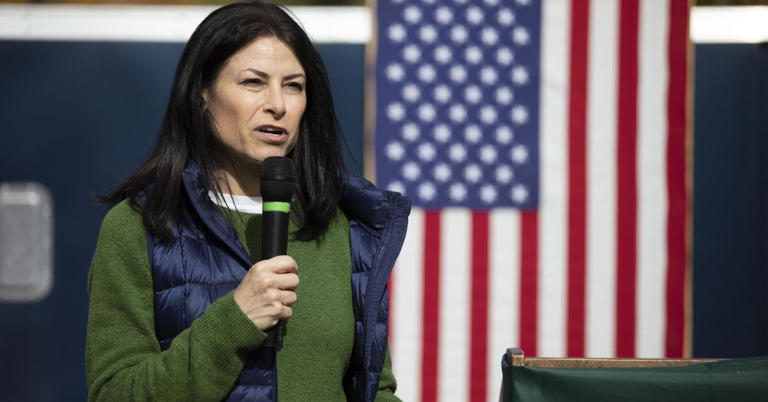

Michigan Attorney General Dana Nessel, a Democrat serving her second term, is facing sharp criticism from Michigan House Republicans who say she committed a “clear ethics violation” by becoming involved in two matters she was supposed to be separated from by an “isolation wall.”
Republicans on the Michigan House Oversight Committee say their months-long review raises concerns about Nessel’s handling of:
- an inquiry connected to Bipartisan Solutions, a group that provided major funding tied to a Fair and Equal Michigan ballot effort in which Nessel’s wife was involved, and
- allegations of financial impropriety involving Traci Kornak, a former Michigan Democratic Party treasurer.
Committee Chair Jay DeBoyer (R) summarized the committee’s view Tuesday, arguing that the safeguards meant to keep the attorney general removed from sensitive inquiries were breached. Kornak did not return calls for comment from Just the News.
Close relationships at the center of the dispute
DeBoyer said the issue is not just procedural but personal, claiming the cases involved people close to Nessel, including her spouse and a former party official who also worked on Nessel’s transition team. He alleged that two separate “firewalls” were violated and that the attorney general’s office may have used its authority to shape the direction of potential criminal matters.
There were also allegations that Bipartisan Solutions violated the Michigan Campaign Finance Act by routing large sums to support efforts by Fair and Equal Michigan to place a petition on the ballot. Bipartisan Solutions has denied wrongdoing. Kornak has also denied wrongdoing in her matter.
Nessel has denied wrongdoing as well, and her office did not immediately respond to a request for comment.
Nessel spokesperson Kimberly Bush rejected the allegations Tuesday, saying the attorney general did not influence investigations or prosecutions where isolation walls were in place and did not violate professional conduct standards. Bush also criticized the committee’s approach, saying the Department of Attorney General offered to make relevant division chiefs available to testify, but the committee declined and instead relied on staff conclusions drawn from selected documents.
Republicans say impeachment is possible
DeBoyer outlined what he called the key issues in each matter.
On the Kornak-related inquiry, he said information was provided to the attorney general’s office alleging potential fraudulent activity tied to Kornak’s role as conservator for an individual, Rosalene Burd. DeBoyer criticized the investigation’s scope, claiming that the office did not interview relevant individuals and spoke only with Kornak before closing the case—after what he described as a firewall breach.
On the Bipartisan Solutions matter, DeBoyer argued the closing document read more like an advocate’s defense than a prosecutor’s analysis.
WZMQ reported that the Oversight Committee “voted to advance a recommendation that Nessel be held in contempt of the Legislature and issued additional subpoenas seeking unredacted documents.” DeBoyer said Tuesday that impeachment “certainly could be on the table.”
Nessel told reporters in July that she had not made decisions about her political future, including a potential run for higher office, and said she had not ruled anything out.
Subpoenas and committee review
Michigan House Republicans said in July they approved two subpoenas—supported by some Democrats—seeking records related to what they described as insufficiently investigated allegations and potential conflicts. Their public statements emphasized a 2023 criminal referral from the Secretary of State alleging Bipartisan Solutions used a “dark money” scheme tied to a ballot effort associated with someone close to Nessel.
Bridge Michigan reported the committee’s eleven Republicans and five Democrats voted to approve the subpoena, while two Democrats abstained.
The subpoena sought “all internal communications within the Michigan Department of Attorney General” regarding the April 2023 criminal referral involving “the Michigan Campaign Finance Complaint in the matter of The Foundation for Accountability and Civic Trust v. Bipartisan Solutions,” along with “any Notice of Isolation Wall” tied to that referral and any resulting investigation.
In August, Republicans said the subpoenas were intended to increase transparency and referenced a separate request for documents about the Kornak investigation, noting Kornak’s personal connection to Nessel through her transition team role and friendship, and citing emails obtained through Michigan’s Freedom of Information Act that raised questions about the attorney general’s involvement.
Documents describe “isolation walls,” then show contact
At Tuesday’s hearing, the Oversight Committee released dozens of pages of internal records obtained through subpoenas.
Those records include a 2020 message notifying staff that, under the Michigan Rules of Professional Conduct, an “Isolation Wall” had been established between Nessel and the Department regarding the Fair and Equal Michigan ballot proposal. The committee argues records later show Nessel was still looped into actions connected to the Bipartisan Solutions inquiry.
The records also indicate that in August 2023 the attorney general’s office sent the criminal referral back to Secretary of State Jocelyn Benson’s office, and that Benson’s legal counsel disagreed with that decision later that month. In February 2024, Nessel’s criminal bureau chief, Daniel Hagaman-Clark, wrote that he was informed Nessel contacted the secretary directly and that the secretary agreed to take the matter back for further review.
Kornak allegations and a separate ongoing probe
The Kornak matter drew additional attention after journalist Charlie LeDuff wrote in July 2022 for The Detroit News that a Grand Rapids nursing home accused Kornak of “inappropriate and unauthorized” invoicing connected to an elderly woman. The attorney general’s office later said its financial crimes division opened a file in September 2022 and that investigators requested a wall be established between the attorney general and the investigation.
Internal descriptions of the investigative steps state that investigators interviewed Kornak, who attributed the billed expenses to respite care during the COVID-19 pandemic, and said no-fault insurance covered the ward’s expenses.
Internal records also suggest an “Isolation Wall” was established between Nessel and the Financial Crimes Division for the Kornak inquiry, but the committee says the documents show Nessel remained informed.
In a Dec. 6, 2022 email, Nessel wrote that Kornak had contacted her directly, said the allegations were affecting a potential judicial appointment, and requested investigation documents. Nessel asked whether Kornak would need to submit a FOIA request and emphasized urgency.
MLive reported that Nessel’s office said the investigation had been completed and no ethical rules were violated, even though the case was not yet formally closed when Nessel asked about the files. MLive also reported Bush said the case was closed in large part because the whistleblower did not respond to investigators.
Assistant Attorney General Matthew Payok wrote on Dec. 19, 2022 that he recommended closing the matter because the alleged victim—the assisted living facility—did not want to make a criminal complaint or pursue a case.
Although Kornak was not charged at the state level in that matter, MLive reported that other agencies later investigated, and that the Kent County Sheriff’s Office recommended multiple charges. Kent County Prosecutor Chris Becker reportedly said this week that no charging decision has been made and that the case remains under active investigation.
Bipartisan Solutions and the campaign finance dispute
Separately, the campaign finance dispute involving Bipartisan Solutions and Fair and Equal Michigan has been argued through complaints, letters, and state-level reviews.
Michigan’s Department of State determined in July 2021 that Fair and Equal Michigan had not obtained enough valid signatures to qualify for the ballot and recommended that the Bureau of Elections decline to certify the petition; the Bureau rejected it.
Bridge Michigan reported that Nessel’s wife, Alanna Maguire, co-chaired Fair and Equal Michigan, which tried but failed to place an LGBTQ anti-discrimination proposal before voters in 2020 or 2022. MLive reported Nessel’s office said Maguire volunteered with Fair and Equal Michigan for part of 2020, and that neither Nessel nor her wife had any association with Bipartisan Solutions. According to that report, Bush said no firewall was erected for the criminal referral because there was no conflict of interest, and said the referral was sent back because the attorney general’s office believed Benson’s office had not followed the process outlined in law for resolving the complaint.
A September 2020 complaint filed with the Secretary of State argued the state could address a “dark money loophole” in the Michigan Campaign Finance Act by applying a presumption when a group makes multiple direct or in-kind contributions to a ballot committee.
Bipartisan Solutions’ attorney, James C. Lamb, wrote to the Department of State in February 2021 arguing the organization was not a political committee, did not engage in activity requiring committee registration, and did not solicit earmarked funds for expenditures. He urged the department to dismiss the matter.
In July 2021, a Department of State elections official wrote that the evidence was insufficient to conclude a potential violation occurred and dismissed the complaint.
In July 2022, the Foundation for Accountability and Civic Trust submitted a letter asserting Bipartisan Solutions’ 2020 activity showed it should have registered and filed reports, citing nearly $700,000 raised and contributed in the first three months of 2020. The complaint argued the timing and size of contributions and subsequent vendor payments suggested coordination and lack of independence.
In November 2022, Benson’s office issued a letter stating there may be reason to believe Bipartisan Solutions violated the Michigan Campaign Finance Act and may have operated as a ballot question committee. The letter cited approximately $782,000 contributed from January to March 2020 and said contributions were often closely followed by similarly sized payments. It alleged that while coordination itself was not prohibited, soliciting funds solely to make expenditures without filing required statements could be.
In April 2023, the Secretary of State’s chief legal director sent a criminal referral to Nessel’s office seeking enforcement of any criminal penalties under the act. Nessel’s office did not pursue charges.