
What began as a high-profile federal enforcement push has spiraled into one of the most politically damaging episodes of the Trump administration’s immigration crackdown—and a growing test of its broader domestic agenda.
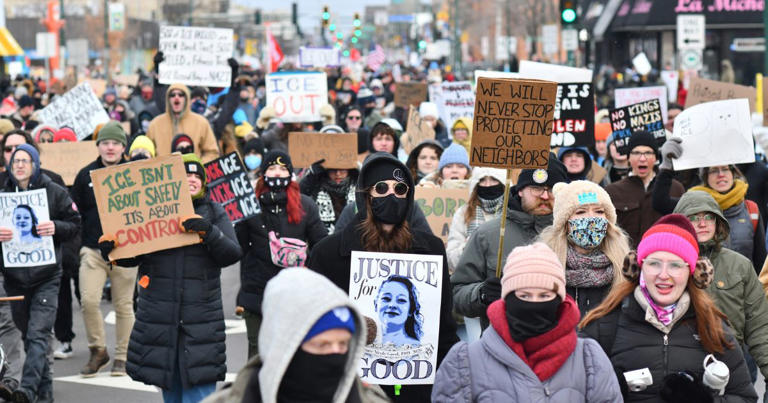
Two 37-year-old U.S. citizens, Renee Nicole Good and Alex Pretti, were shot and killed by federal agents in the streets of Minneapolis this month. The deaths—captured on video from multiple angles—sparked outrage, protests, and a rapid deterioration in public support for the administration’s immigration policy, pushing the White House into an unusual public retreat as it reassesses the scale and posture of federal deployments in Minnesota.
From Earlier Raids to a National Flashpoint
The Minnesota crisis came after major enforcement actions in other large cities, including Los Angeles and Chicago, where raids and targeted operations triggered protests and allegations of excessive force.
Last summer in Southern California, enforcement actions led to clashes with residents and, in at least some cases, deadly consequences. In July 2025, Jaime Alanis, a Mexican farmworker, died after falling while attempting to escape agents during a workplace raid in Camarillo, California. The following month, Roberto Carlos Montoya Valdez, a 52-year-old Guatemalan day laborer, was struck and killed on the 210 Freeway near Monrovia after fleeing a raid at a Home Depot parking lot. In October, Josué Castro Rivera, a 24-year-old Honduran national, was killed on Interstate 264 in Norfolk, Virginia, after being hit by a pickup truck while trying to flee a targeted enforcement stop.
In Chicago, Operation Midway Blitz resulted in thousands of arrests and a wave of legal challenges. Civil rights groups alleged warrantless arrests, unlawful detentions, and heavy-handed tactics in predominantly immigrant neighborhoods. Accounts from the operation included claims that U.S. citizens were pulled from cars, children were zip-tied, and a high-profile sweep involved a Black Hawk helicopter over immigrant communities.
On September 12, Silverio Villegas González, a 38-year-old long-time Chicago resident, was shot and killed by an unnamed ICE officer during a traffic stop in Franklin Park. He reportedly tried to flee, and agents fired. He had no criminal record beyond minor traffic violations and worked as a cook.
Operation Metro Surge and a Mission That Unraveled
Despite earlier flashpoints, the national narrative shifted sharply after the Minneapolis shootings.
Under Operation Metro Surge, launched in December 2025, more than 3,000 federal immigration agents were deployed to Minneapolis and St. Paul. The initial trigger was an investigation into alleged welfare fraud tied to the city’s Somali community, even though most of those immigrants reportedly held legal status. That focus was quickly eclipsed by the deaths of Good and Pretti, transforming what was framed as a targeted enforcement mission into a national crisis.
Bovino Sidelined as Homan Takes Over
As anger intensified—especially after Pretti was killed despite having reportedly already been disarmed—the administration began scaling back its presence in the Twin Cities.
Border Patrol commander-at-large Greg Bovino is being removed from his Minneapolis role, while President Donald Trump has ordered border czar Tom Homan to take charge on the ground. Homan will report directly to Trump, sidelining Homeland Security Secretary Kristi Noem.
One ICE official, speaking anonymously, said Homan would effectively represent Trump’s intentions and provide stronger operational leadership. Retired Border Patrol agent and Texas sheriff Thaddeus Cleveland also backed Homan’s deployment, arguing that he brings career law enforcement experience and a clearer grasp of frontline realities than political leadership at the top of the agency.
As the crisis unfolded, reports described mounting internal friction over enforcement strategy and messaging. Homan—who has emphasized prioritizing arrests of people with criminal histories—has reportedly clashed with Noem’s more aggressive approach aimed at maximizing removal numbers, a strategy favored by senior Border Patrol leadership.
The Department of Homeland Security referred Newsweek to Noem’s statement on X announcing Homan’s move and framing it as part of wide-scale fraud investigations and enforcement against “public safety threats and violent criminal illegal aliens.”
Meanwhile, Bovino—often trailed by camera crews in earlier operations—had drawn attention in cities like Los Angeles, where Border Patrol teams used aggressive tactics such as teargassing public areas and conducting mass detentions. But Minnesota changed the political calculus.
Bovino has been reassigned back to his prior El Centro sector along the California border, a move widely read as an attempt to de-escalate and distance senior leadership from an operation that has become politically untenable. CNN reported DHS also removed Bovino’s access to official social media accounts. DHS has said Bovino has not been relieved of duties, despite reports suggesting he was removed as commander-at-large, according to The Atlantic. DHS Assistant Secretary Tricia McLaughlin pushed back publicly, saying Bovino remained a key part of the President’s team.
A Messaging Collapse After Pretti’s Death
In the immediate aftermath of Pretti’s killing, Noem, Bovino, and White House chief of staff Stephen Miller publicly described the ICU nurse as a “domestic terrorist” and a “would-be assassin” intending to “massacre” federal law enforcement. The language drew immediate backlash as video of the shooting appeared to undercut official claims.
By Monday, the White House worked to step away from the most inflammatory rhetoric.
“Does the president agree with them?” ABC News Chief White House Correspondent Mary Bruce asked press secretary Karoline Leavitt.
Leavitt responded that she had not heard Trump characterize Pretti in those terms, while emphasizing that the administration would let the investigation run its course.
Trump later declined to say whether the agents acted appropriately, telling The Wall Street Journal on Sunday that the administration was “reviewing everything” and would eventually issue a determination.
A senior DHS official told Newsweek the agency believed it was facing a coordinated wave of violence targeting law enforcement and defended the government’s position, citing what they described as large percentage increases in assaults, vehicular attacks, and death threats against federal officers.
Public Support Erodes—and Not Just Among Democrats
Protests in Minneapolis and beyond have been described by critics as an effective challenge to federal overreach, with opponents arguing that the events have eroded public trust in law enforcement and energized broader resistance to aggressive ICE operations.
Polling suggests the fallout has traveled well beyond Minnesota:
- A Reuters/Ipsos poll conducted January 24–26, 2026, found 39% approval for Trump’s handling of immigration and 53% disapproval. In the same poll, 58% said ICE agents have gone too far. The survey included 1,139 U.S. adults with a ±3-point margin of error, and its fieldwork overlapped the period immediately before and after the second Minneapolis shooting.
- An Ipsos KnowledgePanel survey conducted January 16–18, 2026, found 59% saying ICE efforts go too far. It also found respondents viewed Good’s fatal shooting as excessive force by a 52% to 25% margin. The sample was 1,229 adults with a ±3.2-point margin of error, conducted after the first Minneapolis shooting but before the second.
- A January 25, 2026 Economist/YouGov poll of 3,359 U.S. adults found 46% supporting abolishing ICE (34% strongly, 12% somewhat), 41% opposed, and 12% unsure.
The shift is showing up inside Republican politics as well. The Economist/YouGov poll found Republican support for abolishing ICE rising to 19%, up from 15% in early January—while Democrats remained the most supportive, with more than three out of four backing abolition.
Several Republican senators—including Bill Cassidy, Susan Collins, Mike Crapo, John Curtis, Jerry Moran, Lisa Murkowski, and Thom Tillis—have called for a thorough investigation into Pretti’s death.
Texas Governor Greg Abbott, a major Trump ally, said the White House needs to “recalibrate” enforcement strategy in the wake of the fatal shooting.
At the same time, Senator Rand Paul and House Homeland Committee Chair Andrew Garbarino are calling for senior immigration officials to testify. Senator Chuck Grassley has scheduled a hearing for Noem to appear.
Will Noem Keep Her Job?
Noem is under increased scrutiny following the Minneapolis shootings, particularly after her public description of Pretti as a “domestic terrorist,” which triggered sharp criticism and forced the White House to create distance.
A former ICE official told Newsweek he supports replacing her, arguing the situation could stabilize with a leadership change.
House Democrats, meanwhile, are moving toward impeachment proceedings against Noem, citing her oversight of aggressive enforcement tactics. The effort—introduced by Representative Robin Kelly after Good’s death—has gained momentum, with more than 140 Democratic cosponsors backing articles alleging obstruction of Congress, violation of public trust, and self-dealing.
Funding, Shutdown Risks, and a Wider Political Crisis
The killings of Good and Pretti—combined with protests, legal challenges, and political backlash—have raised the stakes far beyond Minnesota.
The DHS appropriations bill is now at risk, and lawmakers are warning of a potential government shutdown as Congress fights over enforcement priorities and the scope of ICE authority.
Senate Democrats, led by Minority Leader Chuck Schumer, have said they will not provide votes to advance a $64.4 billion DHS appropriations bill in its current form, citing roughly $10 billion for ICE without meaningful reforms. Several Democrats have pledged to oppose the measure unless limits are imposed on what they describe as unchecked ICE power, leaving Republicans’ 53-seat majority short of the 60 votes needed to clear a filibuster.
That standoff has brought the appropriations process to the brink, with a partial shutdown looming if lawmakers cannot reach a deal before the funding deadline.
A Turning Point for ICE’s National Standing
This is the point where the Minneapolis saga becomes more than a local crisis. What was framed as standard immigration enforcement is now being treated—across party lines—as a defining test of federal power, accountability, and strategy ahead of the 2026 midterms.
Federal leadership has been reshuffled. Public opinion has shifted sharply. And for the first time in years, ICE’s authority is being openly questioned at a national level by both Democrats and Republicans—tying the future of the agency, DHS funding, and even cabinet-level leadership directly to the fallout from Minneapolis.