
Lori Coble was stuck in standstill freeway traffic on May 4, 2007, driving home to put her three young children down for a nap when a semi-truck slammed into the back of her minivan. Lori and her husband, Chris Coble, lost all three of their children — Kyle Christopher, 5, Emma Lynn, 4, and Katie Gene, 2 — in an instant.
In the aftermath, grief threatened to consume them. Devastated but determined to survive, Lori and Chris made a promise to each other: they would not end their lives, and they would walk through the unimaginable pain together. Though heartbroken, they still longed to be parents.
After exploring adoption and learning that Chris’s vasectomy could not be reversed, the couple turned to IVF. They were left with three viable embryos — two girls and a boy — mirroring the children they had lost. It felt symbolic, almost impossible to ignore. They chose to implant all three, hoping for a miracle.
Almost exactly one year after the fatal crash, the couple welcomed triplets: Jake Christopher, Ashley Lynn, and Ellie Gene. Each child carried the middle name of an older sibling, a quiet tribute woven into their new beginning.
:max_bytes(150000):strip_icc():focal(574x0:576x2):format(webp)/lori-coble-chris-coble-children-121225-1-51b968b5142f478780fa179d84257442.jpg)
For Chris, joy and grief coexisted painfully. It took years to emerge from the fog of loss. Raising the triplets brought overwhelming happiness, but also constant reminders of what had been taken. He often stepped away to cry in private, then returned with a smile, determined to shield his children from the depth of his pain.
Lori poured herself into motherhood and became an advocate for highway safety, hoping to spare other families from similar tragedy. Those who knew her described her as fiercely devoted, compassionate, and defined above all else by her role as a mother.
In June 2025, subtle changes began to worry Chris. Lori, then 48, became increasingly clumsy — bumping into walls, dropping glasses, stubbing her toes. By early July, more alarming signs appeared. Her mouth began to droop slightly, symptoms impossible to ignore.
On July 11, Chris rushed Lori to the emergency room at Mission Hospital in Mission Viejo, California. Doctors delivered devastating news: Lori had an aggressive, stage 4 glioblastoma — a terminal brain cancer.
Chris had hoped their family had already endured its share of life-altering disasters. Instead, they were thrust into another crisis. Doctors explained Lori’s options clearly. Without treatment, she might live only one to two months. With treatment, perhaps a year.
:max_bytes(150000):strip_icc():focal(574x0:576x2):format(webp)/lori-coble-chris-coble-son-121225-e62d223d25d44bc5a26d9c9f76b6febe.jpg)
Lori chose to fight.
From that moment, the family rallied around her, knowing the goal was no longer a cure but time. Chris began grieving the loss of his wife the day she was diagnosed, struggling with anger and disbelief. How could this be happening again?
Lori underwent her first brain surgery on July 12 to remove one of two connected tumors. She recovered quickly, determined and unyielding. Friends recalled her unwavering resolve — she wasn’t ready to give up her life, her dreams, or her future with her children.
But the second half of the tumor grew rapidly, expanding by 25 percent in just two weeks and threatening her vision. Doctors recommended another surgery, one far riskier than the first. It involved areas of the brain responsible for cognition, movement, and sight.
The family traveled to City of Hope in Duarte, California, where Lori underwent the second surgery on August 1. Doctors warned there was a 30 percent chance she could lose motor control on her left side.
She did.
Five days later, on what should have been her discharge day, Lori suffered a massive stroke. Emergency surgery saved her life, but barely. Doctors told Chris she had only a 50 percent chance of surviving.
:max_bytes(150000):strip_icc():focal(812x340:814x342):format(webp)/lori-coble-chris-coble-children-121225-3-0503c351ffd24481a2760401b905f797.jpg)
Lori was placed in a medically induced coma, connected to a ventilator and feeding tube. She remained hospitalized for 40 days. Chris and Lori’s mother stayed by her side daily. Chris missed just one day — the day he physically and emotionally collapsed.
That moment forced a stark realization. Faced with unbearable exhaustion and despair, Chris chose to ask for help instead of surrendering to the darkness. He later reflected on how relentless caregiving can push people to the brink.
Meanwhile, their triplets were beginning their senior year of high school — a milestone year that unfolded without either parent fully present.
Lori eventually regained consciousness. Too young for a nursing home yet too medically fragile for standard rehabilitation, she was placed in a small hospital specializing in traumatic brain injuries. Chris and the children decorated her room with family photos and paintings, trying to bring pieces of home to her bedside.
Still, it wasn’t enough. Lori wanted to go home.
:max_bytes(150000):strip_icc():focal(574x0:576x2):format(webp)/lori-coble-121225-1-c60d95b2f8f249d2bf23d1bc9e1ef82e.jpg)
In October, Chris transformed their house into a “mini-hospital,” determined to give her the best care possible in familiar surroundings. Being home lifted Lori’s spirits. She saw her children more often, and their dog slept at the foot of her bed. Slowly, she made progress.
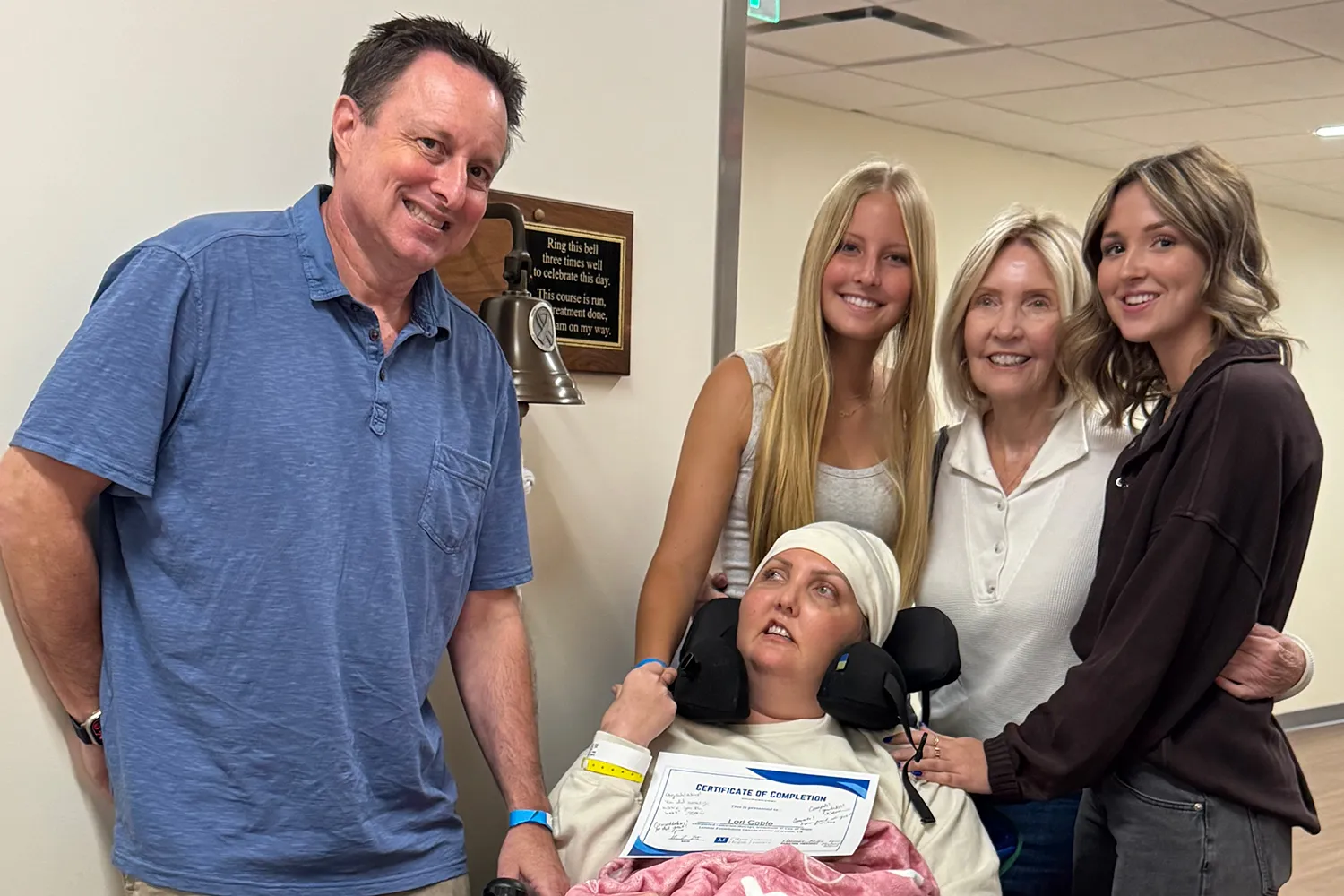
Chemotherapy and radiation soon followed — an exhausting routine requiring hours of travel five days a week. Lori, now unable to control the left side of her body, relied on special equipment just to get out of bed. Months of immobility had stripped away her strength.
The treatments took a toll. Her speech worsened. Her energy faded. Doctors grew concerned that instead of improving, she was declining.
In mid-November, Chris rushed her back to the emergency room. Doctors discovered a severe brain infection requiring yet another surgery — one that would likely be fatal if delayed.
Despite Lori’s earlier wishes to avoid further surgeries, the family made the agonizing decision to proceed.
Chris later described the experience as watching someone you love endure endless suffering, questioning whether the treatment was any kinder than the disease itself.
After surgery, Lori slowly stabilized. She began speaking in full sentences again. But her recovery remained fragile.
In early December, Lori felt well enough to schedule a video interview. The day before it was set to happen, she was hospitalized once more — this time with pneumonia and a lung infection.
Weeks later, her condition improved slightly. She regained enough clarity to reaffirm her wish: no more surgeries. Her family began preparing to bring her home for hospice care, honoring her desire to be surrounded by loved ones and comfort.
Chris has been on unpaid leave from work since September, dedicating himself fully to Lori’s care. The cost of in-home medical support is staggering — about $30,000 per month — and friends have organized fundraising efforts to help.
Each day, Chris focuses on one purpose: making the time Lori has left as peaceful and meaningful as possible. He carries the weight of grief not only for what is coming, but for the life they once had.
The woman he knew, he says, may never return. Yet he remains in awe of her resilience.
He would give his life for hers without hesitation, he admits — but all he can do now is stay, love her fiercely, and walk beside her until the end.