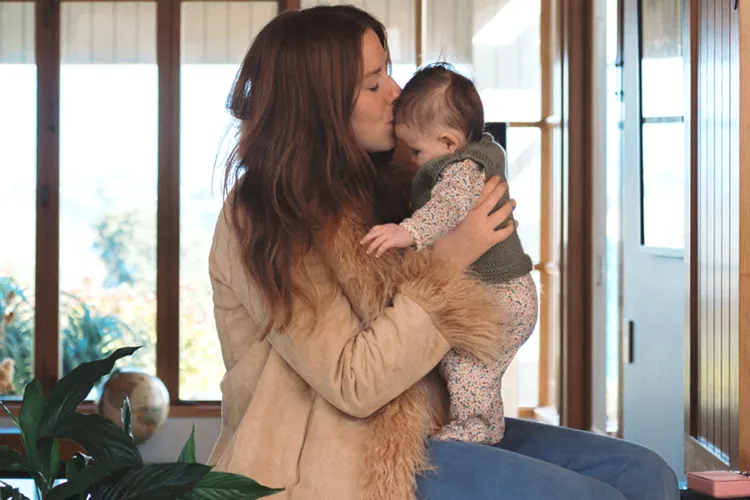

Kate Hall calls potty-training her daughter one of her favorite parts of motherhood — and she says it started from day one.
The New Zealand-based influencer, who documents her lower-waste lifestyle online, shared a January Instagram video filmed in her garden with her 8-month-old daughter, Orchard, strapped to her chest. On-screen text read, “Not to be dramatic but potty-ing my baby (since birth) is one of my favorite parts of parenting.”
In the caption, Hall said her baby “rarely poops in her nappy” thanks to elimination communication, which she describes as “the practice of tuning into a baby’s natural cues and rhythms and responding by offering a potty or toilet instead of relying solely on nappies.”
Speaking in an interview, Hall said she’d heard about elimination communication before she got pregnant — and once she understood the idea, she couldn’t shake it.
“I couldn’t un-learn the fact that no human, no matter what age, wants to poop in their pants and that babies have cues from day one around when they need to go — just like they have sleep and feeding cues,” she said. “So it made practical sense to me as a new mum that I would try my best not to train my baby to poop and pee in a nappy.”
She also liked the practical upsides: spending less and washing fewer reusable nappies.
“I also wanted to save money, plus wash less reusable nappies! I read the book ‘Diaper Free’ by Ingrid Bauer, and everything in it made so much practice sense to me that I wondered why people don’t do this more often,” she said. “I then learnt that EC is actually the main way of toileting babies in many parts of the world. If you think about it, what did we use to do before nappies?”
Hall admits the approach hasn’t been flawless — especially when life happens away from home.
“It’s hard when I am out and about and not super close to the toilet, or sometimes the public baby changing room doesn’t have a toilet in it, so I have to go into the main toilet but cannot lie her down easily afterwards to put her nappy back on,” she explained. “Plus, when Orchard started solids, her bowels started changing and she was going a lot more frequently.”
Still, she says she and her partner, Tim, try not to treat missed moments as failures. On days that include “poopy nappies,” they simply reset, keep offering the potty, and stick with their routine.
After several months, Hall says the process has felt easier than she expected — and more meaningful.
“I remember waking up the second day of her life, immediately taking her clothes and nappy off, holding her over the potty, and she went poo and wee. It felt like magic!” she said. “Since then, it’s been a beautiful way to connect with each other.”
For Hall, the goal isn’t perfection — it’s responsiveness.
“I find it works best when I am not trying to be perfect and catch everything, but more trying to listen to my baby and connect with her needs; mother’s intuition,” she said. “It was definitely easier when she was a newborn and I could hold her over the top hat potty. Now she is bigger, I have a toilet seat reducer so she sits on the toilet and has done so since 6 months old.”
Orchard isn’t fully potty-trained, Hall adds — but she estimates her daughter uses the toilet for “70-95% of her poos.”
:max_bytes(150000):strip_icc():focal(749x0:751x2):format(webp)/mom-potty-trained-baby-since-birth-2-020426-086f4e97b19542f9a92ab884c04cf7b5.jpg)
“She has a ‘poo face’ that I observe before taking her to the toilet,” she explained. “But mainly it is offering her the opportunity to go to the toilet at practical times. e.g., when she wakes up, after eating or breastfeeding, after arriving home, before going out. I notice that now when she needs to go, she often looks to me.”
Hall described one recent moment when she says her daughter’s cues were unmistakable. While feeding Orchard a banana outside, she noticed a shift in her expression — a “concentrated face” that signaled it was time to head to the bathroom.
“All babies have different cues and often it’s several cues that happen all at once,” Hall said. She also uses sounds as part of the routine — “ahh ahh” and “sss sss” — which she’s done since birth.
“This means I am cueing her to go as well; so when I sit her on the toilet and make those sounds, she knows what I am suggesting her to do,” she said.
:max_bytes(150000):strip_icc():focal(695x0:697x2):format(webp)/mom-potty-trained-baby-since-birth-4-020426-c548a0512212434886c25c84b155d20d.jpg)
For parents curious about trying elimination communication, Hall says it doesn’t have to be all-or-nothing. Start small, she suggests — and experiment.
“Simply try offering your baby the potty for a minute or two (hold them over the toilet or over a potty) when you next change their nappy and see what happens,” she said. “Or (if you have time) spend 30 minutes observing them nappy-free and see if you can watch their cues. It’s such a great way to save money and to connect deeply with your baby.”