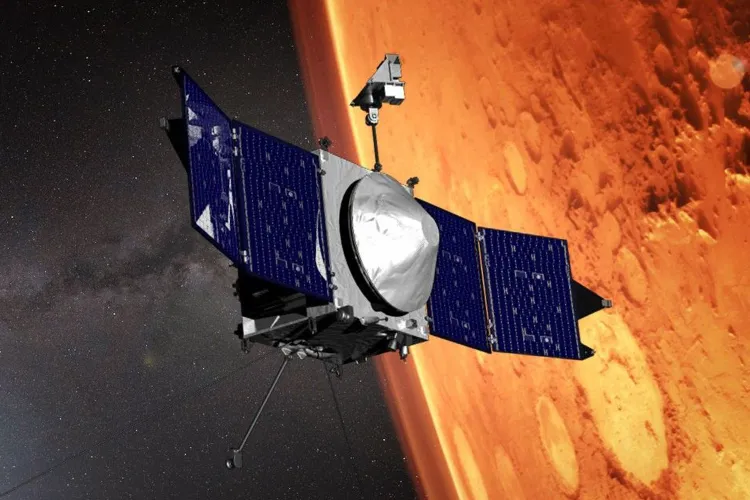

NASA has announced that it has lost contact with its long-serving Mars Atmosphere and Volatile Evolution (MAVEN) spacecraft, which has been studying the Red Planet’s upper atmosphere for more than a decade.
MAVEN launched in November 2013 and entered Mars orbit in September 2014. According to the agency, communication with the spacecraft was lost on Dec. 6, shortly after it passed behind Mars and was expected to reestablish contact.
“Telemetry from MAVEN had showed all subsystems working normally before it orbited behind the Red Planet,” NASA said. However, when the spacecraft emerged from behind Mars, no signal was received.
NASA’s spacecraft and operations teams are now investigating the issue and have said they will share updates as more information becomes available.
For the past 11 years, MAVEN has been focused on understanding how Mars’ upper atmosphere and ionosphere interact with the Sun and the solar wind, and how those processes contribute to the loss of the Martian atmosphere into space, according to NASA. Its observations have helped scientists better understand Mars’ atmospheric loss, its past climate, the history of liquid water on the surface, and the planet’s potential habitability over time.
In addition to its science mission, MAVEN has also acted as a communications relay for rovers on the Martian surface, providing a crucial link between ground-based teams and hardware operating on Mars.
MAVEN is part of a larger network of Mars orbiters. It has been working in coordination with other spacecraft, including NASA’s Mars Reconnaissance Orbiter and Mars Odyssey, as well as the European Space Agency’s Mars Express and the ExoMars Trace Gas Orbiter.
The Mars Reconnaissance Orbiter, launched in 2005, was tasked with searching for evidence that water once persisted on Mars’ surface for extended periods. It has also returned detailed images of the Martian terrain, including its craters.
Mars Odyssey, which launched in 2001, is the longest-running active mission in orbit around the planet. Its instruments study features such as clouds, fog and frost, and map surface rocks to help make future landings safer.
Mars Express, an ESA mission launched in 2003, has been exploring both the atmosphere and surface of Mars from a polar orbit.
The ExoMars Trace Gas Orbiter, a collaborative mission between ESA and Russia’s Federal Space Agency, investigates the Martian atmosphere for methane and other trace gases that may exist in very small amounts, offering clues about geological or possible biological activity.