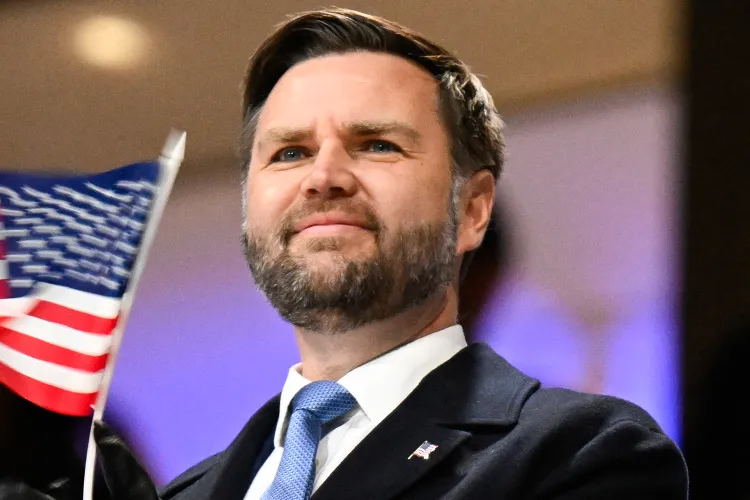

Vice President JD Vance is doubling down on the strategic importance of Greenland, arguing that the Arctic territory sits at the center of America’s ability to detect and defend against long-range missile threats.
Speaking in an interview with Megyn Kelly, Vance framed Greenland as a non-negotiable national security priority — not because the U.S. plans to “own” it, but because America is deeply invested in protecting it.
“Greenland is very important to U.S. national security,” Vance said. “Our missile defense system would be inoperable if Russia or China controlled Greenland. The U.S. is on the hook for defending it, but we don’t own it. So the president wants benefits in exchange for protecting it. We’ve had a good meeting with Denmark and Greenland, and I’m confident it will be resolved in a way that benefits the U.S.”
Vance then underscored the stakes in blunt terms, emphasizing that control of Greenland by a rival power would leave the U.S. vulnerable in a worst-case scenario.
“So, God forbid — I don’t think it’s going to happen, to be clear — but God forbid some foreign country launches a missile, an ICBM, at the United States of America, we couldn’t defend ourselves if a foreign country controlled Greenland,” he said.
Why Greenland is back in Washington’s spotlight
Vance’s comments come as the administration renews its push to strengthen American influence and access in Greenland — a territory that has drawn increasing attention in U.S. strategic planning, particularly as the Arctic becomes more competitive.
The issue has regained momentum since President Trump revived the debate early in his term about expanding U.S. leverage in Greenland. The White House has argued that the Arctic is transforming rapidly, as climate-driven changes reshape the region — exposing new resources and opening potential new routes for travel and trade. That evolving landscape has intensified competition with countries like Russia and China, both of which have increased their interest and activities in the broader Arctic.
The U.S. already has a footprint — but wants more clarity and leverage
The United States already maintains a military presence on Greenland through longstanding arrangements with Denmark. Those facilities are linked to core defense functions, including early warning capabilities and space surveillance.
But the president has argued that if the U.S. is responsible for Greenland’s defense in practice, the country should receive clearer advantages in return — whether through stronger access terms, expanded cooperation, or more formalized agreements that reinforce American operational freedom in the region.
Diplomacy, not “ownership”
Despite periodic talk of “buying” Greenland in past political cycles, the current trajectory is centered on negotiations and cooperation, not a transfer of sovereignty.
Vance referenced a recent meeting involving U.S., Danish, and Greenlandic officials, signaling that the talks are moving forward through diplomatic channels. Discussions have reportedly focused on deeper collaboration across security, economic development, and environmental monitoring — paired with efforts to ensure non-allied powers cannot establish a foothold.
Still, Greenland remains an autonomous territory within the Kingdom of Denmark, and leaders in Copenhagen and Nuuk have repeatedly made clear that sovereignty is not on the table. That reality has pushed negotiations toward alternative deals that strengthen U.S. access and coordination without changing Greenland’s political status.
The bigger geopolitical message
Vance’s warning about Russia and China reflects Washington’s broader concern about strategic positioning in the Arctic. Russia maintains extensive Arctic military infrastructure, and China has invested in polar research and shown interest in resource-related projects in northern regions — trends U.S. officials often cite as reasons the Arctic can’t be treated as a distant afterthought.
At the same time, Greenland’s NATO-aligned protections, international norms, and Denmark’s firm stance make the idea of a hostile takeover highly unlikely. But Vance’s message was less about predicting an imminent threat — and more about arguing that America must lock in Arctic stability now, before the geopolitical balance shifts.
In short, the administration is signaling that Greenland isn’t just a map curiosity — it’s a strategic anchor. And in Vance’s telling, losing influence there would mean risking something far bigger than diplomacy: America’s ability to defend itself.