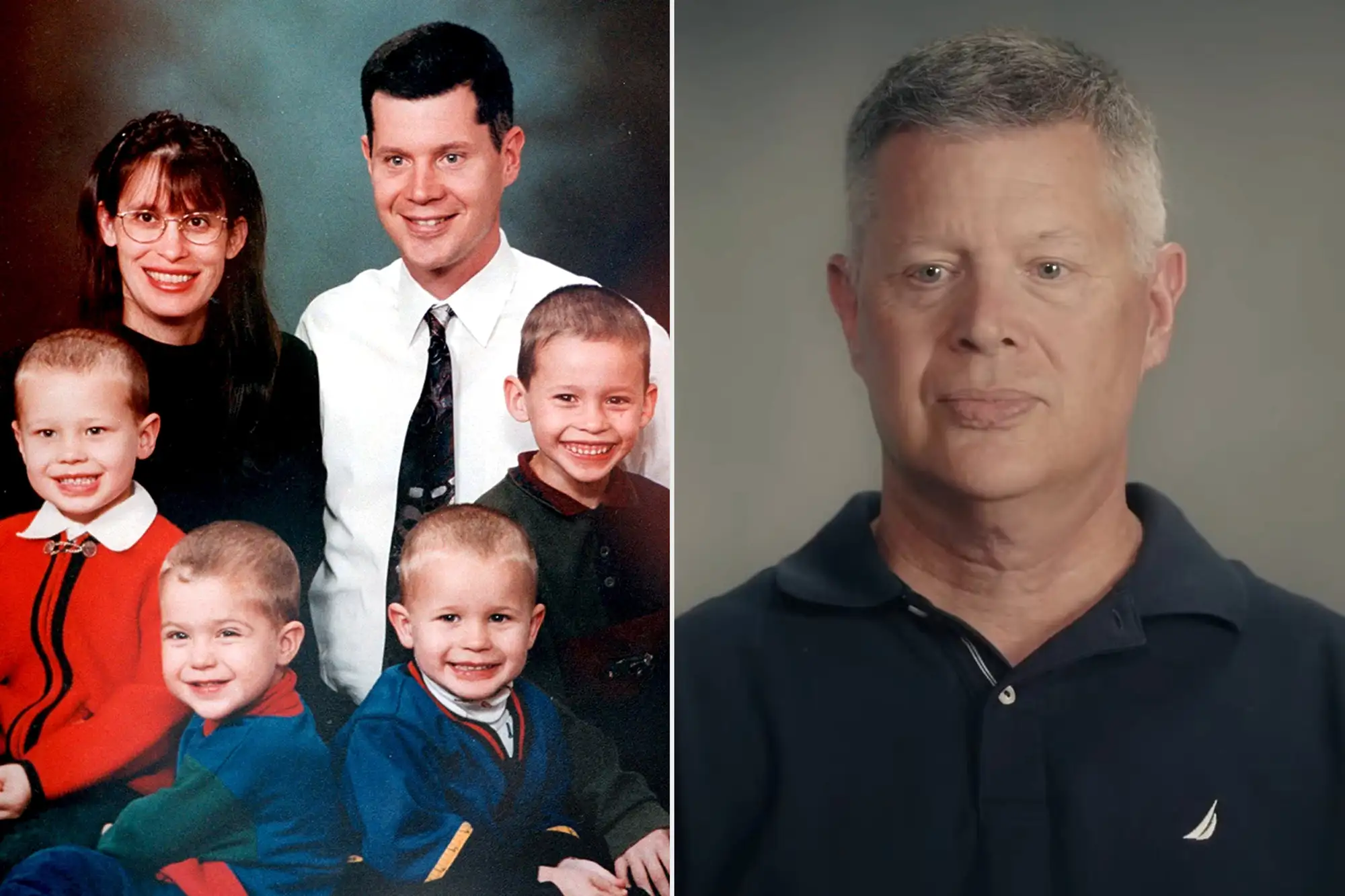

Rusty Yates’ life changed forever on June 20, 2001, when his wife, Andrea Yates, drowned the couple’s five children in a bathtub inside their Houston home.
Andrea had struggled for years with postpartum depression and postpartum psychosis. ID’s The Cult Behind the Killer: The Andrea Yates Story (premiered Jan. 6, now streaming on HBO Max) also explores whether Andrea may have been influenced by the religious teachings of Michael Woroniecki, a preacher some have described as leading a “cult.”
After drowning Noah (7), John (5), Paul (3), Luke (2), and Mary (6 months), Andrea called police and confessed. In March 2002, she was convicted of capital murder and sentenced to life in prison. That conviction was later reversed, and in July 2006, she was found not guilty by reason of insanity. She has lived in a Texas mental health facility since 2007.
:max_bytes(150000):strip_icc():focal(624x269:626x271):format(webp)/andrea-yates-family-portrait_3272-f4f40527ae8d4bc293f6aebf2dee081c.jpg)
Despite the unimaginable loss, Rusty has repeatedly said he never blamed Andrea for the deaths, insisting that without her severe mental illness, she would not have harmed their children.
“Being a mother was Andrea’s favorite role,” he says in the docuseries. “She was an awesome mother.”
Below is an updated look at Rusty Yates’ background, his relationship with Andrea, and where his life stands today.
Rusty Yates’ career: NASA computer engineer
Rusty has worked at NASA’s Johnson Space Center in Houston as a computer engineer since 2001, according to his LinkedIn.
He earned a bachelor’s degree in applied science and mathematics from Auburn University, and later obtained a law degree from the University of Houston. He says he first encountered Woroniecki’s teachings during his college years.
:max_bytes(150000):strip_icc():focal(736x314:738x316):format(webp)/andrea-rusty-yates-wedding-010726-4484e2e37f08442bbe736fcc09da10eb.jpg)
“I’d never seen that kind of message where you don’t have to belong to a church … to find God. I admired that,” Rusty recalls in the docuseries. “It wasn’t a cushy, comfy kind of message. I liked the fact that it was a little bit edgier.”
Rusty and Andrea Yates married in 1993
Rusty and Andrea met in 1989 and married in 1993. Rusty says he introduced Andrea to Woroniecki’s religious teachings early in their relationship, and the couple maintained contact with him for years.
“Andrea and I saw ourselves as a family that had traditional values. We did read the Bible,” Rusty says in the docuseries. “[Woroniecki] would almost be like a … spiritual advisor.”
As their family grew, Rusty and Andrea raised their five children in line with beliefs promoted by the Woroniecki family. Andrea stayed home and homeschooled the children, a choice the docuseries links to Woroniecki’s view that public schools were satanic.
:max_bytes(150000):strip_icc():focal(613x433:615x435):format(webp)/rusty-yates-texas-courthouse-010726-754d540c9a4c4341b577f135914b9222.jpg)
“I think we each had a different perspective on that,” Rusty says. “I thought of it more from a learning standpoint. Andrea was afraid of the negative influence in school. She didn’t want them exposed to that at such a young age.”
Over time, Rusty says he drifted away from Woroniecki as work and parenting demands increased. Andrea, however, remained closely engaged—continuing to write letters, read newsletters, and listen to recorded sermons on cassette tapes, according to the docuseries.
Rusty intervened after Andrea’s 1999 suicide attempt
After the birth of their fourth child in 1999, Andrea experienced what Rusty describes as a “nervous breakdown” and later attempted suicide. She was diagnosed with postpartum depression, hospitalized, and treated with medication that significantly stabilized her condition. Doctors also warned that another pregnancy could trigger a serious relapse.
“After we got married, we discussed children and said we considered each one a blessing, and we’d have however many came along,” Rusty says. “That was our plan.”
Despite the warning, the couple had another child. In 2000, Andrea gave birth to their youngest, Mary.
Rusty says he underestimated the risk.
“I just thought, ‘OK, she’ll get sick. Worst case, it’ll be like a flu,’” he recalls. “‘She’ll get treated with the same medicines that worked for her before, and we’ll be done. Simple enough.’”
:max_bytes(150000):strip_icc():focal(750x176:752x178):format(webp)/rusty-yates-kids-010726-855cbf8a6e264d65aeace5d484daaf1d.jpg)
The morning Andrea drowned their children
After Mary’s birth, Andrea’s mental health deteriorated sharply. Rusty says he recognized how serious things were and admitted her to a mental hospital. She was later discharged, with doctors suggesting she might stabilize once she returned home.
“I didn’t know it at the time, but Andrea was having visual hallucinations, auditory hallucinations,” Rusty says. “It led to the delusions of having the devil in her.”
He also says Andrea didn’t tell him what was happening internally—and that, at the time, no one believed the children were in danger.
That changed on June 20, 2001.
“I was at work, maybe an hour, and got a call from Andrea,” Rusty recalls. “She’s like, ‘You need to come home.’ My heart sank because I’m like, ‘Oh no, what has she done?’”
“When I got to the house, the police wouldn’t let me inside,” he continues. “Andrea was still inside the whole time. I remember banging on the back door, saying, ‘How can you do this? I don’t understand.’ I was heartbroken.”
:max_bytes(150000):strip_icc():focal(742x236:744x238):format(webp)/andrea-rusty-yates-split-010726-4b3752c2633a49d6b8a527799a0ae731.jpg)
Rusty testified in Andrea’s defense
At Andrea’s first trial in 2002, Rusty testified on her behalf. He believed she should not spend her life in prison for actions committed while profoundly mentally ill.
“I took a lot of heat for Andrea,” he says in the docuseries. “People can think what they want. They didn’t live our life.”
“I thought the whole time, ‘How ridiculous is this?’” he adds. “Here’s a loving mother who would never, ever have harmed our children in any way had she not been psychotic, and the state is prosecuting her for capital murder.”
Andrea was convicted of capital murder, but the conviction was later overturned after a key prosecution witness acknowledged an error in testimony. In 2006, at her retrial, Andrea was found not guilty by reason of insanity.
“I thought, ‘Wow, the result of not guilty for reason of insanity was quite a relief,’” Rusty says. “I was super grateful.”
:max_bytes(150000):strip_icc():focal(711x261:713x263):format(webp)/rusty-yates-010726-c2c7eaeea1a242519dd033d5b3bd4e77.jpg)
Where Rusty Yates is now
Rusty and Andrea divorced in March 2005. The following year, he married Laura Arnold, according to ABC News. The couple had a son in March 2008, and later divorced in 2015.
In a 2016 interview with Oprah Winfrey, Rusty said he still maintains contact with Andrea—calling her about once a month and visiting about once a year at the mental health facility in Kerrville, Texas, where she lives.
Over the years, Rusty has faced intense public criticism, including blame for decisions made before the tragedy—criticism echoed by Woroniecki in a television interview shown in the docuseries.
“What about Rusty? … Could you ever stand up and say, ‘I’m looking in the mirror and seeing the guy who is responsible?’ I should have shepherded my wife,” Woroniecki says in that clip.
In The Cult Behind the Killer: The Andrea Yates Story, Rusty says he regrets introducing Andrea to Woroniecki, though he stops short of labeling the teachings a “cult.”
“Looking back, I miscalculated the effect on Andrea,” he says. “Now, I believe her delusions could well have been influenced by her exposure to [Woroniecki]. If I could do it all over, I would not have introduced her to them.”