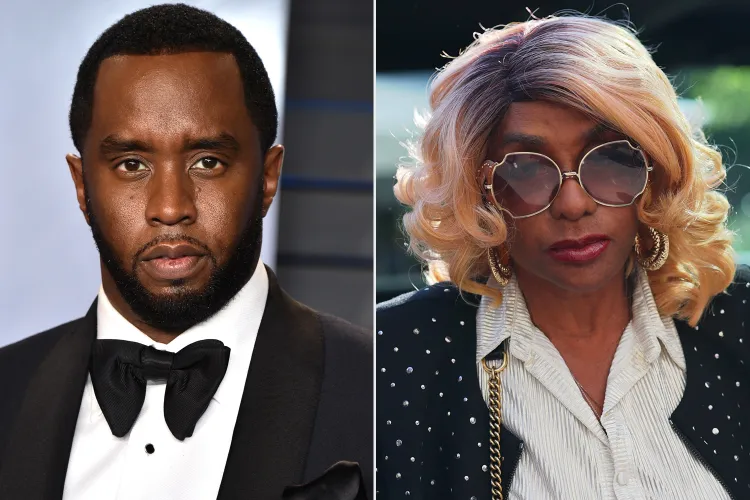

Bad Boy Records co-founder Kirk Burrowes alleges in a new Netflix documentary that Sean “Diddy” Combs once slapped his own mother and insulted her when she confronted him about a fatal stampede at a 1991 event he promoted in New York City.
The four-part series Sean Combs: The Reckoning, released on Tuesday, Dec. 2, includes intimate footage, filmed with Combs’ knowledge, from the six days leading up to his September 2024 arrest and indictment. It also features interviews with former friends and jurors from his federal trial, according to a Netflix press release.
In the first episode, Burrowes — a childhood friend of Combs — recounts what he remembers from the aftermath of the December 1991 stampede during a sold-out celebrity basketball game at City College of New York in Harlem. Nine people were killed when the crowd surged toward the gymnasium doors and victims were crushed at the bottom of a staircase. No criminal charges were filed in connection with the incident, CNN reported.
Burrowes says that after the tragedy, he found himself in a Manhattan hotel room with Combs and Combs’ mother, Janice Combs, discussing what had happened.
“He didn’t know what was going to happen,” Burrowes says in the docuseries. “And I saw Janice question Sean. He’s going into this music business thing. He just left school and now this extreme tragedy has occurred. She’s like, ‘Did he make the right decision?'”
“And I saw him put his hands on her,” he claims. “Call her a bitch and slapped her. He’s not looking back.”
In the series, a title card notes that Combs did not respond to the filmmakers’ request for comment on the allegation that he physically harmed his mother.
The docuseries arrives in the wake of the music mogul’s federal convictions on two prostitution-related charges, for which he is currently serving a 50-month prison sentence handed down in October. Combs, 56, is also facing dozens of civil lawsuits accusing him of sexual assault.
Netflix notes that a civil suit filed by Burrowes against Combs in 2025 — accusing the producer of years of “predatory” conduct toward him — remains pending. Burrowes had previously sued Combs over an alleged 1996 incident in a complaint filed in 2003, but that earlier case was eventually dismissed, according to prior reports.
One day before the new docuseries premiered, Combs’ spokesperson, Juda Engelmayer, denounced the project as a “shameful hit piece” in a statement, claiming that “Netflix relied on stolen footage that was never authorized for release.”
“As Netflix and CEO Ted Sarandos know, Mr. Combs has been amassing footage since he was 19 to tell his own story, in his own way. It is fundamentally unfair, and illegal, for Netflix to misappropriate that work,” Engelmayer said.
“For Netflix to give his life story to someone who has publicly attacked him for decades feels like an unnecessary and deeply personal affront,” he added, referencing longtime rival Curtis “50 Cent” Jackson’s role as a producer on the series.
:max_bytes(150000):strip_icc():focal(999x0:1001x2):format(webp)/Kirk-Burrowes-120225-396ae18de05e45b0b29f698db1dcfcd8.jpg)
When asked specifically about the allegation that Combs slapped his mother, Engelmayer responded: “We’re not going to comment on individual claims being repeated in the documentary. Many of the people featured have longstanding personal grievances, financial motives, or credibility issues that have been documented for years. Several of these stories have already been addressed in court filings, and others were never raised in any legal forum because they’re simply not true. The project was built around a one-sided narrative led by a publicly admitted adversary, and it repeats allegations without context, evidence, or verification.”
In the Netflix press release, director Shan Nicholson and executive producer Sasha Jenkins’ collaborator, Jessica Stapleton, explained the broader purpose behind the series.
“This isn’t just about the story of Sean Combs or the story of Cassie, or the story of any of the victims, or the allegations against him, or the trial,” she said. “Ultimately, this story is a mirror [reflecting us] as the public, and what we are saying when we put our celebrities on such a high pedestal. I hope [this documentary] is a wake-up call for how we idolize people, and to understand that everybody is a human being.”