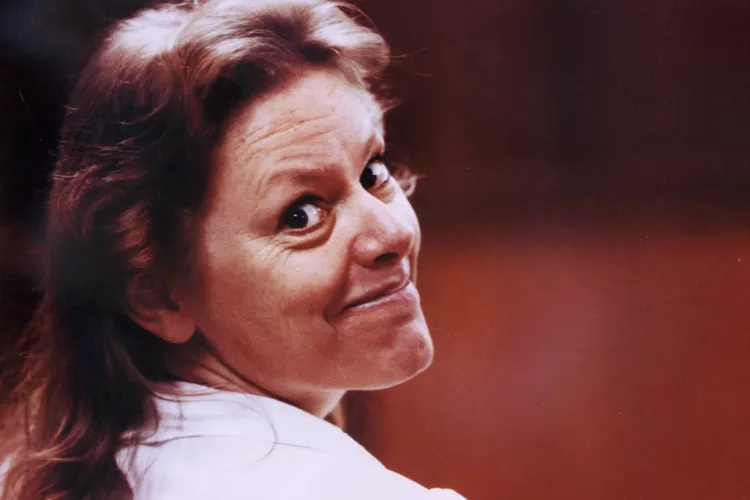

In January 1991, Aileen “Lee” Wuornos — a 34-year-old drifter recently arrested for a string of murders along Florida’s highways — was recorded on a phone call from jail, promising to protect the woman she loved. Speaking to her girlfriend, 28-year-old Tyria Moore, Wuornos’s voice trembled with emotion: “I’m not gonna let you go to jail. Ty, I love you. If I have to confess everything just to keep you from getting in trouble, I will.”
That vow led to Wuornos’s confession and eventual conviction for six murders. In 2002, she was executed by the state of Florida. Branded by the media as “the first female serial killer” and a “hooker from hell,” her story became infamous, later dramatized in the 2003 film Monster, starring Academy Award winner Charlize Theron.
:max_bytes(150000):strip_icc():focal(683x464:685x466):format(webp)/aileen-wuornos-serial-killer-hearse-102725-cad37a7ca65e48bd93682853d79ee4e1.jpg)
Now, the Netflix documentary Aileen: Queen of the Serial Killers (premiering Oct. 30) reopens her case with newly unearthed footage from a death row interview. The film revisits her history of sexual violence, abuse, and betrayal. “Aileen said, ‘I’m going to talk to you about the truth of my crimes,’” says director Emily Turner. “From this interview, a very different version of her comes through — contradictory, human, and often disturbing.”
In the interview, Wuornos insists, “The real Aileen Wuornos isn’t a serial killer. I was so lost I turned into one.”
Born in Michigan and abandoned by her parents at age 4, she was adopted by her grandparents. By 13, she became pregnant (her baby was later adopted) and endured physical abuse from her grandfather. In a 1997 prison interview featured in Aileen: Queen of the Serial Killers, she also claimed she was sexually assaulted by teenage friends. By 16, she had run away and survived as a hitchhiking sex worker. “I slept under viaducts, in abandoned homes, in cow pastures,” she recalled. “I must have been raped about 30 times, maybe more.” Yet, she added defiantly, “I’m tough. A wussy woman? It would have bothered her.”
:max_bytes(150000):strip_icc():focal(124x0:126x2):format(webp)/monster3-170-56aa353c3df78cf772adbe3c.jpg)
Wuornos met Moore, a Daytona Beach motel maid, in 1986. Their connection was immediate and consuming. “I loved her so bad,” Wuornos said. “[She’s the] only reason I carried that darn gun. I wanted to make sure that I got home alive — so I’d be another day breathing with her.”
But their relationship spiraled as a trail of violence emerged. Between 1989 and 1990, six men — Richard Mallory, 51; David Spears, 47; Charles Carskaddon, 40; Troy Burress, 50; Charles Humphreys, 56; and Walter Antonio, 62 — were found murdered near Florida highways. Witnesses saw two women driving a victim’s stolen car, and Wuornos’s fingerprint was discovered on a pawned item belonging to one of the victims.
:max_bytes(150000):strip_icc():focal(749x0:751x2):format(webp)/richard-vogel-bob-kelley-larry-horzepa-jake-erhart-102825-1-a4179a3e491a4c79acb3e2b7a01a0815.jpg)
Arrested on Jan. 9, 1991, Wuornos confessed after Moore cooperated with police to avoid charges. At trial for Mallory’s murder, Wuornos claimed she acted in self-defense after being raped and tortured, but the jury convicted her. She later pleaded guilty or no contest to five additional murders.
:max_bytes(150000):strip_icc():focal(749x0:751x2):format(webp)/aileen-wuornos-murder-trial-102825-1-7e0f883a6c8b4854bddb2ca96c584bc5.jpg)
In the documentary, Wuornos’s childhood friend Dawn Botkins recalls their final meeting the night before her execution. “She said she was definitely a serial killer,” Botkins remembers. “It was all the years of abuse, and then she started drinking. Plus Ty [Moore]. Aileen kept saying that to me: ‘That was quite the love, wasn’t it? It was fatal.’”