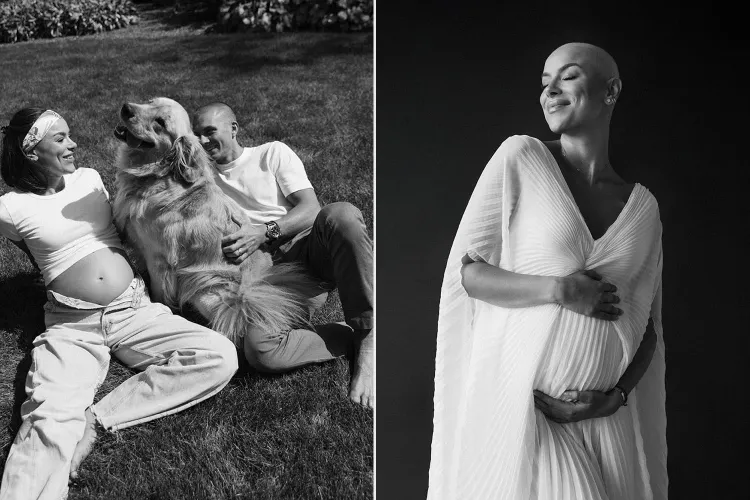

Ever since she was a little girl, Victoria Glass dreamed of becoming a mother. Her own mom used to say she seemed “born to be a mom,” and the phrase stuck with her. So when she and her husband learned they were expecting in November 2024 — after a prior miscarriage and IUI — they were thrilled.
Early pregnancy wasn’t easy. Glass, 28, a content creator from Chicago’s northern suburbs, dealt with persistent nausea that she described to friends as feeling “hungover every day without having had anything to drink.” She was exhausted, drained, and, most frustratingly, couldn’t eat much at all.
“Every single thing sounded disgusting unless it was white bread, white rice, or popcorn,” she says. “I’ve never been a picky eater, so that threw me for a loop.”
Then, just before the second trimester, things suddenly improved.
“By 10 weeks… I woke up one day and felt like myself again,” she says.
Not long after, something far more alarming emerged. Around that same 10-week mark, Glass had a NIPT test (non-invasive prenatal testing), a blood test used to screen for chromosomal abnormalities. Two weeks later, she got a phone call that immediately made her uneasy.
“I knew something was wrong,” she says. “I thought they would only call if there was an issue with the baby, not me.”
:max_bytes(150000):strip_icc():focal(749x0:751x2):format(webp)/victoria-glass-121525-6-267e1579c93844f4b7b794b9bd98e68e.jpg)
A geneticist explained that while the fetus’s DNA looked normal, the test was considered inconclusive because there was extra DNA in Glass’s blood that didn’t appear to belong to the baby — or to her.
“She asked if I had ever been diagnosed with cancer or had a tumor,” Glass recalls. “I hadn’t, and I started panicking. She explained that tumors can shed extra DNA into the bloodstream, which can show up in this test.”
As she started digging for information, Glass realized how unusual this situation is. She learned that in 2013, a similar case reportedly went undetected and the woman died months after giving birth. Glass says the NIH later launched the IDENTIFY Study, which follows people whose NIPT results are abnormal even though ultrasounds and other fetal testing appear normal.
“Of the 107 participants, 52 were diagnosed with cancer,” she says. “It’s still a very rare situation, but this study is helping doctors understand it better.”
Determined to get clarity, Glass flew to Bethesda, Maryland, just eight days after the call. At the NIH, she underwent a full-body MRI, met with an oncologist, and completed extensive blood work. Before traveling, she did a self-exam and noticed a lump in her breast.
:max_bytes(150000):strip_icc():focal(749x0:751x2):format(webp)/victoria-glass-121525-2-02828e013f604176ba9451873caa2c0f.jpg)
“The NIH oncologist and my gynecologist both thought it was likely a cyst, so I was holding on to hope that it would be benign,” she says.
The MRI, however, found a suspicious mass, and she was sent for a biopsy. The following week at Northwestern, she had a mammogram, ultrasound, and more biopsies. The result: invasive ductal carcinoma.
Her tumor was three centimeters, grade three, and triple-negative — an aggressive subtype that isn’t driven by estrogen or progesterone hormones. The news was devastating, but Glass says she shifted quickly into action.
“I was with my mom when I got the phone call,” she says. “She was hysterically crying, and I just went into research mode — figuring out what to do next. I didn’t fully process it until I gave birth. Part of me was subconsciously protecting the baby from heavy emotions. I just focused on problem-solving, because I knew everything is figureoutable.”
Her biggest fear wasn’t for herself — it was for her unborn son. That fear intensified when she faced a decision she never expected: starting chemotherapy during pregnancy.
“I was terrified something could happen to him,” she says. “But knowing my doctors had treated pregnant women with breast cancer before gave me comfort. They were confident in the treatment I was receiving, and I had to trust that.”
She says she handled treatment better than she expected. “I was fatigued and had brain fog, and losing my hair was rough, but otherwise I did okay,” she says.
:max_bytes(150000):strip_icc():focal(749x0:751x2):format(webp)/victoria-glass-121525-5-62e3a087b8f6466ebf637975e970ea16.jpg)
Throughout it all, Glass says her support system held her up — especially her husband.
“My relationships have grown stronger,” she says. “My husband has been my rock, making me laugh every day. I’ve learned to ask for help, focus on gratitude, and stay positive. That mindset has carried me through.”
Her treatment continued during pregnancy: four rounds of AC chemotherapy, followed by a single mastectomy at 32 weeks.
“The surgery was a success, with clear margins and no lymph node involvement — that was the biggest relief,” she says.
She carried her son, August, to 36 weeks and delivered vaginally on Nov. 11. One week later, she restarted chemotherapy. Because of the mastectomy and ongoing treatment, she can’t breastfeed — but she says formula feeding is going smoothly.
“He’s saved my life in a way,” she says. “Knowing I’ll be able to watch him grow is the biggest blessing of all.”
Glass first began sharing her experience on TikTok after finding comfort in the posts of others. When she received her diagnosis, she searched hashtags like #triplenegativebreastcancer and learned from what other women had shared. It helped her feel more prepared — and less alone.
She didn’t anticipate how widely her own video would spread. Since posting, she says it has reached thousands.
“So many women reached out, saying they’d been through the same experience or battled breast cancer postpartum,” she says. “Being able to connect with them, ask how they’re doing, and share experiences has been really fulfilling.”
Now, she speaks daily with three women who are also pregnant, being treated for breast cancer at Northwestern, and living nearby.
:max_bytes(150000):strip_icc():focal(749x0:751x2):format(webp)/victoria-glass-121525-4-d6e0957334f146eabce124f703badea6.jpg)
“What are the odds?” she laughs.
“Social media has its pros and cons, but connecting with women during such a vulnerable, scary, and unique experience has been an incredible blessing. I’ve learned so much from their advice and strength.”
That connection has also shaped how she views her own journey — and what she hopes others take from it.
“Cancer does not discriminate, and self-exams are crucial,” she says. “No matter what challenges you face, blessings can emerge—strengthened relationships, gratitude, and perspective. The human body and spirit are stronger than we think.”
For now, she’s focused on time — the kind that once felt uncertain, and now feels precious.
“We’ll soak up every moment with our son,” she says. “I don’t know what the future holds for fertility, but I’m grateful for the family I have. Every day is a gift.”