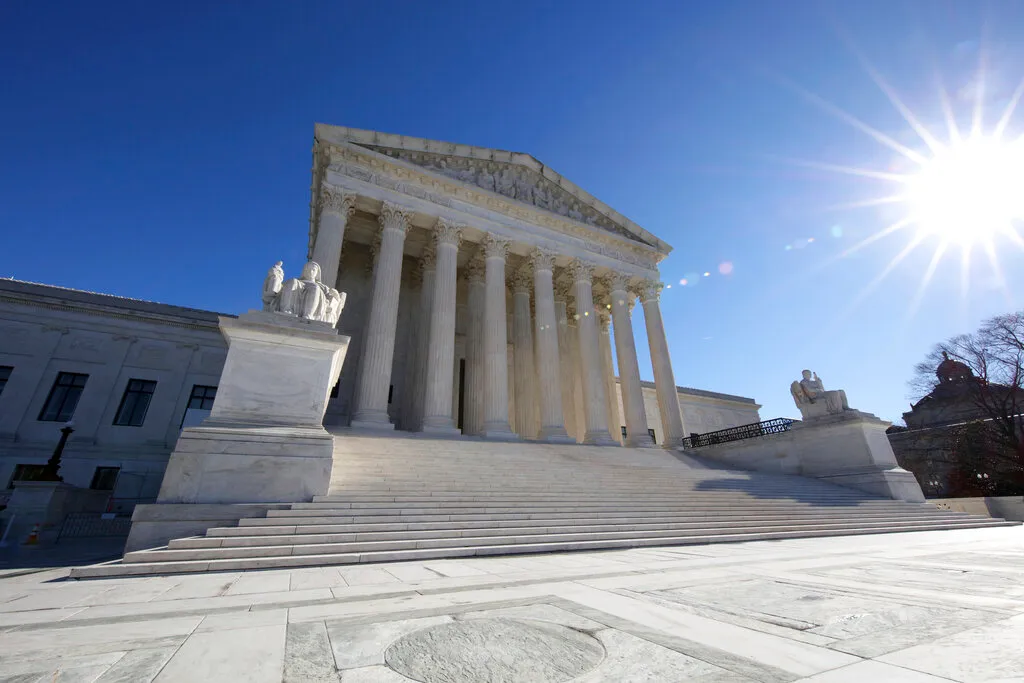

WASHINGTON — The Supreme Court issued a unanimous ruling Wednesday in favor of the Department of Justice, reinforcing the federal government’s authority over asylum determinations and limiting the power of appeals courts to overturn immigration judge findings.
In Urias-Orellana v. Bondi, the Court held that federal appeals courts must apply a highly deferential “substantial-evidence” standard when reviewing whether an asylum-seeker has suffered “persecution” under the law. The decision effectively shields the rulings of immigration judges and the Board of Immigration Appeals (BIA) from broad judicial second-guessing.
Justice Ketanji Brown Jackson, an appointee of President Joe Biden, authored the opinion for the 9-0 Court.
Defining the “Substantial-Evidence” Standard
The case centered on Douglas Humberto Urias-Orellana and his family, natives of El Salvador who entered the U.S. without authorization in 2021. While an immigration judge found Urias-Orellana’s testimony regarding threats from a hitman to be credible, the judge ultimately ruled that the threats did not meet the legal threshold for “persecution” under the Immigration and Nationality Act (INA).
The Supreme Court was tasked with deciding how much power appellate courts have to disagree with that conclusion. Justice Jackson clarified that Congress intended for “significant deference” to be given to the original fact-finding body.
“The statute requires application of the substantial-evidence standard to the agency’s conclusion that a given set of undisputed facts does not constitute persecution,” Jackson wrote. “Accordingly, we affirm.”
Under this standard, a court of appeals cannot overturn a denial of asylum simply because it might have reached a different conclusion; it can only do so if no reasonable fact-finder could have reached the original decision.
A Rare Moment of Judicial Unanimity
The ruling highlights a notable trend of consensus within a bench often characterized by its 6-3 conservative majority. According to SCOTUSblog statistics, the justices reached a unanimous ruling in 42 percent of cases during the 2024 term.
This legal victory for the DOJ comes amid heightened scrutiny of the Department of Homeland Security’s (DHS) enforcement operations. Recent enforcement actions in multiple states have sparked nationwide protests, particularly following a January incident in Minnesota where federal agents fatally shot two U.S. citizens, Renee Good and Alex Pretti.
Despite the political friction surrounding immigration, the Court’s judicial philosophy in this instance prioritized statutory interpretation and the “inverted pyramid” of agency deference over ideological leanings.
Impact on Future Asylum Seekers
The ruling narrows the path for noncitizens seeking to appeal denied asylum claims. To qualify as a “refugee” under the INA, an applicant must prove they are unable or unwilling to return to their home country due to persecution based on:
- Race or Religion
- Nationality
- Membership in a particular social group
- Political opinion
By affirming that the “mixed” determination of facts and law receives deference, the Supreme Court has streamlined the removal process and solidified the finality of Board of Immigration Appeals decisions.
What’s Next?
The decision sets a clear precedent for several pending cases in the 1st and 5th Circuits, where asylum-seekers have challenged the “persecution” definitions used by lower courts. Legal experts expect a decrease in successful appellate reversals for asylum denials moving forward.