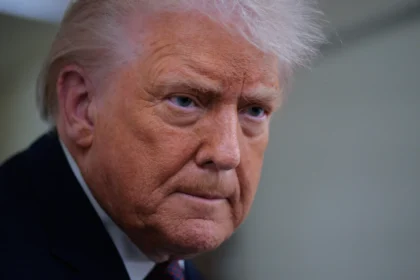
The Supreme Court agreed Friday to take up the question of whether President Donald Trump’s order ending birthright citizenship for children born in the United States to parents who are in the country illegally or only temporarily is constitutional. The justices will hear Trump’s appeal of a lower-court ruling that struck down the restrictions, which have not been implemented anywhere in the country. Arguments are set for the spring, and a decision is expected by early summer.
Trump signed the order on Jan. 20, the first day of his second term, as part of a broad immigration crackdown that has included intensified enforcement operations in several cities and the first peacetime use of the 18th-century Alien Enemies Act. The administration is defending multiple pieces of its immigration agenda in court, and the Supreme Court has issued a mixed series of rulings in related emergency disputes.
In one case, the justices stopped the administration from relying on the Alien Enemies Act to rapidly deport alleged Venezuelan gang members without hearings. In another, they allowed immigration officers to resume wide-ranging stops in the Los Angeles area after a lower court temporarily blocked the practice of targeting people based on race, language, job or location.
The court is also considering an emergency request to permit the deployment of National Guard troops in the Chicago area to assist with immigration enforcement. A lower court has put that plan on hold indefinitely.
Why This Birthright Citizenship Case Matters
The birthright citizenship dispute is the first of Trump’s immigration directives to reach the Supreme Court for a full hearing. His order challenges more than 125 years of prevailing interpretation of the 14th Amendment, which has been read to grant citizenship to nearly all children born on U.S. soil, with narrow exceptions for children of foreign diplomats or a foreign occupying force. Under long-established rules, children born in the United States to parents who entered or remained in the country illegally have been considered citizens at birth.
Federal courts across the country have consistently found Trump’s order unconstitutional or likely unconstitutional. Those rulings continued even after the Supreme Court’s June decision narrowing judges’ authority to issue nationwide injunctions. That ruling did not foreclose other forms of nationwide relief — such as class-action orders or lawsuits filed by states — and the court did not address whether Trump’s birthright citizenship policy itself complies with the Constitution.
The case now before the justices arises from New Hampshire, where a federal judge in July blocked the order in a class-action lawsuit filed on behalf of all children who would be affected. The Justice Department has also asked the Supreme Court to review a separate decision from the 9th U.S. Circuit Court of Appeals in San Francisco. In July, that court concluded that Democratic-led states challenging the order were entitled to a nationwide injunction because letting the policy operate in some states but not others would produce legal confusion. The Supreme Court took no action Friday on the 9th Circuit case.
Birthright Citizenship: What It Is and How It Developed
Birthright citizenship is the long-standing legal principle that anyone born on U.S. soil becomes an American citizen at birth, regardless of their parents’ immigration status. The concept comes from the 14th Amendment, adopted in 1868 after the Civil War to guarantee citizenship for formerly enslaved people and their children.
For more than 125 years, courts and administrations of both parties have interpreted the amendment’s Citizenship Clause to grant citizenship at birth with only limited exceptions, such as for children of foreign diplomats or occupying forces. That understanding has shaped federal immigration policy and ensured consistent national rules for who counts as a U.S. citizen.
The administration now argues that children of noncitizens are not “subject to the jurisdiction” of the United States as required by the 14th Amendment’s Citizenship Clause and therefore do not qualify for automatic citizenship.
“The Fourteenth Amendment’s Citizenship Clause was adopted to grant citizenship to newly freed slaves and their children — not to the children of aliens illegally or temporarily in the United States,” Solicitor General D. John Sauer wrote in a brief urging the Supreme Court to hear the case.
Twenty-four Republican-led states and 27 Republican members of Congress, including Sens. Ted Cruz of Texas and Lindsey Graham of South Carolina, have submitted briefs supporting the administration’s position.
How Many Countries Still Offer Birthright Citizenship?
Roughly three dozen countries continue to provide full birthright citizenship, a policy most common in the Western Hemisphere. The United States and Canada are the only major developed nations that still grant automatic citizenship to nearly all children born within their borders.
Many European and Asian countries have rolled back or eliminated birthright citizenship in recent decades, shifting to systems that require at least one parent to be a citizen or lawful resident. Supporters of birthright citizenship say it offers simple, uniform rules for determining nationality and helps avoid the creation of stateless or second-class populations. Critics contend that it can encourage unauthorized immigration and should be reexamined in light of modern migration patterns.