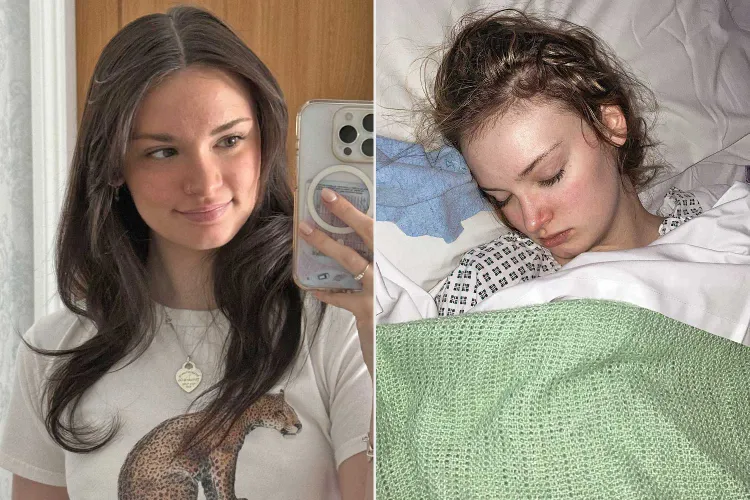

Lara Drew, a 22-year-old performer, narrowly escaped death and permanent disability after dismissing the early warning signs of streptococcal meningitis as simple exhaustion from her freshman year of college. Doctors later confirmed that the student was approximately 30 minutes away from a fatal outcome upon her arrival at the hospital.
A Rapid Escalation of Symptoms
The crisis began in November 2021. While attending a funeral, Drew developed a persistent headache that she initially attributed to a demanding academic and social schedule. By the following morning, her condition had deteriorated into “agonizing” pain and a severe sensitivity to light that rendered her unable to open her eyes.
The situation turned critical when Drew suffered a series of seizures, prompting her parents to rush her to a local emergency room. To stabilize her condition, medical staff placed Drew in a medically induced coma for three days.
:max_bytes(150000):strip_icc():focal(709x484:711x486):format(webp)/LARA-DREW-3-032526-20e9a238b06a4b2796a605b080cd61e7.jpg)
The Diagnosis: Streptococcal Meningitis
Following a lumbar puncture, clinicians diagnosed Drew with streptococcal meningitis. According to the National Institutes of Health (NIH), this condition involves a life-threatening inflammation of the membranes surrounding the brain and spinal cord.
The diagnosis revealed how close Drew had come to a catastrophic outcome. “It was terrifying,” Drew told Kennedy News and Media. “Imagine if my parents said, ‘Let’s wait half an hour’… that could have been it.”
:max_bytes(150000):strip_icc():focal(540x196:542x198):format(webp)/LARA-DREW-7-032526-0ddc841374e544598b51ecc6d4af7455.jpg)
The Toll on Mobility and Recovery
The infection did more than threaten Drew’s life; it nearly cost her her mobility. Upon waking from her coma, Drew found she was unable to move her legs. Medical experts noted that had treatment been delayed any further, she likely would have faced amputation.
For Drew, a trained dancer, the recovery process was grueling. She transitioned from performing double pirouettes to requiring intensive physiotherapy to relearn how to stand. She described her initial efforts to walk as being like “Bambi on ice.”
:max_bytes(150000):strip_icc():focal(491x161:493x163):format(webp)/LARA-DREW-4-032526-9044c76f889c4a47b9951a0000c9f95a.jpg)
A Warning to Students and Families
Drew’s experience highlights a dangerous trend among young adults: the tendency to rationalize severe physical symptoms as “run down” behavior typical of college life.
“We were all going out and socializing and drinking,” Drew recalled, explaining why she initially ignored the red flags.
Now fully recovered, Drew is utilizing her platform to advocate for health vigilance. Her message is direct:
- Prioritize Awareness: Understand that bacterial meningitis can mimic common ailments before progressing rapidly.
- Act Fast: High fevers, light sensitivity, and severe headaches require immediate medical evaluation.
- Advocate for Others: If a peer or loved one seems uncharacteristically ill, do not wait to seek help.