
While the lives of early American presidents have been extensively chronicled, far less attention has been paid to the women beside them — including one of the nation’s most enigmatic first ladies, Mary Todd Lincoln.
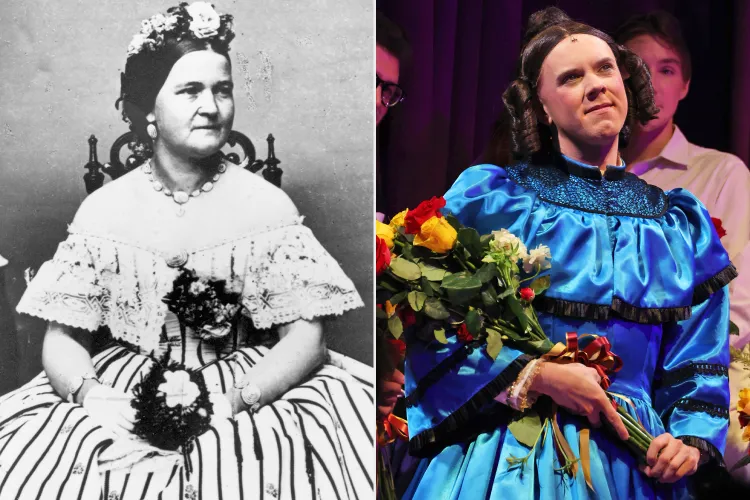
A renewed fascination with Mary has emerged thanks to Cole Escola’s Tony-winning Broadway comedy, Oh, Mary!, which reimagines Abraham Lincoln’s wife as a volatile, boozy would-be cabaret star married to a closeted husband.
“I wrote myself an email in 2009 with an idea: Abe’s assassination wasn’t such a bad thing for Mary,” Escola shared in a 2024 interview with W Magazine. “That was the seed.”
Escola admitted to doing no historical research, instead asking, “What would be the dumbest thing that first lady Mary Todd Lincoln could dream of and want with her life?” The result was less a historical rewrite than an absurd, heartfelt portrait of insecurity and longing.
:max_bytes(150000):strip_icc():focal(726x426:728x428):format(webp)/Cole-Escola-Conrad-Ricamora-102425-6f43a6c329554ad49df3f2fe3fc664ad.jpg)
Within the farce, however, lie glimmers of truth. Abraham Lincoln’s sexuality has long been debated, and his wife’s declining mental health was a painful reality throughout their marriage and his presidency.
A Privileged Beginning and a Complex Marriage
Mary Todd Lincoln was born in Lexington, Kentucky, on December 13, 1818, the fourth of seven children of Robert Smith Todd and Elizabeth “Eliza” Parker Todd. After her mother’s death when she was seven, Mary’s relationship with her stepmother, Elizabeth “Betsy” Humphreys, was often described as tense.
Her father’s belief in education for girls meant Mary received more schooling than many of her peers, attending Ward’s Academy and later Madame Mentelle’s French School for Girls.
At 21, she moved to Illinois to live with her sister, Elizabeth Edwards, where she met a rising state legislator named Abraham Lincoln. Their courtship was rocky — biographer William H. Herndon noted that Mary once walked “arm-in-arm” with Lincoln’s political rival, Stephen Douglas, to provoke jealousy. Despite class differences and a broken engagement, the couple married on November 4, 1842, when she was 23 and he was 33.
:max_bytes(150000):strip_icc():focal(999x0:1001x2):format(webp)/president-lincoln-mary-todd-lincoln-103125-4bdf97db0e4f471295e27ff8b2ad88bc.jpg)
Mary managed their Springfield home while Lincoln worked as a lawyer and politician, until his election as president in 1860.
A Life of Tragedy and Public Scrutiny
As First Lady during the Civil War, Mary endured public criticism for spending money redecorating the White House. Her Southern roots invited suspicion, and the divided loyalties within her own family only deepened her isolation.
The death of her 12-year-old son, Willie, from typhoid fever in 1862 devastated her. Her friend and dressmaker Elizabeth Keckly later recalled, “The pale face of her dead boy threw her into convulsions.”
Then, in 1865, came the nation’s most infamous tragedy: Mary sat beside her husband at Ford’s Theatre when John Wilkes Booth assassinated him. She never attended the funeral and left the White House six weeks later, writing to Senator Charles Sumner that she departed “broken-hearted, with every hope almost in life—crushed.”
:max_bytes(150000):strip_icc():focal(669x379:671x381):format(webp)/Abraham-Lincoln-Mary-Todd-Lincoln-102425-09aa750e1f1b4977b18e6cbfc1331d1e.jpg)
Decline and Isolation
Mary’s later years were marred by financial difficulties and worsening mental health. Historians have speculated she may have suffered from bipolar disorder or depression. In 1875, her surviving son, Robert Todd Lincoln, had her committed to a mental institution against her will. After several months, she was released into her sister’s care and fled to France to avoid being institutionalized again.
Her health continued to deteriorate, and she returned to the U.S., where she died on July 16, 1882.
A Modern Reinvention
Far from the grief-stricken historical figure, Escola’s Oh, Mary! offers the first lady a chance to live again — to dance, shout, and rebel against the roles history imposed on her. The production has featured gender- and race-blind casting, with Betty Gilpin, Tituss Burgess, Jinkx Monsoon, and Jane Krakowski all taking turns as the unhinged yet deeply human Mary.
:max_bytes(150000):strip_icc():focal(516x236:518x238):format(webp)/Mary-Todd-Lincoln-102425-1ef7bc13e8f447a297dfdca31fab006c.jpg)
“It’s a freeing show — for the performers, the audience, and the memory of a long-suffering woman,” Escola said. “Mary is just me. She cares so deeply about what people think of her, but she doesn’t realize that people actually find her grating and annoying. And that is me.”