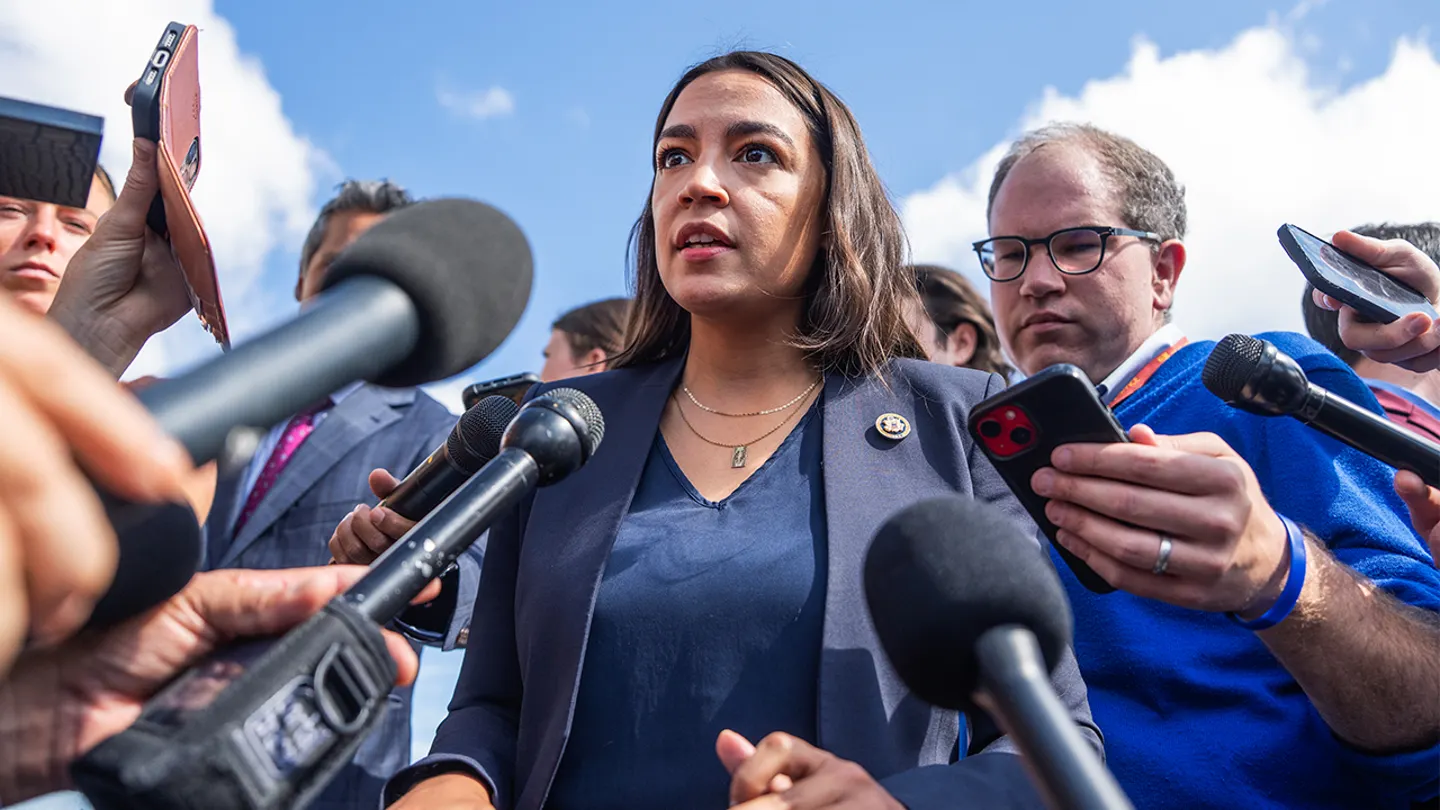

Representative Alexandria Ocasio-Cortez delivered a pointed critique of President Donald Trump’s foreign policy during a question-and-answer session in Munich, warning that a U.S. retreat from global leadership could embolden authoritarian powers. Addressing the audience, the New York congresswoman argued that disengagement from international institutions risks destabilizing the rules-based order that has shaped postwar alliances.
Ocasio-Cortez framed her remarks around what she described as a “new era” marked by rising authoritarian influence both domestically and internationally. She contended that the United States faces a defining choice: withdraw from its longstanding commitments or reaffirm democratic partnerships. While acknowledging that global dynamics have shifted, she maintained that most Americans remain committed to democratic values and international cooperation.
The congresswoman also criticized what she characterized as inconsistent enforcement of democratic principles by Western nations. She suggested that such contradictions — referencing issues ranging from geopolitical disputes involving Greenland to broader humanitarian crises — create openings for authoritarian governments to expand their reach. According to Ocasio-Cortez, these perceived double standards weaken democratic credibility on the global stage.
Expanding on her concerns, Ocasio-Cortez argued that Trump’s approach signals a broader move toward unilateralism. She warned that diminished U.S. engagement could enable leaders such as Vladimir Putin to exploit gaps in international coordination. In her view, a fragmented global response benefits authoritarian regimes seeking to assert regional dominance.
Ocasio-Cortez emphasized the strategic importance of global alliances, highlighting international aid and multilateral agreements as tools for countering authoritarian influence. She called for renewed attention to partnerships and programs scaled back under the Trump administration, including initiatives associated with USAID and trade frameworks such as the Trans-Pacific Partnership. She argued that economic and diplomatic cooperation can act as safeguards against authoritarian expansion.
Her comments arrive amid early speculation about the 2028 presidential race. Betting projections on Polymarket currently place Ocasio-Cortez among several figures being discussed as potential contenders. Other names drawing attention include JD Vance and California Governor Gavin Newsom, reflecting the broad field of possible candidates at this preliminary stage.
Ocasio-Cortez’s remarks reinforce her consistent advocacy for international engagement and democratic norms. By positioning global alliances as essential to preserving democratic stability, she continues to present a sharp contrast to isolationist and unilateral foreign policy approaches.