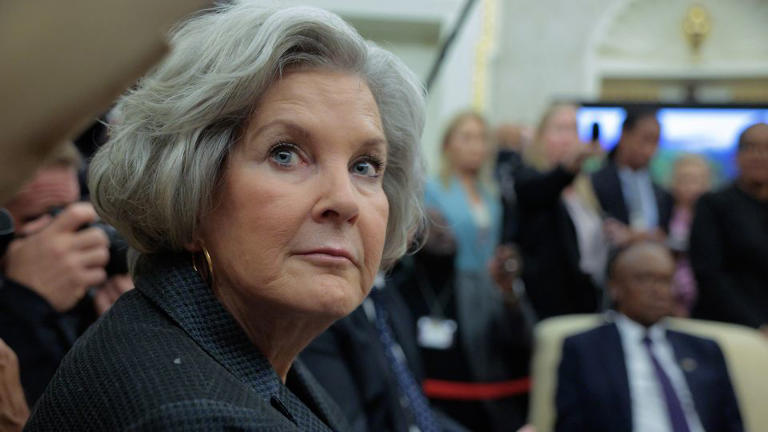

In a series of wide-ranging interviews published Tuesday by Vanity Fair, White House chief of staff Susie Wiles offered unusually blunt assessments of President Donald Trump, his second-term agenda, and several of his closest allies.
Across more than 10 interviews conducted over the past year with author Chris Whipple, Wiles spoke frankly about working for Trump and described him as having “an alcoholic’s personality,” despite his reputation as a teetotaler. She also acknowledged the president’s appetite for revenge, suggesting some of his second-term actions are rooted in retribution. Wiles appeared to indicate Trump’s “boat-bombing campaign” in Venezuela was aimed at regime change, a characterization that conflicts with official explanations for the strikes. She also described multiple areas where Trump ignored her advice, including decisions on deportations and pardons.
The remarks stood out for both their tone and breadth. Wiles—who argued Tuesday that her comments were used out of context in what she called a “hit piece”—has cultivated a reputation inside the West Wing as a careful operator who avoids generating internal enemies. She has maintained Trump’s confidence, in part, by running a White House operation that functions without trying to box in the president’s impulses.
Trump frequently praises his top aide as the “most powerful woman in the world,” suggesting she can influence global affairs with a single phone call. Yet Wiles has kept a notably low public profile during Trump’s second term, making her extended comments to Whipple—whose book The Gatekeepers is viewed as a major work on the chief of staff role—especially striking.
Wiles said Trump governs with “a view that there’s nothing he can’t do. Nothing, zero, nothing.” She expanded on her “alcoholic’s personality” remark by pointing to her own experience with large personalities and noting her upbringing with an alcoholic father, sportscaster Pat Summerall.
Trump responded to the characterization in an interview with the New York Post, saying he agreed he has a “possessive and addictive type personality.” He also downplayed any suggestion Wiles’ job might be at risk. “I didn’t read it, but I don’t read Vanity Fair — but she’s done a fantastic job,” he said.
Retribution, prosecutions, and lines she says he crossed
In the interviews, Wiles conceded there “may be an element of” retribution in the administration’s pursuit of prosecutions involving Trump’s political opponents.
“I mean, people could think it does look vindictive,” she said when asked about the failed prosecution of former FBI Director James Comey. “I can’t tell you why you shouldn’t think that.”
“I don’t think he wakes up thinking about retribution. But when there’s an opportunity, he will go for it,” she added.
After the Vanity Fair piece was published, Wiles wrote on X that the article was framed to create a misleading narrative.
“The article published early this morning is a disingenuously framed hit piece on me and the finest President, White House staff, and Cabinet in history,” she wrote. “Significant context was disregarded and much of what I, and others, said about the team and the President was left out of the story. I assume, after reading it, that this was done to paint an overwhelmingly chaotic and negative narrative about the President and our team.”
In a separate statement, White House press secretary Karoline Leavitt defended Wiles, saying Trump “has no greater or more loyal advisor than Susie.”
“The entire Administration is grateful for her steady leadership and united fully behind her,” Leavitt wrote.
Whipple defended his reporting during an interview with CNN’s Anderson Cooper on Tuesday night, emphasizing that each interview was recorded.
“Everything was scrupulously in context,” he said. “The giveaway is that they haven’t been able to challenge a single fact.”
Wiles also described specific episodes where she said Trump dismissed her guidance. Asked about mortgage fraud accusations involving New York Attorney General Letitia James, she replied, “Well, that might be the one retribution.”
She also said Trump lacked evidence for his claim that former President Bill Clinton visited the private island of convicted sex offender Jeffrey Epstein.
“There is no evidence,” Wiles said of Clinton’s alleged visits. When asked whether the Epstein files contained anything incriminating about Clinton, she reportedly added, “The president was wrong about that.”
Cutting portraits of top allies
Wiles’ interviews included pointed critiques of some of the president’s closest partners.
On Vice President JD Vance, she said he has “been a conspiracy theorist for a decade,” and suggested his shift from Trump critic to loyal ally was “sort of political.” Vance later acknowledged during a speech in Pennsylvania that he “sometimes” is a conspiracy theorist, but said he believes only “in the conspiracy theories that are true.” He also defended Wiles, saying disagreements haven’t changed his view of her loyalty.
“We agree on much more than we disagree,” he said. “But I’ve never seen her be disloyal to the president of the United States, and that makes her the best White House chief of staff that I think the president could ask for.”
Wiles described tech billionaire and former Trump ally Elon Musk as “an avowed ketamine” user and “an odd, odd duck, as I think geniuses are.” She said Musk’s move to dismantle the U.S. Agency for International Development left her “aghast.”
Turning to Attorney General Pam Bondi, Wiles said she “completely whiffed” in how she handled the Epstein files. She criticized Bondi’s decision to give binders of materials to conservative influencers, saying the binders were “full of nothingness,” and took issue with Bondi’s claim that a witness or client list was on her desk.
“There is no client list, and it sure as hell wasn’t on her desk,” Wiles said. Bondi later defended Wiles in a post on X, calling her “my dear friend” and writing: “We are family. We are united.”
In another sharp assessment, Wiles described Russell Vought—linked to the conservative blueprint Project 2025 and serving as head of the Office of Management and Budget—as “a right-wing absolute zealot.” Vought later wrote on X that Wiles is his “ally” and an “exceptional” chief of staff.
Policy doubts and internal clashes
Wiles also signaled discomfort with several policy fronts. On deportations, she said the administration needed to “look harder” to avoid mistakes. On Venezuela, she said Trump “wants to keep on blowing boats up until [President Nicolás] Maduro cries uncle,” adding that “people way smarter than me on that say that he will.” She also noted Trump would need congressional authorization for strikes in Venezuela that he has said will come “soon.”
She said she urged Trump not to pardon the most violent rioters from January 6, 2021—advice he rejected—and said she pushed unsuccessfully to delay announcing major tariffs amid what she called a “huge disagreement” among his advisers.
Wiles added that she wants the president to prioritize the economy more and Saudi Arabia less, and she weighed in on potential successors, contrasting how figures including Vance and Secretary of State Marco Rubio ultimately came to support Trump after initially opposing him.
Fallout inside Trump circles
After the interviews published Tuesday morning, aides, advisers, and allies were described as stunned by Wiles’ bluntness.
“It’s in every group chat,” one Trump ally told CNN. “Everyone is shocked and confused.”
“Yikes,” a senior White House adviser said.
The quotes fueled speculation throughout Trump’s orbit: Why would Wiles speak this openly? Was she aiming at someone inside the administration? Was she preparing an exit? Or was there confusion about what was on the record and when it could run?
Even amid the uncertainty, allies agreed on one point: Wiles is viewed as intensely strategic—and an interview like this, they believed, would not happen without a reason. One adviser noted that Wiles did not deny the quotes in her X post. Another said the remarks sounded unmistakably like her voice.