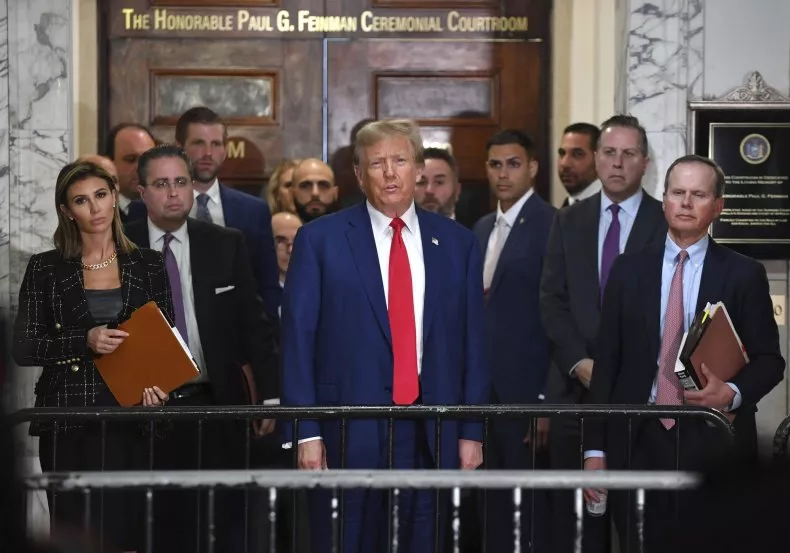

An appeals court has overturned the massive civil fraud penalty against President Donald Trump, delivering a major setback to New York’s lawsuit accusing him of inflating his wealth.
The ruling, issued Thursday, still upheld a finding that Trump exaggerated his fortune for decades, and it temporarily bars him and his two eldest sons from serving in corporate leadership roles.
The decision came seven months after Trump returned to the White House. A five-judge panel of New York’s Appellate Division determined that the $515 million judgment—originally set at $355 million plus interest—was “excessive” and violated the Eighth Amendment. Trump had avoided immediate collection earlier this year by posting a $175 million bond, which will now be returned to the Trump Organization.
Eric Trump celebrated the ruling on X, writing, “Total victory in the sham NY Attorney General case!!! After 5 years of hell, justice prevailed!”
The appellate panel struck down Judge Arthur Engoron’s penalty in full but left the door open for New York Attorney General Letitia James to appeal to the state’s highest court. James confirmed Thursday that her office intends to pursue that appeal.
What to Know About the Civil Fraud Case Against Donald Trump
In 2022, New York Attorney General Letitia James filed a civil fraud lawsuit against Donald Trump, the Trump Organization, and his sons Donald Trump Jr. and Eric Trump, accusing them of inflating property values to secure better loan and insurance terms.
The trial began in October 2023 and ended in January 2024, when Judge Engoron ruled that Trump and his sons engaged in persistent financial deception. He ordered Trump to pay $355 million, which ballooned past $515 million with interest, and barred the family from running New York companies for several years. Oversight of the Trump Organization was also imposed through a court-appointed monitor and compliance director. Trump denounced the case as a politically motivated “witch hunt.”
New York Appellate Division Ruling
The appeals panel eliminated the financial penalty but allowed further review by the state’s Court of Appeals. Other sanctions, such as restrictions on Trump and his sons holding corporate positions, remain on hold during ongoing appeals.
In a more than 300-page opinion, Judges Dianne T. Renwick and Peter H. Moulton argued that while Engoron’s restrictions on Trump’s business operations were “well crafted,” the monetary punishment went too far. “The court’s disgorgement order, which directs that defendants pay nearly half a billion dollars to the State of New York, is an excessive fine that violates the Eighth Amendment of the United States Constitution,” they wrote.
The panel deliberated for nearly 11 months after oral arguments last fall, far longer than the usual turnaround. The drawn-out process underscores the high stakes and constitutional questions surrounding the case, seen as a test of how far states can go in penalizing corporate misconduct.
The ruling marks just one chapter in Trump’s ongoing legal battles, which also include a criminal hush money case, civil defamation judgments related to E. Jean Carroll, and other lawsuits. Despite these hurdles, he has continued to push forward in his second term.
What is Donald Trump’s Net Worth?
Donald Trump’s net worth has long been debated, with estimates varying widely depending on methodology.
As of March 2025, Forbes reported his fortune had dropped by $1.5 billion, from about $6 billion to $4.5 billion since the beginning of the year. The decline was largely tied to struggles in the real estate market amid high U.S. interest rates.
Trump, however, has frequently claimed his wealth exceeds $10 billion, citing the value of his brand.
While the appeals court decision erased one of the costliest judgments against him, Trump still faces other expensive legal fights and mounting fees. His core assets—including Trump Tower and Mar-a-Lago—remain central to his financial empire, though the true figure of his fortune is still difficult to pin down.