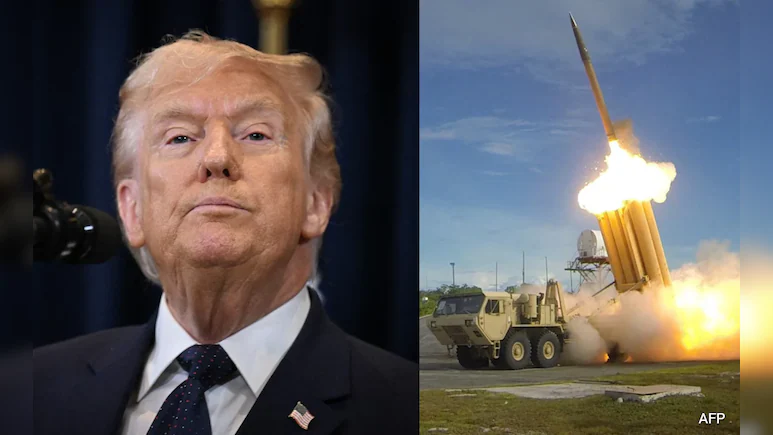

President Donald J. Trump issued a final 48-hour ultimatum to Tehran late Saturday, vowing to “obliterate” Iran’s domestic power infrastructure if the Strait of Hormuz is not fully reopened to international shipping.
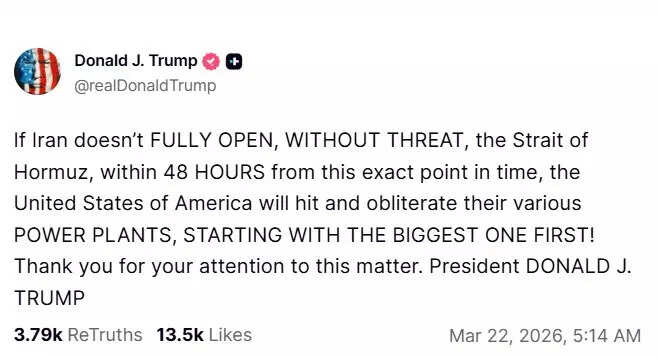
The directive, posted to Truth Social at 7:44 p.m. ET, marks a dramatic escalation in the 23-day conflict between the U.S.-Israeli coalition and the Islamic Republic. The deadline is set to expire late Monday, placing the global energy market and Middle Eastern security on a razor’s edge.
“If Iran doesn’t FULLY OPEN, WITHOUT THREAT, the Strait of Hormuz, within 48 HOURS from this exact point in time, the United States of America will hit and obliterate their various POWER PLANTS, STARTING WITH THE BIGGEST ONE FIRST!” the President declared.
Global Energy at a Breaking Point
The Strait of Hormuz, a narrow waterway through which 20% of the world’s petroleum and liquefied natural gas (LNG) passes, has been effectively shuttered since early March. Iranian Revolutionary Guard Corps (IRGC) forces have utilized mines, drones, and ballistic missiles to halt traffic, causing global oil prices to skyrocket and forcing the International Energy Agency to authorize a coordinated release of strategic reserves.
While the Trump administration recently offered a temporary reprieve by allowing the sale of Iranian crude already at sea, the President’s latest rhetoric signals a shift from maritime containment to a “maximum pressure” strike campaign against civilian-adjacent infrastructure.
Failed Interceptions and Regional Retaliation
The ultimatum follows a bloody weekend in the Levant. On Saturday, Iranian ballistic missiles breached Israeli air defenses, striking the southern towns of Arad and Dimona.
- Casualties: Over 100 civilians were reported injured in the strikes.
- Strategic Impact: The hits occurred near Israel’s Negev Nuclear Research Center, raising fears of a catastrophic secondary escalation.
- Iranian Warning: Tehran’s Unified Combatant Command responded to Trump’s threat by vowing to target “all U.S. energy, IT, and desalination infrastructure” in the region if their power plants are hit.
Military Readiness
Despite the President’s recent comments about “winding down” the war, the Pentagon has continued to surge assets to the region. Three additional warships and 2,500 Marines are currently en route to the Arabian Sea.
Strategic analysts suggest the “biggest” power plant referenced by the President could be the Damavand Combined Cycle Plant near Tehran or the Bushehr Nuclear Power Plant. However, the White House has not specified whether nuclear sites are on the target list.
The U.S. State Department confirmed that while indirect talks mediated by Oman continue in Muscat, the “window for diplomacy is closing.”