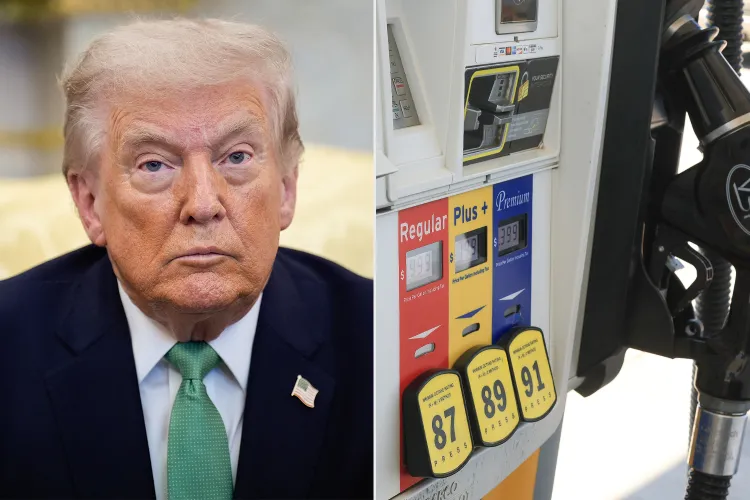

President Donald Trump on Thursday defended his administration’s military campaign in Iran, asserting that the resulting domestic economic turbulence has been less severe than he initially anticipated.
Speaking from the Oval Office during a bilateral meeting with Japanese Prime Minister Sanae Takaichi, the President acknowledged he expected a sharper downturn following the commencement of hostilities three weeks ago.
“I thought the numbers would be worse,” Trump said. “I said, ‘You know, if I do that, oil prices will go up and the economy will go down a little bit.’ Actually, I thought there was a chance it could be much worse. It’s not bad and it’s going to be over with pretty soon.”
Despite the President’s optimistic framing, American consumers are facing a sharp reality at the pump. The national average for a gallon of regular gasoline hit $3.88 on Thursday, according to AAA data. This represents a nearly $1.00 surge in just thirty days, fueled by a global oil market rattled by the expansion of conflict across the Middle East.
:max_bytes(150000):strip_icc():focal(749x0:751x2):format(webp)/Iran-oil-storage-facilities-strike-031926-838437f7e1424834817a75bb9e5e0c3c.jpg)
Energy Markets Under Siege
The volatility is rooted in the dramatic spike of crude oil benchmarks. Prices have surged from the low $70s to well over $100 per barrel since the launch of U.S. and Israeli operations.
The regional instability has reached a critical bottleneck at the Strait of Hormuz. In retaliation for strikes that killed senior Iranian leadership—including Supreme Leader Ayatollah Ali Khamenei—Tehran has targeted energy infrastructure in neighboring states and effectively shuttered the waterway.
The Strait is the world’s most important oil transit point; its closure disrupts the flow of approximately 20% of the world’s crude oil consumption, creating a supply-side shock that economists warn could have a “domino effect” on global trade.
Political Headwinds and Public Dissent
The timing of the price hike is precarious for the White House. With the midterm elections approaching, the President is currently seeing the lowest approval ratings of his second term. Recent polling reveals a deep divide between administration rhetoric and public sentiment:
- Handling of Gas Prices: 66% of Americans disapprove of the President’s management of fuel costs, according to a Yahoo/YouGov poll.
- War Sentiment: Only 7% of the population supports the deployment of U.S. ground troops into Iran, per Reuters/Ipsos.
- Cost of Living: Just 26% of respondents expressed support for the administration’s broader economic strategy regarding inflation.
Administration Pledges “Temporary” Relief
In an effort to stabilize voter confidence, Vice President JD Vance traveled to Michigan on Wednesday to address the “pain at the pump” directly. Vance characterized the current economic climate as a “temporary blip” linked to the duration of the military engagement.
“We’re doing everything that we can to ensure [prices] stay lower,” Vance told supporters. “We’re going to take care of business, we’re going to come back home, and when that happens, you’re going to see energy prices come back down to reality.”
However, some members of the President’s own party are signaling urgency. Rep. Ryan Zinke (R-MT), a former Interior Secretary, warned that the impact of high fuel costs extends far beyond the gas station.
“High fuel prices result in higher fertilizer prices. Higher fertilizer prices result in higher food prices,” Zinke told CNN. “At the core of inflation, when prices raise… Americans see it.”
As the conflict enters its fourth week, the White House remains under intense pressure to demonstrate that its “excursion” into Iran will not result in a long-term domestic recession.