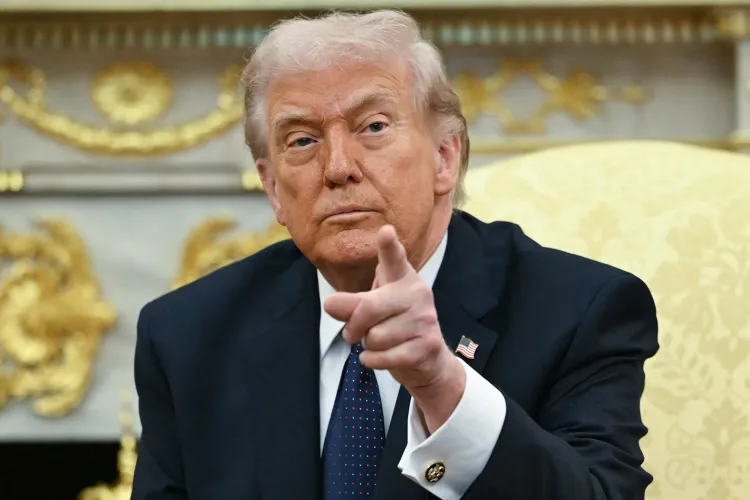

President Donald Trump issued a scathing rebuke of the U.S. Supreme Court on Sunday, accusing his own conservative appointees of betrayal after the high court dismantled a centerpiece of his administration’s economic agenda.
In a series of pointed posts on Truth Social on March 15, the 79-year-old president claimed that Justices Amy Coney Barrett and Neil Gorsuch went “out of their way” to oppose him with “bad and wrongful rulings and intentions.” The outburst follows a high-stakes 6-3 decision on February 20 that struck down the president’s sweeping emergency tariff regime.
The ‘Tariff’ Ruling: A Constitutional Wall
The legal battle, Learning Resources, Inc. v. Trump, centered on the president’s use of the International Emergency Economic Powers Act (IEEPA) of 1977 to bypass Congress and impose broad import taxes.
Writing for the majority, Chief Justice John Roberts—joined by Trump appointees Barrett and Gorsuch, as well as the court’s three liberal justices—affirmed that the power to levy tariffs is a function of the taxing power reserved exclusively for Congress under Article I of the Constitution.
“The decision that mattered most to me was TARIFFS!” Trump wrote Sunday. “The Court knew where I stood, how badly I wanted this Victory for our Country, and instead decided to, potentially, give away Trillions of Dollars to Countries and Companies who have been taking advantage of the United States for decades.”
:max_bytes(150000):strip_icc():focal(511x0:513x2):format(webp)/GettyImages-1276846524-3c29ef27f0d34a00bc1065bcb9fcfb83.jpg)
Partisan Friction and Judicial Independence
Trump’s Sunday morning rhetoric highlighted a growing rift between the White House and the conservative-majority court he helped shape. He contrasted the “solidarity” of the court’s Democratic appointees with what he characterized as the “disrespect” of his own picks.
“The Democrats on the Court always ‘stick together,’ no matter how strong a case is put before them… But Republicans do not do this,” Trump posted. “They openly disrespect the Presidents who nominate them… to prove how ‘honest,’ ‘independent,’ and ‘legitimate’ they are.”
While lashing out at Barrett and Gorsuch, the president extended gratitude to Justices Samuel Alito, Clarence Thomas, and Brett Kavanaugh for their dissenting votes. Kavanaugh, also a Trump appointee, argued in his dissent that the court should not employ the “major questions doctrine” to restrict executive authority in matters of foreign affairs and national emergencies.
Executive ‘Backup Plan’ and Future Fallout
Despite the legal setback, the Trump administration has already pivoted to alternative statutory authorities to keep its trade policy intact.
- Section 122 Invocation: Within hours of the February ruling, the president invoked Section 122 of the Trade Act of 1974, which allows for a temporary 10% global import surcharge for up to 150 days.
- Section 301 Investigations: The administration has signaled it will launch new investigations into “structural excess capacity” in foreign markets to justify longer-term duties.
“Our Supreme Court has made these Countries very happy but… I have the absolute right to charge TARIFFS in another form, and have already started to do so,” Trump asserted.
The tension between the branches was palpable during the February 24 State of the Union address, where only four of the nine justices—Roberts, Barrett, Kavanaugh, and Elena Kagan—opted to attend. The absence of a majority of the bench underscored the deepening chill in relations between the West Wing and One First Street.
As importers now look to the U.S. Court of International Trade to seek billions in potential refunds for the invalidated IEEPA duties, the administration continues to signal that its “America First” trade strategy will proceed regardless of judicial hurdles.