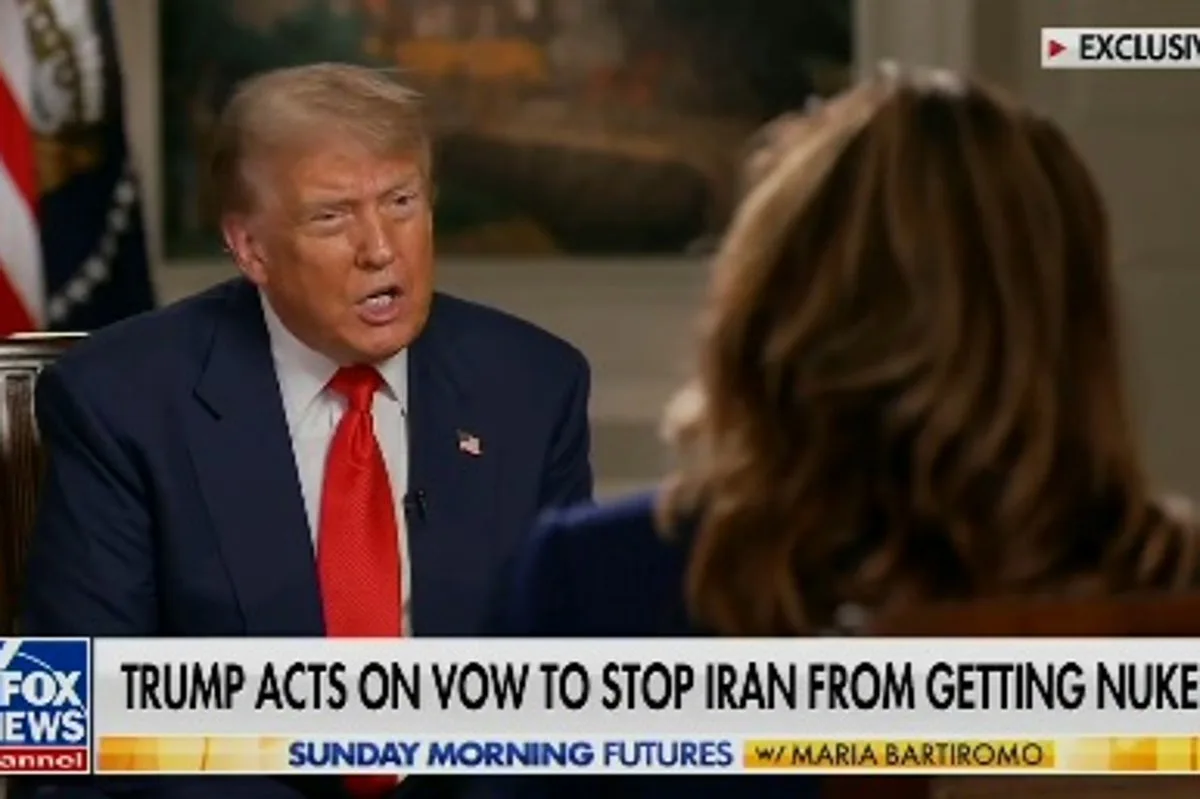

In a fiery interview on Fox News’ Sunday Morning Futures, former President Donald Trump threatened legal consequences for journalists and Democratic lawmakers who allegedly leaked or published parts of a classified U.S. intelligence assessment on his administration’s recent airstrikes in Iran.
Trump doubled down on his claim that the strikes, which targeted three Iranian nuclear facilities, had “completely destroyed” the country’s enriched uranium stockpile and significantly crippled its nuclear weapons program. He denied Iranian assertions—and U.S. intelligence assessments—that the uranium had been relocated prior to the attack, particularly from the Fordow nuclear site.
“I don’t think they moved it,” Trump insisted. “It’s very difficult, very dangerous to move. It’s extremely heavy, and we didn’t give them much notice.”
But the president’s narrative has been challenged from multiple fronts. U.S. intelligence officials reportedly concluded that the strikes caused only limited damage to Iran’s nuclear infrastructure, setting back its weapons development program by mere months—not eliminating it.
Trump, in turn, lashed out at those who leaked the classified report to the media and the journalists who published it. “You go up and tell the reporter: ‘National security—who gave it?’” Trump told host Maria Bartiromo. “You have to do that. And I suspect we’ll be doing things like that.”
He further claimed that members of Congress who shared information from the classified assessment should be “prosecuted.”
In response to the leak, NBC News reported that a senior White House official revealed plans to reduce the amount of intelligence shared with Congress, including limiting briefings to members of the Intelligence Committees and the so-called “Gang of Eight.” Despite Congress’s constitutional oversight authority, few expect pushback from Republican leadership. House Speaker Mike Johnson echoed Trump’s accusation, alleging that a Democrat in Congress had leaked portions of the classified report.
According to reports, the leaked intelligence directly contradicts Trump’s public statements, concluding that the June 21 airstrikes failed to destroy Iran’s core uranium stockpiles and key elements of its nuclear infrastructure.
Rafael Grossi, Director General of the International Atomic Energy Agency (IAEA), also contradicted Trump’s claims in an interview, acknowledging “serious” damage but confirming that Iran retains the knowledge and capability to resume enrichment within months. “Military options or not, you are not going to solve this in a definitive way militarily,” Grossi warned.
Further casting doubt, The Financial Times cited two U.S. officials familiar with the intelligence who insisted Iran’s uranium stockpile had not been located at the targeted sites and was not significantly affected.
Despite mounting evidence to the contrary, Trump continues to promote a narrative of total success, even citing satellite images of charred ground as proof of the strike’s effectiveness.
Meanwhile, critics argue that the leak crackdown, combined with misleading claims about the operation’s outcome, is part of a broader effort to control the narrative and stifle dissent within national security discussions. Some intelligence experts warn that the strikes may even accelerate Iran’s pursuit of nuclear weapons as a deterrent against future attacks.