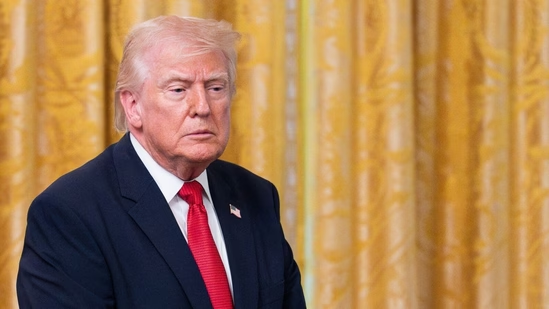

President Donald Trump has authorized a 10-day extension on potential military strikes against Iran’s energy infrastructure, shifting the deadline to April 6. The pause, intended to facilitate diplomatic negotiations, comes as the Pentagon simultaneously evaluates the deployment of up to 10,000 additional ground troops to the Middle East.
Diplomatic Breathing Room Amid Military Readiness
The revised deadline follows a high-stakes ultimatum issued by the White House last Saturday, which warned of the systematic destruction of Iran’s power grid unless the Strait of Hormuz was fully reopened. While the Pentagon continues to bolster its regional presence—a move first reported by The Wall Street Journal—President Trump characterized the delay as a response to a direct request from Tehran.
“Talks are ongoing and… they are going very well,” the President stated via Truth Social, dismissing reports of a diplomatic stalemate.
The 15-Point “Action List” and Iranian Counter-Demands
The diplomatic track gained clarity Thursday when U.S. envoy Steve Witkoff confirmed that Washington had delivered a 15-point “action list” to Iranian leadership through Pakistani intermediaries. Witkoff noted “strong signs” of Iranian receptivity, describing the current moment as an “inflection point” where the alternative to negotiation remains “death and destruction.”
In a signaled “goodwill gesture,” Iran permitted several Pakistan-flagged oil tankers to transit the Strait of Hormuz. President Trump hailed the move as a “present” and a sign of serious intent from Tehran.
However, the path to a ceasefire remains fraught. Iran’s state-aligned Tasnim News Agency reported that Tehran’s official response, delivered Wednesday night, includes demands that may be non-starters for Washington and Jerusalem:
- An immediate cessation of U.S. and Israeli strikes on Iranian territory.
- The withdrawal of forces targeting Tehran-backed groups, including Hezbollah.
- The payment of war reparations.
- Formal recognition of Iranian sovereignty over the Strait of Hormuz.
A Conflict Entering Its Second Month
The current hostilities began on February 28, 2026, with a joint U.S.-Israeli air campaign. As the war enters its fourth week, the dual-track strategy of the Trump administration—escalating military pressure while maintaining a channel for “the deal”—faces its most critical test.
While the strike pause offers a temporary reprieve for Iran’s energy sector, the potential arrival of 10,000 additional American boots on the ground suggests that the White House is prepared for a rapid shift back to full-scale kinetic operations should negotiations collapse by the April 6 cutoff.