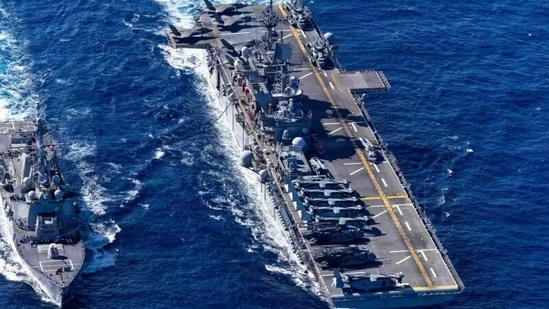

The Pentagon has dispatched the USS Tripoli (LHA-7) and the 31st Marine Expeditionary Unit (MEU) to the North Arabian Sea, marking a significant escalation in the U.S.-led effort to break Iran’s “de facto” blockade of the Strait of Hormuz.
The 45,000-ton amphibious assault ship, currently transiting the Indian Ocean south of Sri Lanka, is expected to enter the combat theater by March 22. Its arrival provides the Biden-Trump transition era military command with a specialized “plug-and-play” ground force capable of seizing sovereign Iranian territory—specifically key islands used to launch drone and missile attacks against global shipping.
The ‘Gator’ Force Arrives
The USS Tripoli is not a traditional aircraft carrier but an “America-class” amphibious assault ship optimized for aviation. It carries a potent air wing of F-35B Lightning II stealth fighters, MV-22 Osprey tilt-rotor aircraft, and MH-60S Seahawk helicopters.
Accompanying the Tripoli are landing ship decks (LSDs) housing over 2,200 Marines from the Okinawa-based 31st MEU. Unlike the carrier-based jets of the USS Abraham Lincoln already in the Gulf of Oman, this force is designed for “ship-to-shore” maneuvers.
“The Tripoli gives us the option to put boots on the ground where airpower alone hasn’t finished the job,” a senior defense official stated on the condition of anonymity. “If the goal is to permanently silenced the batteries choking the Strait, you eventually have to occupy the land they sit on.”
Strategic Objective: The Hormuz Chokehold
Since the conflict erupted on February 28, 2026, the Strait of Hormuz—a 33-kilometer-wide artery for 20% of the world’s oil—has remained functionally closed. Despite U.S. claims that the Iranian Navy has been “decimated,” Tehran continues to utilize mobile coastal batteries and “smart” mines to terrorize commercial tankers.
Potential U.S. targets for the 31st MEU include:
- Kharg Island: Iran’s primary oil export terminal. U.S. planners may seek to secure the island to both stop Iranian exports and potentially leverage its crude reserves to stabilize skyrocketing global energy prices.
- Qeshm and Abu Musa Islands: Strategic outposts that allow Iran to dominate the narrowest points of the shipping lanes.
Diplomatic and Economic Fallout
The stakes reached a fever pitch this week as the G7—including the UK, France, and Japan—issued a joint statement condemning Iran’s interference with international shipping as a “threat to international peace.”
Domestically, the White House remains coy about a ground invasion. President Trump, speaking to reporters last night, maintained a posture of strategic ambiguity: “I’m not putting troops anywhere… If I were, I certainly would not tell you.”
However, the movement of the Tripoli suggests otherwise. Without a ground presence to clear mines and secure coastal launch sites, insurance premiums for tankers remain prohibitively high, keeping the global economy in a stranglehold.
As the USS Tripoli nears the Gulf of Oman, the window for a diplomatic resolution appears to be closing, replaced by the clinical preparations for an amphibious assault that could redefine the map of the Middle East.