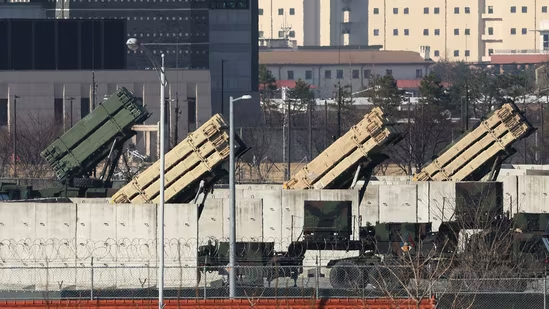

The Pentagon is weighing a high-stakes redirection of advanced weaponry originally destined for Ukraine to bolster U.S. operations in the Middle East, according to officials and internal reports. The proposal comes as “Operation Epic Fury,” the month-old campaign against Iran, consumes critical munitions at a “staggering” rate, threatening the stability of U.S. global stockpiles.
The PURL Pivot
Central to the discussion is the Prioritised Ukraine Requirements List (PURL), a NATO-led initiative where European nations fund American-made interceptors for Kyiv. Sources familiar with the matter indicate the Pentagon notified Congress on Monday of its intent to divert approximately $750 million in PURL-related funding to replenish U.S. inventories.
Secretary of State Marco Rubio confirmed the possibility Friday, stating, “If we need something for America, we’re going to keep it for America first.” While Rubio maintained no official diversion has occurred yet, he emphasized that U.S. national interests will dictate final delivery schedules.
A Precarious “Burn Rate”
The scale of ammunition consumption in the West Asia theater is unprecedented.
- Target Volume: U.S. Central Command (CENTCOM) has struck over 9,000 targets in four weeks.
- Financial Strain: Initial estimates place the conflict’s cost at $2 billion per day, with the first six days alone totaling $11.3 billion.
- Interceptor Deficit: European Commissioner Andrius Kubilius reported that U.S.-allied forces fired 800 Patriot missiles in just three days—surpassing Ukraine’s entire four-year consumption against Russia.
Strategic Vulnerability
The destruction of a $300 million AN/TPY-2 radar at Muwaffaq Salti Air Base in Jordan has intensified the crisis. The loss of this “heart” of the THAAD (Terminal High Altitude Area Defense) system has forced the U.S. to lean more heavily on Patriot batteries, which are already in short supply.
Lockheed Martin recently agreed to triple PAC-3 interceptor production to 2,000 units annually, but analysts warn this surge will not manifest in time to meet the current operational deficit.
Ukraine’s Rebuffed Leverage
Ukrainian President Volodymyr Zelensky attempted to bridge the gap by offering a “swap”: thousands of Ukrainian-made interceptor drones—costing roughly $2,000 each—in exchange for Patriot missiles. Despite the drones’ proven success against Iranian-designed Shahed platforms, President Donald Trump publicly rebuffed the offer, asserting, “We know more about drones than anybody.”
As Russian missile strikes on Ukraine reach a four-year peak, the potential loss of the PURL lifeline leaves Kyiv facing its most severe defensive crisis since the 2022 invasion.