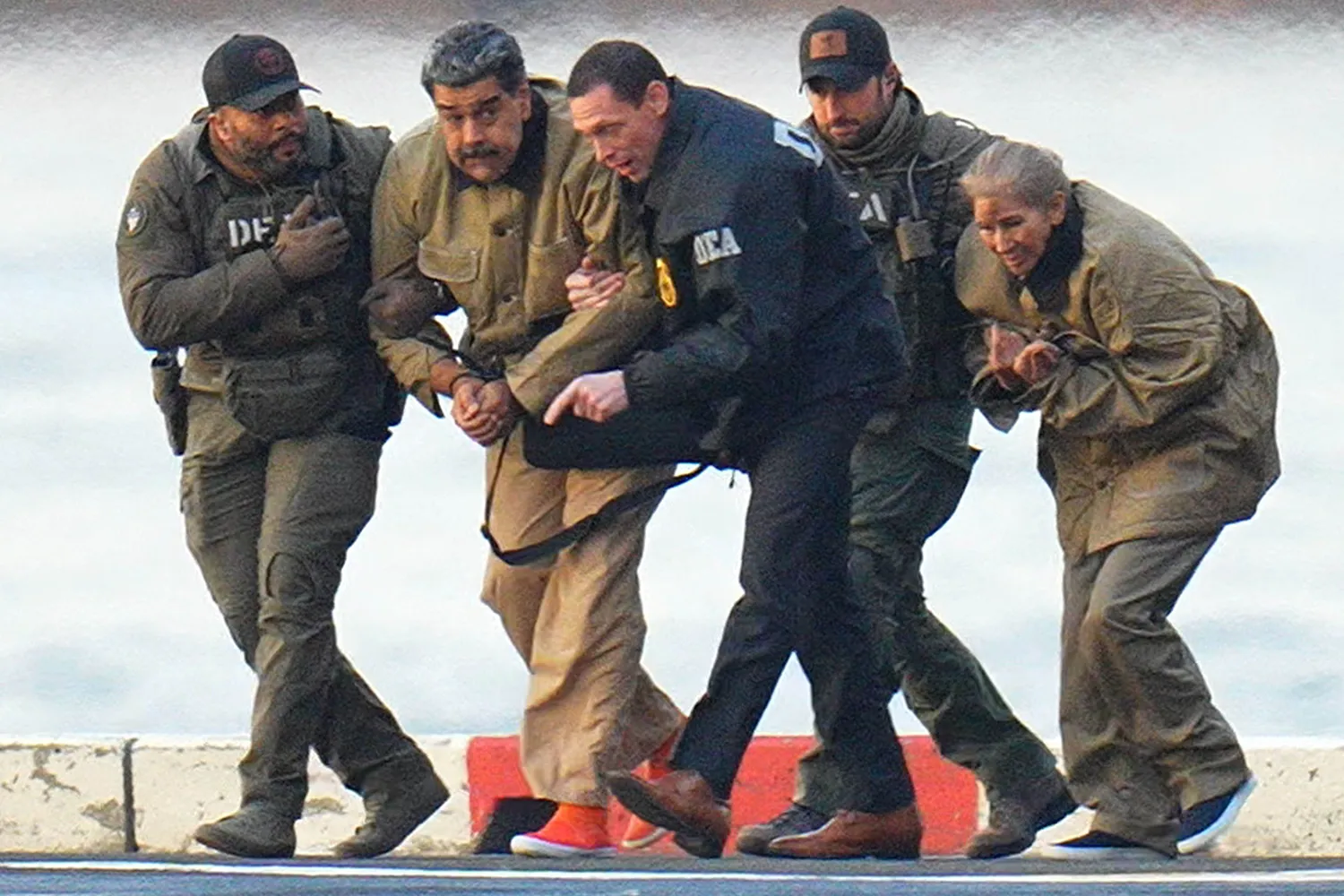

Venezuelan President Nicolás Maduro and his wife, Cilia Flores, were arraigned in a New York federal court on Monday, Jan. 5, after being captured in Venezuela and transported to the United States by the U.S. military over the weekend.
Speaking through a Spanish interpreter before Judge Alvin K. Hellerstein, Maduro described himself as a “prisoner of war” and entered a plea of not guilty.
“I am the president of Venezuela,” Maduro said. “I consider myself a prisoner of war. I was captured at my home in Caracas, Venezuela.”
President Donald Trump confirmed Maduro’s removal from Venezuela in a Truth Social post on Saturday, Jan. 3, stating that U.S. forces also carried out a large-scale strike on Caracas. Trump accused Maduro of narco-terrorism and said the United States would take interim control of the country.
Maduro, 63, faces four federal charges: narco-terrorism conspiracy, cocaine importation conspiracy, possession of machine guns and destructive devices, and conspiracy to possess machine guns and destructive devices. He formally entered a not-guilty plea in court.
“I am not guilty,” Maduro said. “I am a decent man. I am still the president of my country.”
Flores, 69, is charged with cocaine importation conspiracy, possession of machine guns and destructive devices, and conspiracy to possess machine guns and destructive devices. She also pleaded not guilty, briefly addressing the court through an interpreter.
:max_bytes(150000):strip_icc():focal(353x568:355x570):format(webp)/Nicolas-Maduro-010326-e0114975066946bca0e0906ca45a38df.jpg)
“Not guilty, completely innocent,” Flores said.
As he was escorted from the courtroom, Maduro again shouted in Spanish that he was a “prisoner of war.”
Federal prosecutors alleged in the indictment that senior Venezuelan leaders have, for decades, exploited state institutions to traffic massive quantities of cocaine into the United States. The document claims Maduro played a central role, using his authority and influence to facilitate the transport of thousands of tons of narcotics.
After the operation, Trump spoke to reporters at Mar-a-Lago, suggesting that Venezuela’s vast oil reserves were a significant factor behind the action. The country holds the world’s largest proven oil reserves.
“We’re going to get the oil flowing the way it should be,” Trump said. “We’re gonna run it properly, and we’re gonna make sure the people of Venezuela are taken care of.”
Trump added that the U.S. would manage the country’s oil sector and sell large quantities of Venezuelan oil to other nations.
On Jan. 4, Trump issued a warning to Venezuela’s interim leader, Delcy Rodríguez, urging her to cooperate with U.S. plans and grant full access to the country’s natural resources.
In an interview with The Atlantic, Trump said that Rodríguez would face severe consequences if she did not comply. “If she doesn’t do what’s right, she is going to pay a very big price, probably bigger than Maduro,” he said, later adding that Maduro “gave up immediately.”
Trump also confirmed that Secretary of State Marco Rubio had spoken with Rodríguez, saying she agreed to cooperate.
“She really doesn’t have a choice,” Trump said.