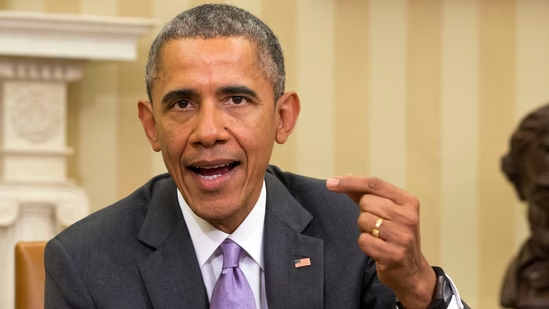

Barack Obama delivered a pointed critique of Donald Trump’s governing style, warning that it poses risks to democratic norms and the rule of law. Speaking in an interview with Brian Cohen, Obama contrasted his own use of executive authority with Trump’s approach. He stressed that he intentionally avoided wielding presidential power to penalize states that opposed him politically.
“When I was president, I suppose I could have unilaterally ordered actions against states that didn’t vote for me — whether by cutting funding or pressuring governors — but that runs counter to how democracy should function,” Obama said. He argued that leadership requires adherence to integrity, honesty, and institutional respect, cautioning that abandoning those principles weakens the foundations leaders claim to protect.
Obama’s remarks come against the backdrop of heightened tensions surrounding federal immigration enforcement, particularly following a controversial incident in Minneapolis. In late January 2026, U.S. immigration agents fatally shot 37-year-old Alex Pretti, a lawful U.S. citizen, during an operation. The shooting sparked protests across several cities, with local officials demanding accountability and criticizing the federal response.
Minnesota Governor Tim Walz and Minneapolis Mayor Jacob Frey called for the operation to be halted, citing concerns about public safety and civil liberties. Meanwhile, federal authorities and Trump allies defended the agents’ actions, characterizing the shooting as self-defense and portraying the protests as a threat to order.
In the interview, Obama described such confrontations as reflective of a broader political environment where established norms and legal standards face mounting pressure. He noted that Republicans have frequently advanced forceful policies with limited regard for institutional constraints, while Democrats have tended to prioritize procedural safeguards and legal frameworks.
Obama acknowledged that this difference can make Democratic governance more challenging but insisted it remains essential for preserving democratic legitimacy. “People sometimes ask why Democrats aren’t as ruthless,” he said. “We shouldn’t be discouraged by having a harder task. We should expect ourselves to be capable enough to navigate it responsibly.”
He emphasized that respecting democratic boundaries, even when politically inconvenient, is vital to sustaining public trust. The Minneapolis episode, alongside other contentious immigration enforcement measures, underscores how aggressive federal actions can fuel local resistance and civic unrest.
Obama concluded by reaffirming his belief that principled governance is both ethically necessary and strategically sound. Upholding decency, institutional integrity, and the rule of law, he argued, is critical to preventing democratic erosion and maintaining confidence in government.