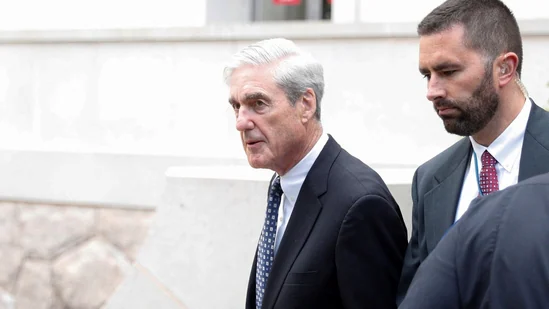

President Donald Trump sparked a wave of condemnation Saturday after celebrating the death of former FBI Director and Special Counsel Robert Mueller III. Mueller, a decorated Vietnam War veteran who led the high-profile investigation into Russian interference in the 2016 election, died Friday evening at the age of 81.
Shortly after the Mueller family confirmed his passing, the President took to Truth Social to deliver a scathing assessment of the former prosecutor’s life.
“Robert Mueller just died. Good, I’m glad he’s dead. He can no longer hurt innocent people!” Trump wrote.
The remark instantly polarized a nation already divided by the legacy of Mueller’s 22-month Special Counsel probe. While loyalists echoed the President’s sentiment, critics and former colleagues decried the statement as a “vile” breach of presidential decorum.
A Career Defined by Duty
Mueller’s tenure in public service spanned four decades, serving under both Republican and Democratic administrations. Appointed by George W. Bush, he assumed leadership of the FBI just one week before the September 11 attacks, subsequently overseeing the bureau’s transformation into a counterterrorism powerhouse. He remained in the post for 12 years—the longest tenure since J. Edgar Hoover.
In 2017, Mueller was summoned back to the spotlight as Special Counsel. His investigation resulted in 34 indictments, including senior Trump associates and Russian intelligence officers. While the final report did not establish a criminal conspiracy between the Trump campaign and Moscow, it explicitly stated it did not exonerate the President regarding obstruction of justice—a point that fueled years of personal animosity from Trump.
Political Fallout
The President’s “glad” comment drew immediate fire from across the aisle. Representative Dan Goldman (D-NY) called the celebration of Mueller’s death “disgusting,” noting that Mueller and Trump represented “polar opposites of what a public servant should be.”
On social media, Democratic commentator Harry Sisson challenged Republicans to condemn the remarks, citing the outrage previously seen when right-wing figures were targeted with similar rhetoric.
Conversely, far-right activist Laura Loomer defended the President, asserting he was merely “saying what everyone is thinking.”
Final Years
Mueller had largely retreated from public life following his 2019 congressional testimony. In late 2025, reports surfaced that he had been battling Parkinson’s disease since 2021. He is survived by his wife of nearly 60 years, Ann Standish, and their two daughters.
The White House has not issued a formal statement beyond the President’s social media post.