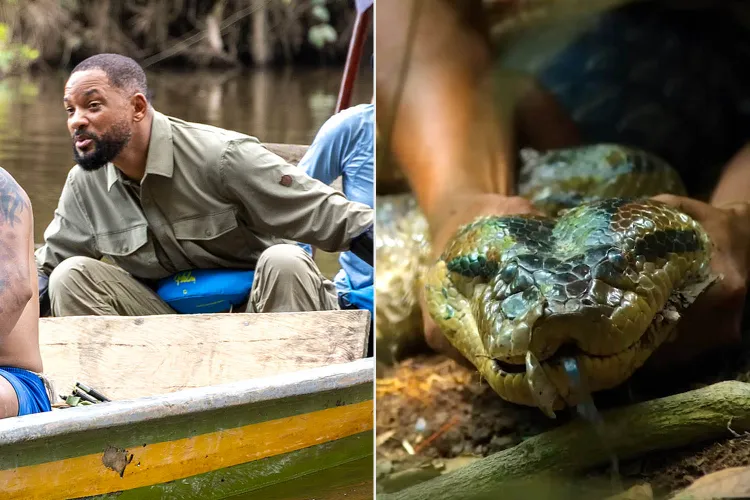

Fresh footage from Pole to Pole with Will Smith shows the moment a team filming in Ecuador came across a huge anaconda along the riverbank.
In a clip obtained by LiveScience, Will Smith is seen riding in a boat with venom expert Bryan Fry, expedition leader Carla Perez and Indigenous Waorani guides. As they move along the river, the group spots an enormous anaconda resting on the shore.
The Waorani guides quickly take the lead, stepping off the boat and working to secure the snake so Fry and Smith can collect a sample for a genetics study.
“Let them try to control this,” Fry tells Smith in the video, as Smith reacts with visible shock.
“That’s gigantic. Wow!” Smith says. Fry estimates the snake could be as long as 17 feet.
:max_bytes(150000):strip_icc():focal(757x509:759x511):format(webp)/Anaconda-The-Amazon-Dark-Waters-Pole-To-Pole-With-Will-Smith-011026-03-4b1c6093958b43548e336188706fd7e2.jpg)
Once the animal is under control, Smith and Fry step closer for a better look. Smith admits the scene was intimidating even from the boat, then asks the guides—speaking in their language—whether it’s safe. They confirm that it is.
Fry explains they want to remove a small piece of scale to study both the snake’s genetics and the buildup of pollutants in the surrounding water. The catch: the sample needs to come from the snake’s underside. When Fry asks Smith to help, Smith hesitates.
“Yeah, nah. I’m a little nervous,” Smith says. Fry encourages him: “You can do it.”
Following Fry’s instructions, a guide lifts part of the snake’s belly while Smith wipes away mud and debris from the area. Fry then uses scissors to cut a small piece cleanly and seals it in a vial for analysis.
Smith exhales in relief as Fry confirms the team has what it needs. “There you go. There’s our sample. We can do all the research on this animal with just that one tiny little piece,” Fry says.
:max_bytes(150000):strip_icc():focal(914x747:916x749):format(webp)/Anaconda-The-Amazon-Dark-Waters-Pole-To-Pole-With-Will-Smith-011026-01-eef26c81309f4801a7bd9b1b163316be.jpg)
“That’s fantastic,” Smith replies, holding up the vial.
The sample proved significant. In a release from the University of Queensland, Fry said the material collected helped scientists determine that northern and southern green anacondas—long thought to be the same species—are actually two genetically distinct species.
Fry added that the lineages split nearly 10 million years ago and differ by about 5.5% genetically. “It’s quite significant—to put it in perspective, humans differ from chimpanzees by only about 2 percent,” he said.
:max_bytes(150000):strip_icc():focal(627x380:629x382):format(webp)/Anaconda-The-Amazon-Dark-Waters-Pole-To-Pole-With-Will-Smith-011026-02-bf33663febbb4509954f5175dae430a2.jpg)
The northern green anaconda—documented and identified by Fry’s team—appears to grow larger and occupies a smaller, different range in the Amazon compared with the southern green anaconda.
According to National Geographic, green anacondas are non-venomous constrictors native to South America and part of the boa family. They are considered the heaviest snakes in the world and typically live up to around 10 years in the wild.
Pole to Pole with Will Smith premieres on Disney+ on Jan. 13.