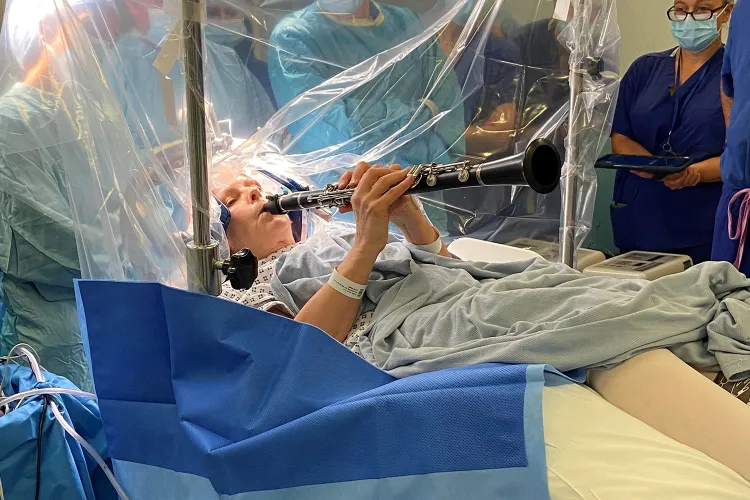

A 65-year-old British woman with Parkinson’s disease has shared her joy after successfully playing the clarinet while undergoing brain surgery.
Denise Bacon, from Crowborough in East Sussex, spent four hours at King’s College Hospital in London as surgeons performed a deep brain stimulation (DBS) procedure, according to a news release shared by the hospital on Tuesday, Oct. 21.
The hospital said Bacon underwent the operation on July 16.
According to the Mayo Clinic, DBS “involves implanting electrodes within areas of the brain.” These electrodes send controlled electrical impulses that influence brain activity to treat certain medical conditions. The impulses can also affect brain cells and chemicals that contribute to those conditions.
The stimulation level is managed by a pacemaker-like device placed under the skin in the upper chest. A wire running beneath the skin connects the device to the brain electrodes, the Mayo Clinic explains.
Bacon, a retired speech and language therapist, was diagnosed with Parkinson’s in 2014. Over the years, the disease affected her ability to walk, swim, dance, and play her “beloved clarinet,” the hospital said.
Before her symptoms worsened, she had played in the East Grinstead Concert Band but had to stop five years ago.
:max_bytes(150000):strip_icc():focal(749x0:751x2):format(webp)/denise-bacon-playing-clarinet-surgery-102125-4-30036b9a301f43e19dc63b316f9dda14.jpg)
During surgery, Bacon played the clarinet, allowing surgeons to hear real-time evidence of the procedure’s success.
According to the hospital, Bacon had experienced “slowness of movement (bradykinesia) and muscle stiffness (rigidity)” due to Parkinson’s. “The results were instantaneous on the operating table,” the statement read. “The movement in Denise’s fingers improved immediately, allowing her to play the clarinet with much greater ease.”
Supported by a team of specialists — including a neurologist, neuropsychologist, and DBS nurses — surgeons connected electrodes to a pulse generator, similar to a pacemaker, which delivers electrical impulses to modify brain activity and reduce symptoms.
Professor Keyoumars Ashkan, a neurosurgeon at King’s College Hospital, led the procedure.
“Holes half the size of a five-pence piece were made in Denise’s skull after a frame with precise coordinates was placed on her head, acting as a sat nav to guide us to the correct positions within the brain to implant the electrode,” Ashkan explained.
“Once the electrodes were in place on the left side of Denise’s brain, the current was switched on and an immediate improvement was noted in hand movements on her right side,” he continued. “The same happened on her left side when we implanted electrodes on the right side of her brain.”
:max_bytes(150000):strip_icc():focal(749x0:751x2):format(webp)/denise-bacon-playing-clarinet-surgery-102125-2-027ad18e99d54f1db17b17c8efe97d75.jpg)
As a passionate clarinetist, Bacon was encouraged to bring her instrument into the operating theater. “We were delighted to see an instant improvement in her hand movements — and therefore her ability to play — once stimulation was delivered to the brain,” Ashkan said.
Bacon received a local anesthetic to numb her scalp and skull but remained awake throughout so her symptoms could be monitored. The hospital noted that the brain itself has no pain receptors.
After surgery, Bacon said she was thrilled to regain her ability to play. “I remember my right hand being able to move with much more ease once the stimulation was applied, and this in turn improved my ability to play the clarinet, which I was delighted with,” she shared.
“I’m already experiencing improvements in my ability to walk, and I’m keen to get back in the swimming pool and on the dance floor to see if my abilities have improved there,” she added.
Bacon opted for a rechargeable pulse generator battery implanted in her chest that can last up to 20 years before replacement. The device delivers a continuous electrical current to her brain and can automatically adjust stimulation when needed.
While DBS can manage motor symptoms like tremors, it isn’t a cure and doesn’t halt disease progression, The Times reported.
According to the Mayo Clinic, Parkinson’s disease is a “movement disorder of the nervous system that worsens over time.”