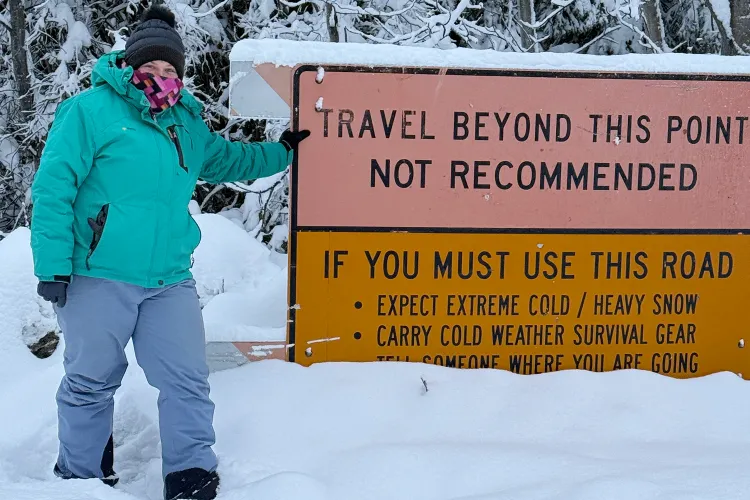

Olivia Jones quite literally lives where the mile markers end.
On social media, the mom of four documents her life living with her family in Eagle, Alaska, for her 177,000 followers on her TikTok, which is aptly called “Beyond the Mile Markers.” That’s because Jones lives beyond the final mile marker in Alaska, at the end of State Highway 5.
“You take one road in Alaska, and it ends here, which is where we got ‘Beyond the Mile Markers’ because the mile markers end and you have to just keep going to get to us,” Jones explains.
Jones and her family originally lived in St. Louis, Missouri. After COVID-19, she and her husband decided to move to rural Alaska—where her grandfather had gone in the 1970s for gold mining. Jones says her family fell in love with the state when she was young, returning on and off over the years.
When the pandemic hit and her husband’s job became remote, they finally made the leap.
“We were in that in-between stage of either we’re going to do it and just give it a try or we’re going to stay behind and regret never trying it,” she says.
They’ve lived in Eagle ever since, near a town of fewer than 100 residents. But life in such a remote area comes with daily challenges—including dangers that are hard to ignore.
One of the biggest threats, Jones says, is the Yukon River, visible behind her window during a Zoom call.
“All of this that you can see white is the Yukon River,” she says. “It is extremely fast.”
With four young children, she’s constantly alert when it comes to the water.
:max_bytes(150000):strip_icc():focal(567x892:569x894):format(webp)/Alaska-kids-012226-24289354ee504bb0bae8bbcc2767f51e.jpg)
“It’s completely frozen right now, but when it starts to break up, it actually floods up here,” she says, motioning toward her back deck. She recalls hearing from neighbors about a major flood in 2009 that “took out the whole town.”
“We have been told that boats were docked on this railing here at our house during that flood because it came all the way up here,” she says.
Their family rules around the river are strict: kids aren’t allowed near it—and if they’re anywhere close, life jackets are mandatory.
“Our rule is if we see a kid near it, one, they’re not allowed to be near it, but two, you have a life jacket,” she says. “Life jackets are non-negotiable.”
To help their children understand how powerful the current can be, Jones says they’ve even let them go into the water under tight control—“swim in it, and we had them tied off” to the boat—so they could feel just how quickly it pulls.
“We don’t mess with it,” she says.
Another danger is more familiar to many people who think of Alaska: grizzly bears.
Jones recalls an incident last fall when her family was walking near the boat ramp and spotted grizzly tracks. Neighbors soon approached with an urgent warning.
“Some neighbors came by and they were like, ‘We just saw the grizzly. You guys got to go,’” she says.
Beyond their own safety, Jones says they also worried about their pets and their 15 sled dogs. She believes the bear hibernated somewhere near their home.
“Come spring, we’ve already warned all the kids—you just can’t be outside by yourself until after the bears waking up,” she says. “We got to give ’em a while just to move on.”
:max_bytes(150000):strip_icc():focal(671x579:673x581):format(webp)/Alaska-sled-dogs-2-012226-85d42cd094a047a295267fea774d9752.jpg)
Bears, she notes, may be more afraid of people than people are of them—but caution is still essential.
Jones also points to a reality that feels unthinkable in most places: there is no 911 service where she lives.
“There is a health clinic out in our native village and they have a health aide there who has taken her training, who can help you and wait until a medevac comes in,” she says, adding that many residents carry medevac insurance because emergencies often require an airlift.
:max_bytes(150000):strip_icc():focal(1279x693:1281x695):format(webp)/Alaska-Olivia-Jones-trapline-012226-fe23167ae5f04b2abdbf50bdab2769ee.jpg)
If something goes wrong, the process is direct and highly local.
“If something were to happen, you call specifically to the person you need,” she says, noting there are volunteers who can drive the ambulance if required. Otherwise, families drive to the clinic. If the situation is life-threatening, the health aide calls for a medical evacuation; if not, the aide provides first aid.
The nearest hospital is in Fairbanks—nearly 400 miles away. Jones says it can take an hour for the plane to reach Eagle and another hour to fly back.
“You can’t think about it too hard or you’ll freak yourself out,” she says.