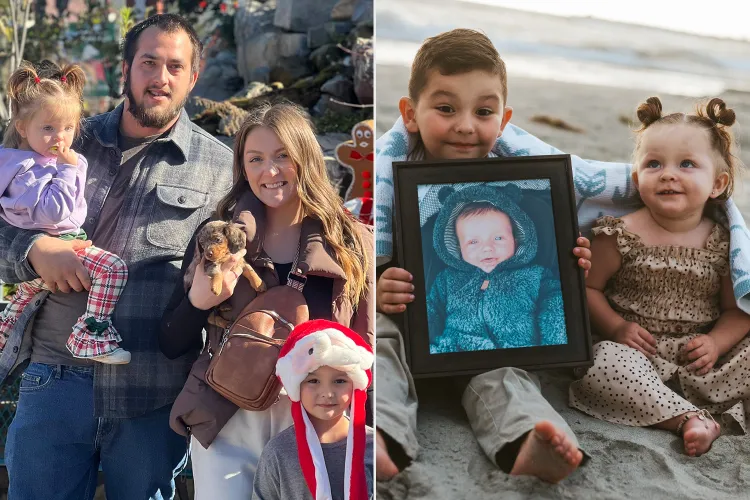

Rebekka Card was nursing her nearly 4-month-old son, Hayden, one evening—part of her usual nighttime routine—when tragedy struck.
“I was exclusively nursing Hayden. He never really took a bottle, despite our attempts; he very much preferred nursing,” Card tells PEOPLE. “I nursed him at about 9:15 p.m. and then put him down in his DockATot.”
The 27-year-old mother says she had consulted Hayden’s pediatrician, who recommended placing the DockATot in their bed rather than in a crib, citing a higher risk of suffocation in the latter.
“I thought that was okay at the time, so he would sleep in our bed,” she explains. “It was also more convenient for nursing during the night.”
:max_bytes(150000):strip_icc():focal(574x0:576x2):format(webp)/rebekka-card-baby-062725-b20de84f75414121bd620c58b1770f0a.jpg)
Card notes that she always made an effort to stay awake during feedings.
“I would lean against the wall and headboard while nursing him upright in a crisscross position,” she says. “That night, I went to bed around 10 p.m., less than an hour after I had nursed him. He woke up again just before 1 a.m.”
She retrieved Hayden from the DockATot, which was on the left side of their king-size bed. Card was in the middle, and her husband was on the right. But exhaustion overwhelmed her.
“I don’t remember falling asleep while nursing him,” she recalls. “The next time I woke up, my husband was asking where Hayden was.”
:max_bytes(150000):strip_icc():focal(574x0:576x2):format(webp)/rebekka-card-family-062725-3-1901c74b3a7a42a299d17c30be713da3.jpg)
She looked over. Hayden was no longer in the DockATot.
“I was sort of slouched, and Hayden had ended up between me and my husband,” she says.
Unresponsive, Hayden was rushed to emergency services after his parents dialed 911.
“I picked him up—he was still warm,” she remembers. “We performed CPR until the ambulance arrived.”
At the hospital, Card and her husband were separated, questioned, and denied access to their child. It wasn’t until medical staff delivered the devastating news that they learned Hayden hadn’t survived.
“Two doctors and a nurse came in, and I knew right away—like something out of Grey’s Anatomy or a movie,” she says. “They told us he hadn’t made it. I begged to see him, but they wouldn’t let us. We were treated like we had done something wrong.”
Hayden was just eight days away from turning 4 months old. Card and her husband were finally allowed to say their goodbyes hours later.
In a video shared to TikTok, Card later revealed that Hayden’s cause and manner of death were both classified as “undetermined.” Following an autopsy, doctors found no signs of illness, trauma, toxins, or blockages—effectively ruling out suffocation.
However, the report mentioned that the circumstances were “consistent with SIDS” (Sudden Infant Death Syndrome) and referenced the possibility of a “sleeping position causing a baby to not be able to breathe.”
The American Academy of Pediatrics (AAP) strongly advises against bed-sharing with infants, citing a dramatically increased risk of sleep-related death—up to 67 times higher, according to their research.
Card describes Hayden as having “the purest soul.”
“His energy was so genuine. The way he looked at you—he was perfect. He rarely cried. We did so much in those four months. I wouldn’t trade that time for anything.”
After influencer Emilie Kiser’s toddler passed away in May, Card shared a TikTok video of herself playing with Hayden the day before his death.
“I fell asleep nursing my son, and he never woke up. Tragedy only looks preventable when you’re not the one going through it,” she wrote.
Card says she initially felt isolated in her grief. But after opening up online, she began to receive messages from other mothers and even those without children who felt connected to her story.
Sharing her journey helped create a sense of purpose.
“It brought a different light to his passing—it gave meaning to my pain,” she says, adding that she discovered resources like Sleep Safe Seven for families who choose to bed-share.
“I wanted others to know they weren’t alone—that someone out there truly gets it and is willing to meet them where they are,” she says. “I keep my messages open. I’ve built a community.”
Though time has helped, the grief still resurfaces.
“Some days feel just like the day he passed,” she says. “Other days, I feel strong and motivated. I’ve learned not to suppress the sadness—because it only comes back harder.”
For Card, healing means giving herself space to feel it all.
“The most important thing is to embrace whatever comes. Smiling doesn’t mean you’re not grieving. I always say, ‘I hope you find a reason to smile today.’ That small thing can bring so much healing.”