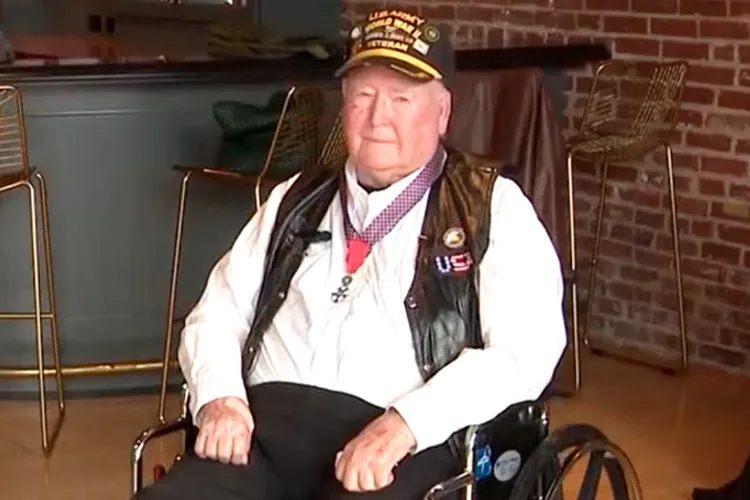

Glenn Fisher, a 99-year-old veteran of the 1945 Rhine River crossing, is locked in a final bureaucratic struggle with the U.S. Army to secure a Purple Heart that has eluded him for eight decades. Despite carrying German shrapnel in his body for 77 years, a clerical error in military records remains the primary obstacle to his official recognition.
Fisher’s service began with an act of determined patriotism. In 1943, at just 16 years old, he altered his birth certificate—changing a “6” to a “7”—to meet the enlistment age requirement. By September 1944, he was deployed to England and eventually moved through France and the Netherlands as the Allied forces pushed toward Germany.
The pivotal moment occurred in March 1945 during the perilous Rhine River crossing. Fisher’s unit came under heavy German fire.
“They shot so many rounds that it was an airburst,” Fisher told local reporters. “The shell went over about 20 feet off the ground and [slung] hundred and some pieces of shrapnel. One hit me.”
The explosion killed two soldiers and wounded 14 others. However, the chaos of frontline combat resulted in a critical administrative failure: Fisher’s injury was recorded with the wrong date.
The Army’s official records list Fisher’s injury as occurring in June 1945, a timeframe that does not align with his unit’s location or the specific engagement. This discrepancy has created a “documented” impossibility that has stalled his application for the Purple Heart for decades.
The case for Fisher’s medal saw a brief surge of hope three years ago. During an unrelated surgery, doctors discovered a piece of shrapnel embedded in his body—physical evidence of the 1945 blast. However, in a devastating blow to his claim, the extracted shrapnel was subsequently lost by the medical facility, and Fisher lacks the original field documentation from the day he was wounded.
“We have a lot of circumstantial evidence, but we don’t have anything saying Glenn was wounded [in March]. That’s the issue,” says Jeff Thoke, a friend and advocate assisting Fisher with the Army’s rigorous appeals process.
As Fisher approaches his 100th birthday this year, his supporters are calling on the Department of the Army to consider the totality of his records. This includes documentation of his hospitalization and subsequent treatment for a “reinfected wound” months after the Rhine crossing—evidence that corroborates his account of the March injury.
:max_bytes(150000):strip_icc():focal(499x0:501x2):format(webp)/purple-heart-medal-032626-fa783897741d4d5c823b35e7b94c17f7.jpg)
For Fisher, the pursuit is not about the decoration itself, but the validation of a sacrifice made by a 17-year-old soldier on the front lines of freedom. The Army has not yet signaled if it will grant a waiver or correction based on the circumstantial evidence provided.