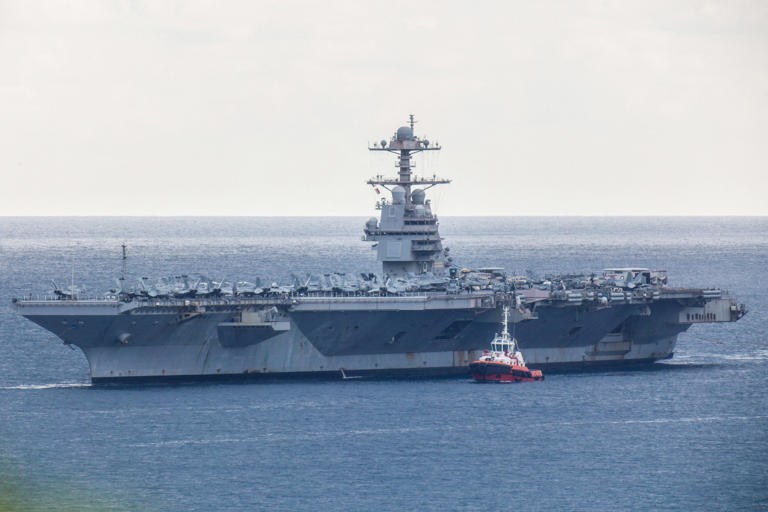

The USS Gerald R. Ford, the Navy’s most advanced aircraft carrier, arrived at Naval Support Activity Souda Bay on Monday, temporarily withdrawing from the frontline of the conflict with Iran to undergo urgent maintenance and resupply.
The first-in-class vessel transitioned from the Red Sea through the Suez Canal following a grueling nine-month deployment that has tested both the ship’s cutting-edge systems and its crew of 4,000 personnel. While U.S. 6th Fleet officials emphasized the carrier remains “fully mission capable,” the port call in Greece marks a critical pause for a strike group that has been extended twice since departing Virginia in June 2025.
A Deployment Defined by Strain
The Ford’s journey highlights the shifting priorities of the Trump administration. Initially deployed to Europe, the carrier was redirected to the Caribbean in late 2025 to pressure the Maduro government in Venezuela before being surged to the Middle East in early March to support Operation Epic Fury.
However, the deployment has been marred by persistent mechanical and safety hurdles:
- Laundry Room Fire: On March 12, a significant fire in the ship’s main laundry spaces resulted in smoke inhalation injuries for hundreds of sailors and forced the Navy to scavenge mattresses from the under-construction USS John F. Kennedy.
- Chronic Infrastructure Issues: Internal reports and service officials confirm the vessel has battled daily sewage system failures, a recurring problem first identified by the GAO in 2020.
“Extended deployments demand endurance,” stated Adm. Daryl Caudle, Chief of Naval Operations, acknowledging the “real sacrifice” of a crew now eclipsing the rare nine-month mark at sea.
Strategic Vacuum in the Persian Gulf
The Ford’s departure leaves the USS Abraham Lincoln as the sole U.S. aircraft carrier operating in the region. This reduction in naval presence coincides with a fragile diplomatic window.
President Donald Trump announced Monday a five-day postponement of planned strikes against Iranian energy infrastructure, citing “productive talks” with Tehran. Despite this pause, the strategic Strait of Hormuz remains under Iranian control, maintaining a stranglehold on global oil transit and leaving the U.S. military in a state of high alert.
The Ford is expected to undergo “efficient assessment and repairs” in Crete before determining its next operational phase. Its absence from the Persian Gulf, even if temporary, shifts the tactical burden to land-based assets and the lone Lincoln strike group as the administration’s 48-hour ultimatum on the Strait of Hormuz expires.