
On what he describes as the darkest morning of his life, Kevin Berthia woke up and decided he was done fighting his depression. The 22-year-old from Oakland, Calif., drove to the Golden Gate Bridge, determined to end his life.
He had never been to the iconic bridge before and had to stop several times for directions. When he finally arrived on March 11, 2005, he left his keys in the ignition and walked onto the span, staring down at the San Francisco Bay.
“The water is my freedom. I’m ready,” he told himself.
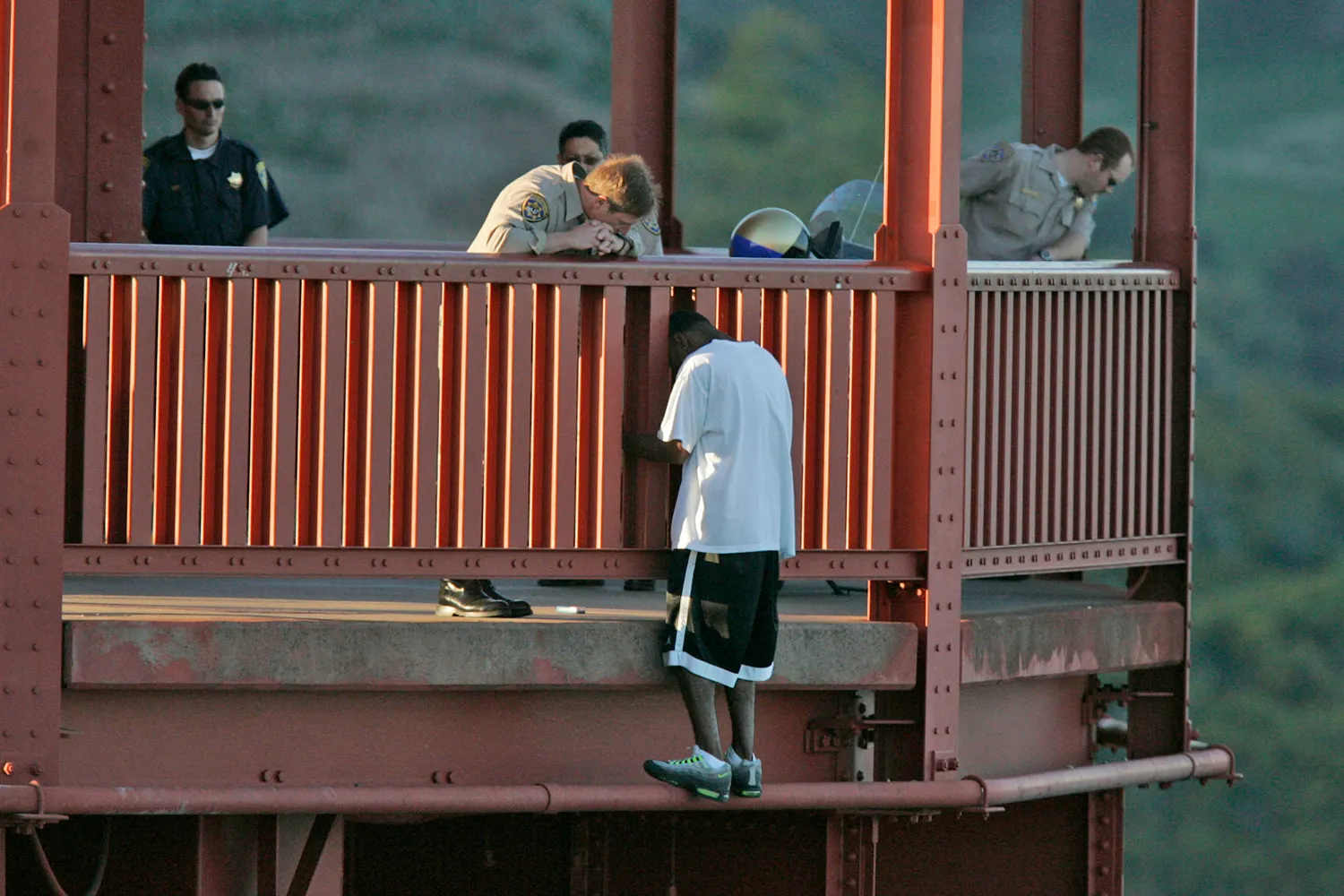
At the time, Berthia was overwhelmed — he had lost his job and was drowning in medical debt after the premature birth of his daughter. Within minutes, he climbed over the railing and balanced on a narrow metal beam as the icy water churned 220 feet below.
“I started my countdown,” he recalls. “And I braced myself for impact.”
Then, something happened that he still calls “a miracle.”
Passing by was California Highway Patrol Sgt. Kevin Briggs, whose duty included monitoring the bridge for people in distress. Known as “the guardian of the Golden Gate Bridge,” Briggs had prevented more than 200 suicide attempts during his career.
:max_bytes(150000):strip_icc():focal(749x0:751x2):format(webp)/Kevin-Briggs-and-Kevin-Berthia70-080725-54bb5b06f3f149f5b4ddce4e9183ec47.jpg)
Spotting Berthia on the ledge, Briggs calmly approached. “Hi,” he said gently. “Is it okay if I come over and speak with you for a while? I’m not going to touch you. I’m just here to talk and to listen.”
For 92 minutes, Briggs listened as Berthia opened up about the crushing weight of his struggles. It was the first time Berthia says he had ever shared his “deepest, darkest secrets.”
Briggs never gave orders or false assurances. “I never try to tell anyone what to do,” he explains. “I just listen with empathy and understanding, let them speak their peace, then get them to think about coming back over the rail.”
Eventually, it worked. Berthia climbed back to safety and was taken to a hospital, where he stayed for 11 days.
But recovery wasn’t immediate. The photo of him on the bridge ran on the front page of the San Francisco Chronicle, and for years afterward, Berthia sank back into a deep depression.
Everything began to change in 2013. That year, the American Foundation for Suicide Prevention wanted to honor Briggs for his service and asked if one of the lives he had saved could present him with the award in New York City.
Briggs had never stayed in touch with survivors, fearing he might become a painful reminder. The only gratitude he had ever received came in the form of a letter from Berthia’s mother, Narvella. Determined to find her son, Briggs visited her and shared the plan for the ceremony. She convinced Kevin to attend by telling him he’d won a free trip to New York through a radio station.
When Berthia arrived and finally met the man who had saved him, he was stunned. “I was like, ‘Dang, this whole time it was a cop who saved me.’” Growing up in Oakland, he says he never had positive experiences with law enforcement. “If I’d known who he was, I never would have opened up to him like I did.”
But when they finally shook hands, all of that fell away.
“We’ve been friends ever since,” says Briggs. Berthia describes their bond as even stronger: “We’re more like brothers. What happened that day had nothing to do with him being a White man and me being Black. It’s all about the power of connection.”
That night in New York, Berthia gave an unplanned speech while presenting Briggs with his award. He spoke openly about the pain that had led him to the bridge, and for the first time, he felt truly seen. When he finished, the entire room stood and applauded.
The experience changed his life. He realized he wasn’t alone — and that sharing his story could help others.
Now 42, Berthia runs a foundation focused on removing the stigma around mental illness. He speaks to groups ranging from police recruits to elementary students. Often, he joins Briggs, who has also become a respected speaker on suicide prevention.
Their mission is simple: to help others realize what Briggs showed Berthia two decades ago — that sometimes listening, without judgment, can save a life.
Suicide remains a serious crisis. In 2023, more than 49,000 people in the U.S. died by suicide, according to the Centers for Disease Control and Prevention.
“It’s about learning how to talk to someone who is suffering,” Briggs says. “Not offering empty promises — just listening.”
Berthia agrees. “It’s not an easy topic to talk about,” he says. “But as I always tell people: Kevin makes you think, and I make you feel.”