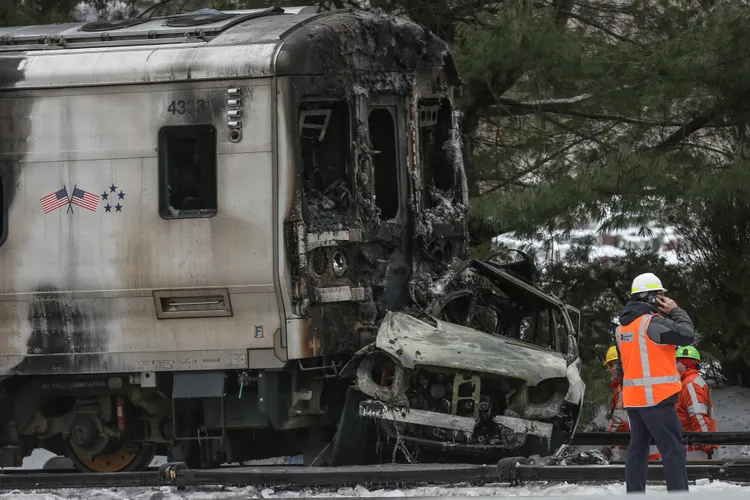

Nearly a decade after a commuter train struck an SUV stuck on tracks outside New York City, Metro-North Railroad has reached a $182 million settlement with families of the victims.
Court records reviewed by the Journal News—before being sealed by a judge—show that most of the money will go to the families of the five passengers who died in the train’s first car. The February 2015 collision was the deadliest in Metro-North history, and the agreement is being described as the third-largest settlement tied to a U.S. railroad crash, according to the outlet.
Attorney Andrew Maloney, who represented some injured passengers and served as local counsel in one of the death cases, said the process took far too long.
He argued that the case was mishandled, saying families who lost loved ones and survivors with life-changing injuries were forced to wait nearly 11 years for resolution.
What happened in the 2015 crash
On the evening of Feb. 3, 2015, the driver of the SUV was navigating rush-hour traffic when she drove onto the tracks in Valhalla, the Associated Press reported.
The crossing arm gate then came down on the vehicle, and the driver moved farther onto the tracks. The train’s engineer applied the emergency brake three seconds before the train hit the SUV at 50 mph, according to the report. The impact caused part of the third rail to puncture the SUV’s gas tank and rip through the first passenger car.
The SUV driver, 49-year-old Ellen Brody, a mother of three, died in the crash, along with five men seated in the train’s first car, according to the Journal News.
:max_bytes(150000):strip_icc():focal(599x0:601x2):format(webp)/valhalla-ny-train-crash2-11326-2aa784b6ec744cd7939f4cc660dc7f38.jpg)
Investigators cited third-rail design as a factor
In 2017, the National Transportation Safety Board (NTSB) concluded Brody caused the crash, but said the third-rail design also contributed to the deaths, according to the paper.
“This accident demonstrated that Metro-North’s third rail assembly catastrophically compromised a passenger railcar with fatal consequences,” the NTSB said in July 2017, according to the Journal News. The agency said the third rail penetrated the passenger compartment, broke apart at splice bars, and significantly worsened the damage and the severity of injuries and fatalities.
How the legal fight unfolded
In 2024, a jury found Metro-North largely responsible for the crash’s consequences. The Associated Press reported that Metro-North was found 71% liable for the deaths of the five men and the injured passengers, and 63% liable for Brody’s death. The jury cited the train engineer’s actions and the company’s oversight of the third rail as specific failures, according to the report.
After years of litigation, the families of the five men received varying settlement amounts based on factors such as age and expected earnings, the Journal News reported.
The largest amount—$79 million—will be paid to the family of 42-year-old Joseph Nadol, a Harvard graduate who was working as an equity analyst at JP Morgan when he died, according to the outlet. The Journal News also reported that 29 injured survivors will receive settlements ranging from $125,000 to $8 million.
The Brody estate has not yet reached a settlement with Metro-North, according to the family’s attorney, who told the Journal News the case remains unresolved.
Safety concerns remain, attorney says
Maloney said he believes key safety issues have still not been fully addressed, arguing the third rail remains “dangerous and defective.”
He said fixes have been identified and are feasible, but claims they have not been implemented—warning that a similar incident could happen again.
An MTA spokesperson, Joana Flores, said Metro-North “continues to prioritize safety” and has worked with NYSDOT (New York State Department of Transportation) and the Federal Railroad Administration on railroad crossing safety enhancements across the network over the last decade.