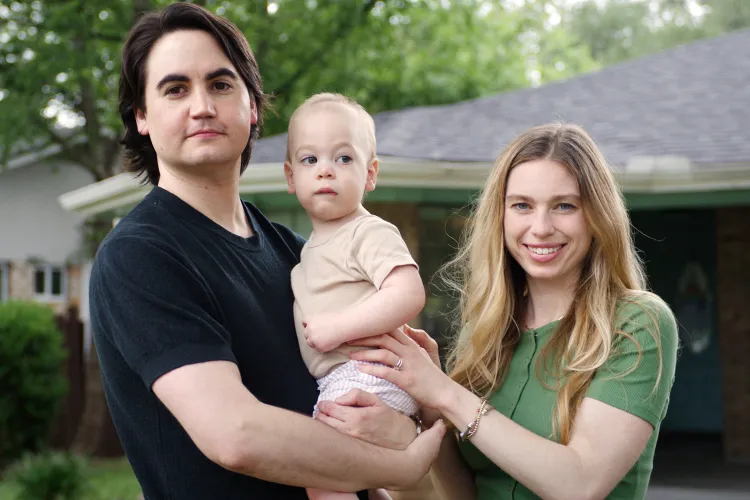

When Taylor Edwards and her husband, Travis, learned they were expecting in late 2022, they were overwhelmed with joy — and relief. After two years of fertility struggles and three rounds of IVF, they were finally going to be parents.
“With IVF and infertility, you’re always waiting for the other shoe to drop,” says Edwards, 33. Once she reached the 12-week mark, she allowed herself to breathe again. “I was like, ‘Finally. I’ve run a marathon. I did it. It’s my turn to be a mom.’”
But at 17 weeks, during a February 2023 ultrasound, everything changed. The technician called the doctor for a closer look. “He gets to the back, and her skull and neck are not connected,” Taylor recalls. “There’s this bubble-like structure. Her brain was coming out. And he says, ‘This baby’s not going to survive.’ I didn’t understand the words he was saying in that moment.”
:max_bytes(150000):strip_icc():focal(749x0:751x2):format(webp)/taylor-travis-baby-reid-101725-191fb5bdc6cd4bcfb154d0d83d116972.jpg)
Their baby girl, Phoebe, had a rare neural tube defect called encephalocele, which causes the brain to develop outside the skull. In her case, it was fatal. “It felt like there was a gaping hole in the earth that just split open,” Taylor says. “And what came next added trauma onto an already traumatic situation.”
Her doctors presented three heartbreaking options: “I could go in weekly and wait for her to die in utero. I could carry to term and watch her suffocate to death in front of me. Or I could terminate the pregnancy,” Taylor recalls. But at 17 weeks, that wasn’t possible in Texas.
Less than a year earlier, the Supreme Court had overturned Roe v. Wade, and Texas had enacted one of the country’s strictest abortion bans, prohibiting the procedure after six weeks. Although the law included an exception for life-threatening conditions in the mother, doctors told Taylor that she didn’t qualify.
“I was terrified,” she says. “My first experience of labor and delivery couldn’t be death. I just knew I wouldn’t be able to get through it.”
Her doctor gave her the name of a clinic in New Mexico, one of the few places where she could receive care. But time was running out — many clinics don’t perform the procedure after 18 weeks. She called, got an appointment a week later, and paid for flights and a hotel herself to protect her husband from Texas’s “bounty law,” which allows people to sue anyone helping someone get an abortion.
On the morning of their flight, the clinic called to cancel because of a medication shortage. Desperate, the couple found another clinic near Denver that could take her. Her procedure was scheduled for March 7, 2023 — at 19 weeks and two days.
During the extra week she had to wait, Taylor became ill with vomiting, dizziness, and high blood pressure — symptoms she now believes were early signs of preeclampsia. Because of the delay, the procedure became a two-day process. “The entire time we were in Colorado, even checking in at the airport, I kept thinking, ‘Do people know why we’re here?’” she says.
Afterward, she was exhausted and heartbroken. “I didn’t want to be in an airport 24 hours after losing my child and bleeding,” she remembers. “I was so afraid of being arrested when we landed back in Texas, even though I knew what I did wasn’t illegal.”
:max_bytes(150000):strip_icc():focal(599x0:601x2):format(webp)/taylor-travis-baby-reid5-101725-750835c8ed40452a8c6b1326fe508b61.jpg)
When she returned home, the grief was overwhelming. “I would sit in what was supposed to be a nursery and hold ultrasound pictures and sob.”
The extensive procedure left her with uterine scarring that required reconstructive surgery before she could try IVF again. But in March 2024, Taylor and Travis finally welcomed a healthy baby boy — something she believes was only possible because she was able to safely end her previous pregnancy.
“A lot of people have to have abortions to become mothers,” Taylor says. “I know it’s uncomfortable for some to hear, but it’s the truth.”
:max_bytes(150000):strip_icc():focal(599x0:601x2):format(webp)/taylor-travis-baby-reid4-101725-ac45d05d85f84eb4be0930f1252c50c8.jpg)
She’s faced criticism for her decision. “People think I don’t deserve to have my son because I had an abortion,” she says. “But I’ve never regretted it for a single second. It allowed me to become a mother, to protect my fertility, and to save my life.”
When it came time to name their son, Taylor and Travis struggled. “I was so afraid I wouldn’t bring him home,” she says. They loved the names Reid and Owen, and then Travis realized the initials — R.O.E. — would spell “Roe.”
“I was like, yep, that’s it,” Taylor says. “It was meaningful, it honored our daughter, and it was the perfect fit.”