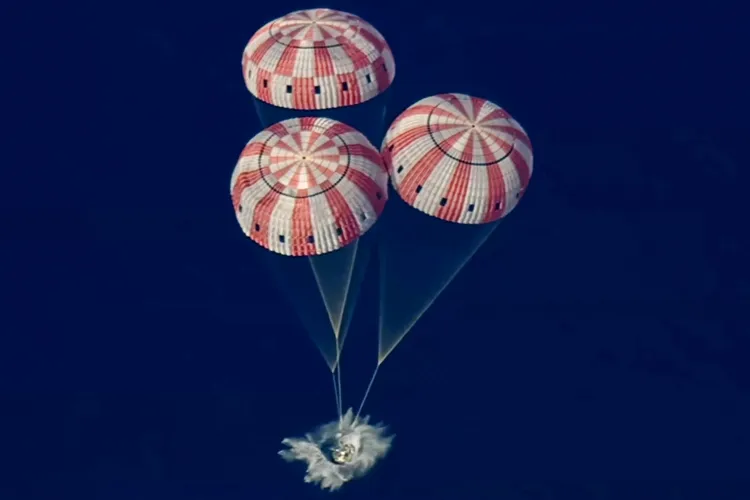

NASA’s Artemis II mission concluded successfully on Friday afternoon as the Orion spacecraft splashed down in the Pacific Ocean, marking the first human voyage to the vicinity of the moon in over 50 years.
The capsule, carrying NASA astronauts Reid Wiseman, Victor Glover, Christina Koch, and Canadian Space Agency astronaut Jeremy Hansen, hit the water off the coast of San Diego at 5:07 p.m. local time. The successful recovery signals a pivotal milestone in the agency’s effort to establish a sustained human presence on the lunar surface.
The return journey tested the limits of aerospace engineering. Orion entered the Earth’s atmosphere at approximately 400,000 feet, traveling at a staggering 24,661 mph—more than 30 times the speed of sound.
During the descent, the crew endured a six-minute communications blackout caused by a plasma buildup as the capsule’s exterior reached temperatures of 4,000 degrees Fahrenheit. To ensure safety, NASA flight controllers utilized a modified re-entry trajectory. This strategic adjustment was designed to mitigate risks associated with the spacecraft’s heat shield, which had been under intense scrutiny following technical concerns raised earlier in the mission.
:max_bytes(150000):strip_icc():focal(749x0:751x2):format(webp)/Artemis-II-splashdown-041026-1-9cfeb6630c0a424ba80387038dedae33.jpg)
Once communication was restored at 157,000 feet, a sequence of parachutes deployed, slowing the vehicle to a gentle 19 mph for splashdown.
While the mission did not include a lunar landing, the Artemis II crew achieved a historic milestone by traveling farther into deep space than any humans in history. The mission surpassed the previous record of 248,655 miles from Earth, set by the crew of Apollo 13 in 1970.
Throughout the flight, the crew conducted critical systems tests and captured high-resolution imagery of the lunar far side, providing invaluable data for future surface operations.
:max_bytes(150000):strip_icc():focal(749x0:751x2):format(webp)/artemis-ii-crew-1-041026-12d1843ac874403985f933bdfad939d1.jpg)
Artemis II serves as the final crewed flight test before Artemis III, the mission intended to land the first woman and the first person of color on the moon. While NASA initially aimed for a sooner return, current projections suggest the lunar landing mission could launch as early as 2028.
“Artemis II is really about the crew and proving we can operate in deep space,” said Patty Casas Horn, NASA’s deputy lead for Mission Analysis.
The successful recovery of Wiseman’s team ends a 54-year hiatus of crewed lunar proximity missions, the last being Apollo 17 in 1972. For NASA, this splashdown is not just an end to a mission, but the definitive start of a new era in deep-space exploration.