

Garry McFadden, a high-profile, plainspoken former homicide detective who became Mecklenburg County sheriff after pledging to scale back jail cooperation with Immigration and Customs Enforcement, is now facing a new wave of federal immigration enforcement in the heart of his county.
This month, agents from Customs and Border Protection carried out a large operation across Charlotte and nearby areas, arresting more than 350 people in what the Trump administration called “Operation Charlotte’s Web.” The sweep moved forward without coordination with McFadden, according to the sheriff, and has reignited a long-running fight over how immigration enforcement should intersect with local public safety.
The sheriff said his office asked to meet with CBP leaders before and during the operation but never got a response. While CBP has now ended its Charlotte deployment, McFadden remains central to the debate — both because of his past decisions on ICE cooperation and because he continues to argue that aggressive immigration actions undermine trust in law enforcement.

“I don’t think you can make someplace safer when you are in fear … of deportation,” McFadden said Monday on CNN’s “Erin Burnett OutFront.” He added that his office wanted a direct dialogue with Border Patrol while agents were in the area.
From homicide detective to TV name to sheriff
McFadden, originally from Sumter, South Carolina, spent 36 years with the Charlotte-Mecklenburg Police Department. Over that career, he built a reputation for solving a large number of homicide cases and became known for a distinctly personal, high-energy investigative style.
He also led the “Cops and Barbers” program, which focused on improving communication between police and the community and earned national recognition, including attention from the Obama administration.
Late in his policing career, McFadden became a recognizable TV figure through the 2016–17 reality series “I Am Homicide” on Investigation Discovery (now part of Warner Bros. Discovery). The show positioned him as a charismatic detective driven to fight for victims and their families, and his on-screen persona helped raise his public profile locally and nationally.
That visibility carried into politics. In 2018, he ran for sheriff of Mecklenburg County — a role that oversees the county jail and courts — promising to reduce the jail’s involvement in federal immigration enforcement. A key part of his platform was ending participation in the 287(g) program, which allows ICE to delegate certain immigration functions to local authorities. He argued that limiting such cooperation would encourage immigrant communities to report crime without fear.
After taking office in December 2018, he followed through: deputies stopped participating in 287(g), and the jail stopped honoring ICE detainers — requests to hold someone past their release time so federal agents can take custody.
A strained relationship with ICE, then new state mandates
ICE pushed back. In 2020, the agency launched billboards in Charlotte featuring people it said were in the country illegally, had criminal convictions, and were released from local custody instead of being transferred to ICE. The message criticized the jail’s refusal to honor detainers and warned of the risks of non-cooperation.
In the years since, North Carolina lawmakers passed two laws that expanded what sheriffs must do in immigration-related cases. The statutes require jail administrators to check some inmates’ immigration status, honor detainers, and give ICE advance notice before releasing someone held on a detainer. McFadden has said his office will comply with the letter of those laws, but will not assist ICE in enforcement actions beyond what is required.
He said he met with ICE regional officials last month and described the conversation as constructive. But he sharply criticized CBP for operating in Mecklenburg County without any similar outreach.
“We are all law enforcement,” McFadden said Monday. “At least respect me enough to come and have a conversation with me while you’re operating in my county.”
Federal officials did not cite McFadden by name when announcing the operation. Still, some Republicans quickly tied the sweep to his policies. North Carolina House Speaker Destin Hall wrote on X that Border Patrol was in Charlotte because McFadden’s “sanctuary policies” led to blocked detainers and the release of people ICE wanted in custody.
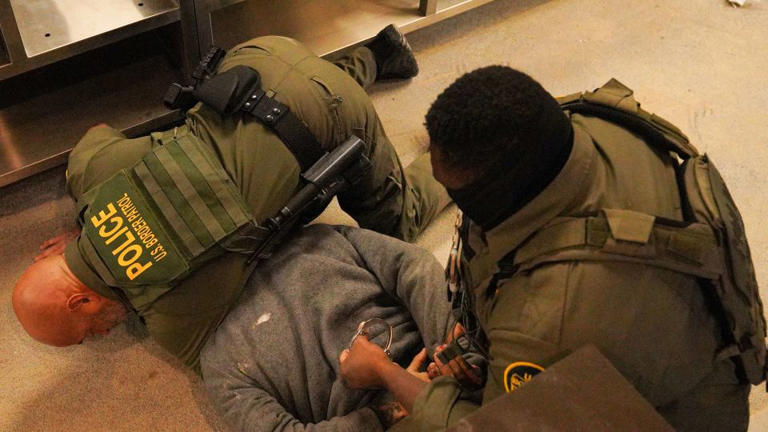
Advocates and local observers say the explanation could be broader. Charlotte’s growing immigrant population, the presence of immigration court, and a large ICE field office likely made the city a target. Stefanía Arteaga, co-founder of the Carolina Migrant Network, said the sweep may also reflect retaliation for McFadden’s earlier decision to curb ICE collaboration.
In its statement, the Department of Homeland Security framed the operation as a public-safety intervention, saying agents targeted individuals with serious immigration and criminal histories, including domestic violence, assault, and drunk driving.
Democratic Rep. Alma Adams condemned the deployment, warning that the presence of CBP and ICE agents can destabilize neighborhoods and put residents on edge.
McFadden said those fears are already visible. He told CNN that many residents are staying home, unsure when the operation will truly end. He also said some students in heavily Black and Latino communities skipped school Monday, and local business owners reported workers staying away.
The Charlotte-Mecklenburg school district said more than 30,000 students — roughly one-fifth of enrollment — were absent across 185 schools that day.
Community trust vs. enforcement pressure
McFadden’s larger-than-life profile has made him both influential and polarizing. Jonathan Thompson, executive director of the National Sheriffs’ Association, said McFadden quickly became an active national voice after his election and now serves on the association’s board.
Thompson described him as someone who believes in law enforcement cooperation and the rule of law, but also as a leader who expects respect and communication between agencies. He said McFadden’s frustration over CBP’s lack of coordination is understandable, even as federal partners may choose secrecy to protect operational plans.
Locally, criticism has been sharper. Daniel Redford, head of the Charlotte-Mecklenburg Fraternal Order of Police, said his organization has no working relationship with McFadden and called the sheriff “self-serving,” arguing that he repeatedly resists immigration enforcement.
Redford recently sent a letter requesting federal support and a possible National Guard deployment, citing staffing shortages and safety concerns. He said the letter may have contributed to the administration’s decision to focus on Charlotte. It referenced a September public-transit killing that drew national attention; the suspect in that case is a U.S. citizen, but Trump highlighted the incident in broader claims about crime in Democratic-run cities.
Ongoing controversy inside the sheriff’s office
McFadden’s tenure has also been dogged by internal turmoil. A former business director sued him in federal court in September, alleging she was fired in retaliation for reporting racial pay disparity and refusing to alter records related to travel spending. McFadden denied the claims in a November filing.
Separately, multiple former employees have accused the sheriff of creating a toxic workplace. Reports have described allegations of emotional abuse and vindictive leadership, including a resignation letter from a former chief deputy who said the office was run like a dictatorship. Another episode involved a recording in which McFadden used racial slurs to refer to colleagues; he later apologized publicly.
In a video posted two months ago, McFadden addressed the wave of departures and criticism. While saying he could not discuss personnel matters in detail, he rejected the characterizations of his leadership and instead described himself as progressive, direct, and demanding of accountability — and said he felt betrayed by former staff.
After months of publicly criticizing immigration enforcement tactics and facing workplace allegations, McFadden has announced he will seek a third term as sheriff, ensuring that his role in Mecklenburg County’s immigration and public-safety debate will continue into the next election cycle.