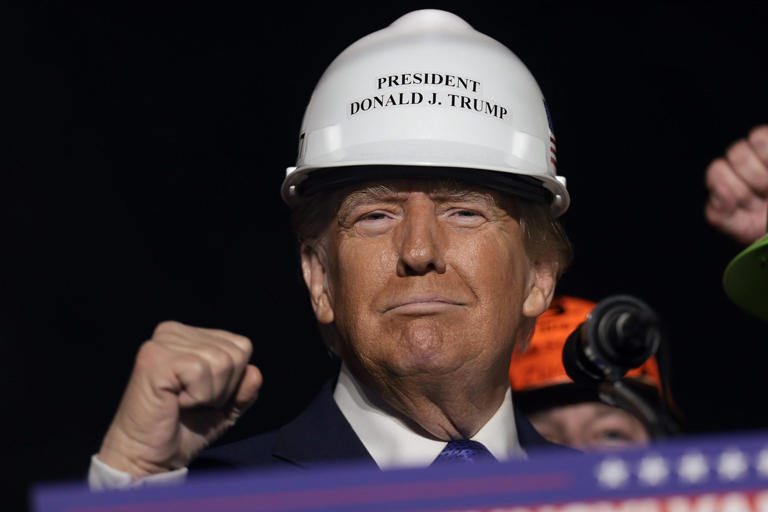

Back in April, President Donald Trump framed his tough tariff approach as the key to bringing manufacturing jobs back to U.S. soil. Eight months later, that pledge has yet to translate into visible progress.
The latest jobs report from the Bureau of Labor Statistics shows that while nonfarm payrolls grew by 119,000, the economy actually shed 6,000 manufacturing positions. That adds up to roughly 59,000 factory jobs lost since Trump promised to jump-start domestic production in April. Those figures line up with November data from the Institute for Supply Management, which recorded an eighth straight month of contraction in manufacturing employment.
Economic commentator Joseph Politano summed up the trend in a recent LinkedIn post, noting that the U.S. is “losing blue-collar jobs for the first time since the pandemic,” as manufacturing roles disappear quickly and hiring in construction and transportation has nearly flatlined.
At a time when white-collar hiring has cooled, trade and factory work had been viewed as a relative safe harbor for Gen Z and frustrated office workers alike. But with manufacturing roles shrinking, the outlook in this already sluggish job market may be even dimmer than many workers expected.
Ironically, the decline in opportunities in a sector that was supposed to ease domestic labor pressures is being linked to the very tariff policies that were designed to revive it, according to Laura Ullrich, director of economic research at the Indeed Hiring Lab.
She said the weak performance is “striking,” because tariffs are typically justified as a way to protect domestic producers so that manufacturing employment grows — and the opposite has happened instead.
Tariff turbulence
Ullrich attributes part of the sector’s slump to the uncertainty introduced by Trump’s tariffs, which has made employers more cautious about expanding their workforce. In a September note, Pantheon Macroeconomics analysts Samuel Tombs and Oliver Allen similarly tied slowing wage growth in the U.S. to firms affected by tariffs, arguing that many are trying to preserve profit margins by cutting labor costs. That kind of uncertainty, Ullrich said, tends to discourage companies from pursuing growth.
When businesses face shifting rules and costs, she explained, it becomes harder to make timely decisions, which in turn drags down hiring and broader activity.
To be clear, she added, hiring has cooled across much of the economy due to broader uncertainty, with notable exceptions in health care and leisure and hospitality, both of which continue to add jobs and include many blue-collar roles. But manufacturing carries a specific vulnerability because tariffs have directly hit intermediate goods—components and materials used to produce finished products.
Those levies have raised input and production costs, which can make employers more hesitant to bring on new workers. A recent study in the American Economic Journal: Economic Policy looked back at former President George W. Bush’s 2002 steel tariffs and found that they did not reduce local steel unemployment; instead, they worsened it, and the negative effects persisted even years after the tariffs were lifted.
Taxing intermediate goods, Ullrich said, flows straight through to manufacturers’ bottom lines—and that’s a key piece of what’s playing out today.
A mismatch in the labor market
The current jobs report doesn’t tell the whole story, however. Ullrich pointed to Indeed data showing that postings for manufacturing roles have remained relatively resilient, even as the industry contracts. That suggests the sector is dealing not only with fewer open positions, but also with a shortage of workers who have the skills needed to fill them.
Some of the decline in blue-collar employment may reflect reduced demand, she said, but another piece is likely on the supply side: there are jobs open that employers simply can’t staff.
Ford CEO Jim Farley recently underscored that gap on the Office Hours: Business Edition podcast, saying the company had roughly 5,000 unfilled mechanic positions—some paying as much as $120,000 a year. A 2024 survey by the Manufacturing Institute and Deloitte of more than 200 manufacturing firms found that over 65% of respondents cited recruiting and retaining workers as their biggest challenge.
All of this suggests that while manufacturing opportunities have diminished from their recent peaks, learning a trade may still be a smart path to stable employment. Enrollment in trade schools and vocational programs has been climbing nationwide, indicating that young people have not written off manufacturing as a viable career.
As Matt Scott, a welding instructor at Portland Community College in Oregon, put it in an interview with KATU in July, more students are realizing they can build “an amazing career” and earn strong incomes by pursuing skilled trades.