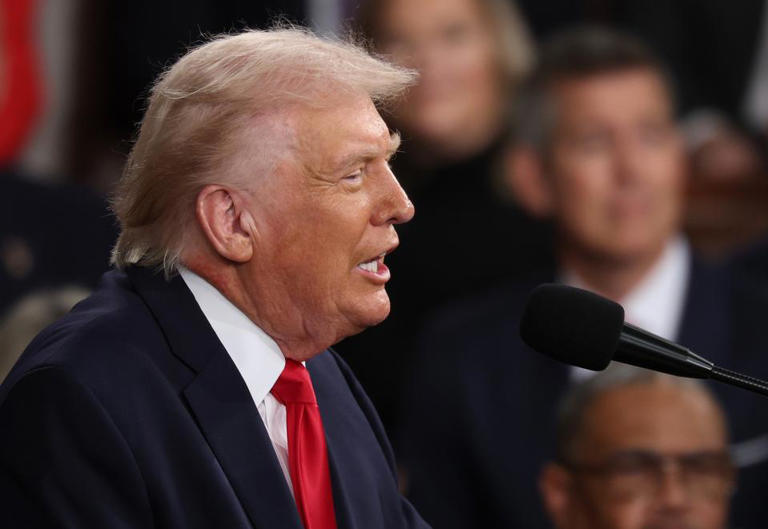

WASHINGTON — President Donald Trump’s first State of the Union address of his second term took a volatile turn Tuesday night as a victory lap over global diplomacy devolved into a heated confrontation with congressional Democrats.
The President claimed to have “ended eight wars” in his first 10 months back in office—a statement that triggered immediate, audible laughter from the Democratic side of the aisle. Trump, visibly agitated by the reaction, halted his prepared remarks to scold the hecklers, calling them “sick people” and “crazy” before doubling down on a list of geopolitical “wins” that fact-checkers say range from exaggerated to demonstrably false.
A “Golden Age” of Peace or Political Hyperbole?
During the nearly 108-minute speech—the longest in U.S. history—Trump framed himself as a “President of Peace,” credit-hoarding for the resolution of long-standing conflicts.
“Our country has never been stronger,” Trump declared. “In my first 10 months, I ended eight wars, including Cambodia.” When the room erupted in laughter, Trump snapped back: “Isn’t it funny? Sick people!”
The President listed the following eight conflicts as “solved”:
Armenia and Azerbaijan: A White House-brokered declaration was signed in August; however, it remains a “preliminary approval” rather than a ratified peace treaty.
India and Pakistan: Trump claimed to have averted a “nuclear war” that would have killed 35 million people. While a ceasefire was reached in May 2025, New Delhi has notably declined to credit U.S. intervention.
Israel and Hamas (Gaza): Trump touted a “Gaza Peace Plan,” though hostilities continue and the deal remains in a fragile, multi-stage implementation phase.
Israel and Iran: Trump cited a June ceasefire following “Operation Midnight Hammer”—U.S. strikes on Iranian nuclear sites. Yet, he simultaneously warned of “further military action” during the speech.
Congo and Rwanda: Despite a June treaty, internal reports confirm that violent skirmishes and civilian deaths have persisted.
Cambodia and Thailand: A July ceasefire collapsed by December and was replaced by a regional agreement in which the U.S. played a minimal role.
Serbia and Kosovo: Trump referenced a 2020 economic deal, but no formal peace treaty exists, and territorial tensions remain high.
Egypt and Ethiopia: This “war” was actually a decade-long diplomatic dispute over the Grand Ethiopian Renaissance Dam; no military conflict ever officially began.
Journalistic Scrutiny: The Reality Gap
The discrepancy between the President’s rhetoric and the ground reality has drawn sharp criticism from foreign policy experts. While the administration has secured notable successes—including the return of Israeli hostages and the capture of Venezuelan leader Nicolás Maduro in January—the “eight wars” tally appears to be a mix of temporary ceasefires and rebranded diplomatic stalemates.
“The President is counting participation trophies as championship rings,” said one senior diplomatic analyst. “Calling a dam dispute in Africa a ‘war’ that he ‘ended’ is a staggering stretch of the truth.”
Domestically, the speech did little to bridge the partisan divide. While Republicans cheered his “America First” results, Democrats remained seated for much of the night. Rep. Al Green (D-TX) was even escorted out of the chamber early in the evening after a silent protest against the President.
Looking Ahead: Diplomacy Under Pressure
Despite his “peacemaker” branding, Trump’s address contained a paradoxical “red line” for Iran, suggesting that military options remain on the table if Tehran restarts its nuclear ambitions.
As the administration prepares for midterm elections, the narrative of “global stability” will likely remain a cornerstone of Trump’s platform. However, with ceasefires in Southeast Asia failing and tensions in the Middle East still simmering, the durability of these “eight peaces” will be tested in the coming months.