
A federal judge has delivered a stinging rebuke to the Trump administration’s immigration agenda, striking down a controversial policy that permitted the rapid deportation of migrants to “third countries” where they have no prior ties or citizenship.
In a ruling issued Wednesday, U.S. District Judge Brian E. Murphy declared the Department of Homeland Security (DHS) policy unlawful, finding that it violated federal statutes and the Fifth Amendment’s due process protections. The decision grants the government a 15-day stay to appeal before a nationwide ban on the practice goes into effect.
‘It Is Not Fine, Nor Is It Legal’
Judge Murphy’s opinion was notably sharp, specifically targeting the administration’s argument that it could “drop off” migrants in unfamiliar nations as long as there was no immediate evidence of a threat.
“The Department of Homeland Security has adopted a policy whereby it may take people and drop them off in parts unknown — in so-called ‘third countries’ — and, ‘as long as the Department doesn’t already know that there’s someone standing there waiting to shoot . . . that’s fine,'” Murphy wrote. “It is not fine, nor is it legal.”
The judge, a Biden appointee, emphasized that due process is a bedrock principle that applies to every person within U.S. borders, regardless of their immigration status. He questioned the validity of the “diplomatic assurances” the administration claimed to receive from third-party nations, asking: “Whom do they cover? Why has the Government deemed them credible? How can anyone even know for certain that they exist?”
A Pattern of Rapid Removals
The ruling stems from a class-action lawsuit filed last year by several noncitizens. Under the DHS policy, federal officials were authorized to remove migrants with final orders of deportation to countries other than their own, provided the U.S. had received assurances that individuals would not be persecuted or tortured.
Key details from the investigative record include:
Lack of Notice: The policy allowed migrants to challenge their removal only if they “affirmatively” stated a fear, with immigration officers not required to ask whether migrants feared being removed to that country.
Bypassing Danger Screenings: Officers were not required to ask if a migrant feared persecution in the third country unless the migrant raised the concern unprompted.
Specific Victims: One plaintiff, identified as O.C.G., was granted legal status preventing deportation to Guatemala, but in response, officials sent him to Mexico, where he had recently been raped, and he was quickly returned to Guatemala — the place an immigration judge had found he would likely be persecuted.
High-Stakes Legal Battle
The White House and DHS have defended the policy as a necessary tool for the administration’s mass deportation campaign. In a statement, DHS expressed confidence that the ruling would be overturned, noting that the U.S. Supreme Court had previously intervened in this case, pausing Murphy’s earlier injunction.
“DHS must be allowed to execute its lawful authority and remove illegal aliens to a country willing to accept them,” a department spokesperson stated.
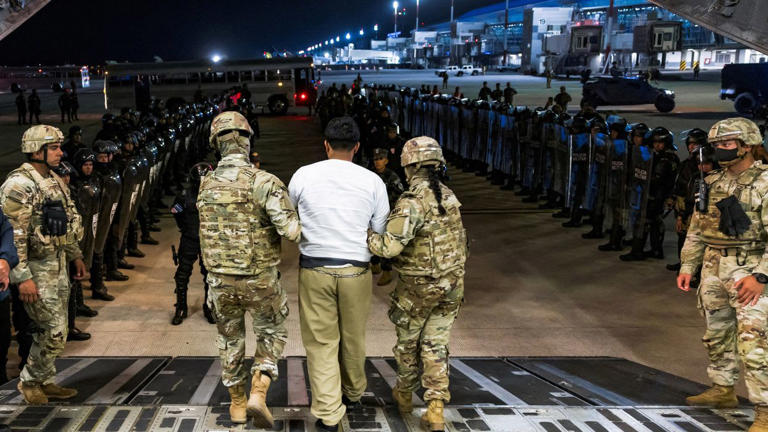
The ruling creates a temporary roadblock for the administration’s efforts to utilize nations like El Salvador, South Sudan, and other third countries as destinations for deportees who are not their citizens.
What’s Next
The 15-day stay allows the Trump administration time to petition the First Circuit Court of Appeals or the Supreme Court for an emergency freeze. If the ruling stands, DHS will be required to provide “meaningful notice” and a formal opportunity for migrants to contest removals to any country other than their home nation.