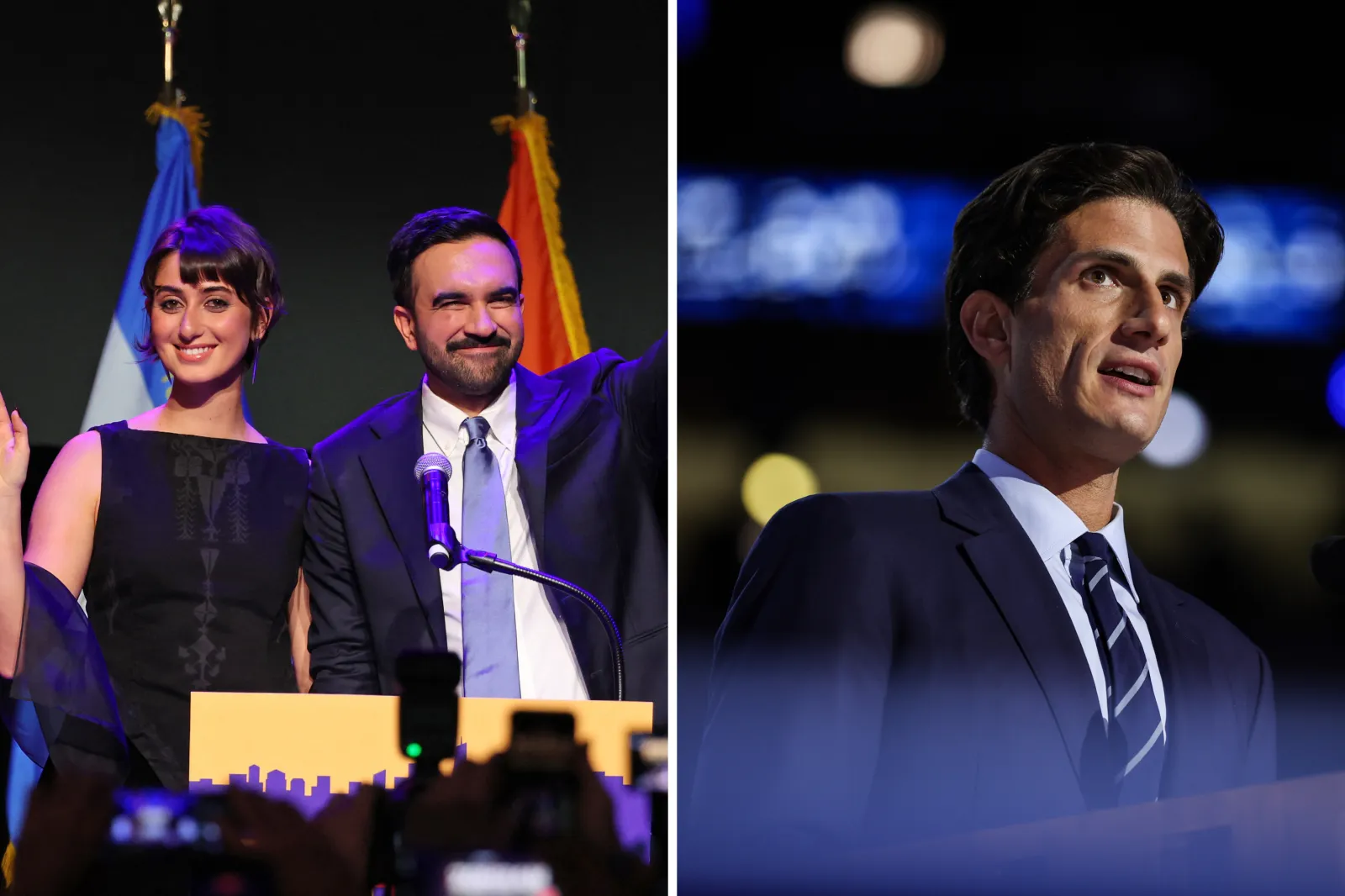

Whether you’re a fan of his politics or not, most observers agree on one thing about mayor-elect Zohran Mamdani: he has presence.
Together with his Gen Z wife, artist Rama Duwaji, Mamdani projects a breezy, polished, youth-driven image that can feel, to some, more like a lifestyle campaign than a traditional political operation. Their affectionate, film-shot wedding photos—captured in the chaos of New York City’s subway rush hour—have sparked debate about whether we’re seeing a new archetype in public life: the “aesthetically literate” politician, fluent in culture, visuals, and vibes.
They’ve been loosely grouped with other image-forward figures such as Jack Schlossberg, Alexandria Ocasio-Cortez, and even 84-year-old Bernie Sanders, whose mitten-clad meme moment dominated the internet a few years back. But is this truly a new phenomenon, or just a rebranding of something politics has always relied on—a memorable, carefully crafted image? And does any of it matter when it comes to what politicians actually do in office?
The question has been circulating online, helped along by a post from @fooleryco on Threads, the Meta-owned platform, that declared: “Not to be dramatic but we’re witnessing the dawn of the aesthetically literate politician.”
Alongside Mamdani’s subway wedding photos, the post featured an image of Schlossberg, grandson of John F. Kennedy, riding a bicycle mid-motion while balancing two bouquets of pink tulips. The photo, pulled from Schlossberg’s Instagram, appeared around the time he announced his run for New York’s 12th Congressional District in the 2026 election.
Social media users quickly began swooning over Schlossberg following the announcement, despite his relatively thin political résumé—largely a function of his age—and limited experience in governance.
The post has attracted more than 32,000 likes and a rush of comments from people who say they agree with the idea. Many chimed in with their own favorite “cool-looking” political figures who know how to land in a feed.
“They come across as earnest at a time when a lot of older politicians are viewed as stale, scandal-ridden, or checked out,” Andrellos Mitchell, a Washington, D.C.-based attorney and cultural commentator, told Newsweek. “And of course, promising ‘free stuff’ never hurts with certain voters.”
Mitchell, however, cautioned against overstating how revolutionary any of this really is. “This isn’t some deep new trend. Politics has always borrowed from acting…And New York has its own thing going on—loud, crowded, dramatic, and convinced that those traits equal authenticity. A lot of what goes viral from New York politicians is just the city’s culture spilling onto the internet.”
He added that figures like Mamdani and Schlossberg benefit from being photogenic—or from consciously leaning into a look that plays well online.
Experts argue that what has really shifted is not the mere fact of image-making, but the visual language around it and the way those aesthetics are deployed.
“What we’re seeing with Mamdani and Schlossberg is the rise of the ‘aesthetically literate’ political figure, someone who understands how imagery, tone, and cultural relevance shape modern political identity,” Michelle Glogovac, host of the podcast My Simplified Life, told Newsweek.
Glogovac credits Duwaji—a 28-year-old illustrator who frequently contributes to media publications—as “the creative brain behind much of [Mamdani’s] visual identity.”
That identity, she said, speaks directly to younger millennial and Gen Z voters.
“[They] read visuals the way previous generations read op-eds,” she explained. “They pick up on cues: Is this person grounded? Are they self-aware? Are they in touch with the culture? And do they look like someone who’s living life alongside us rather than above us?”
Andrellos agreed: “The younger generations gravitate toward anyone who seems ‘real,’ even if ‘real’ just means loud, dramatic, or visually interesting. But as for downsides, yes, image can eclipse substance.”
The emerging aesthetic leans less on stiff formality and top-down authority, and more on relatability, accessibility, and cultural savvy.
“A photo of Mamdani and his wife in a subway-wedding photoshoot, or Schlossberg holding flowers on a bike, signals a lived-in humanity,” Glogovac said. “AOC posing for GQ, or Bernie looking cold in mittens, creates a cultural shorthand: ‘This person is part of our world.’
“It’s relatability that is being artfully communicated visually, not staged stoicism or political theater.”
Giovanni Bordone, a marketing lecturer and former stylist turned image consultant, told Newsweek he believes there’s clear strategic thinking behind Mamdani’s rise.
“Mamdani’s style—being young, Muslim and from a BAME background—works to elevate his image…To establish credibility, appear more mature, appeal to Wall Street investors but still retain a touch of ethnic identity while at the same time speaking to a large Western audience,” he said.
That strategy, he added, is visible in everything from grooming choices to wardrobe—especially with the knowledge that every appearance could become a photo, a reel, a meme.
“Beard? Yes, but always trimmed. Clothing? Yes, a suit and tie, consistently styled, yet with occasional ethnic touches to signal belonging,” Bordone said. “His team’s masterpiece was the ability to appeal simultaneously to the white working-class ‘average Joe’ who sees him as ‘different’ but not too different, an acceptable distance that does not create dissonance with the American cultural system, the Muslim conservative family, and the young, multicultural, international Gen Z New Yorker.”
As for Duwaji, he noted: “Her image is a bit different: more natural, more genuine, less obviously built, more spontaneous—all traits that Gen Z absolutely adores.”
Still, as Andrellos pointed out, this kind of image construction is not risk-free.
“In a marcomm landscape that demands authenticity, he will potentially be seeing a backfire to some of his current wins as time goes on,” Leo Napper, a cultural anthropologist, told Newsweek. “But I do believe that Mamdani’s PR is completely planned out to appeal to Gen Z, including zillennials, of course, as well as other key voter demographics.”
Snigdha Sur, CEO of New York City-based media company The Juggernaut, offered more context on Mamdani’s now-familiar persona.
“He was once a rapper named Mr. Cardamom,” she said, also pointing to the influence of his mother, filmmaker Mira Nair. “Mamdani’s rise uses a bit of a different visual language than other folks—warmer, Bollywood colors—to also seem more approachable and ‘South Asian,’ allowing folks to even overlook whether his policies benefit them.”
Critics of this style-driven politics warn against mistaking charming aesthetics, social media buzz among left-leaning Gen Zers, and quirky imagery for genuine value or competence.
“Once politicians learn that a photoshoot or a meme gets more attention than policy, they start leaning into the performance,” Mitchell said.
Glogovac shares that concern. “The downside is that aesthetics really can be confused for substance. A good ‘vibe’ doesn’t make someone a good legislator, and charisma doesn’t replace policy.”
At the same time, she argued that voters are not simply dazzled by nice photos.
“They’re responding to a culture where authenticity is the currency,” Glogovac said. “And where political storytelling happens visually, not through press releases and stump speeches.”