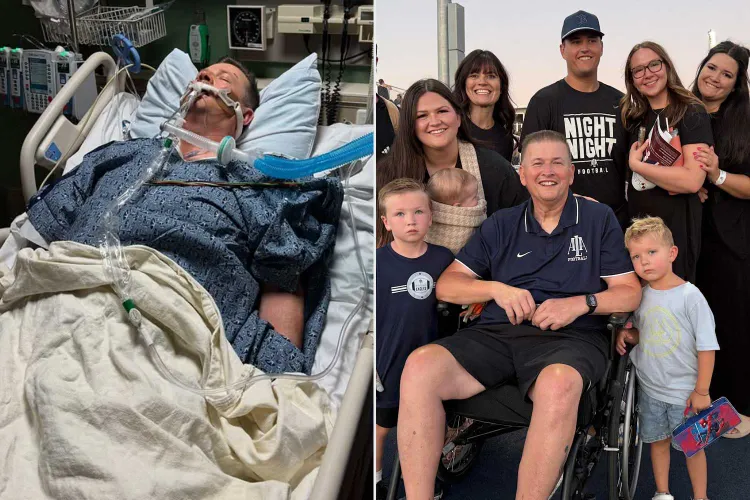

For as long as she can remember, Madisen Franklin’s family has been inseparable.
The 28-year-old from Mesa, Arizona, is the oldest of six siblings — the youngest just 17 — and says their closeness has always been the heart of their lives. She lives only minutes away from her parents, Kenny, a former high school dean of students and military veteran, and her mother, Charity Thorley. Married for 30 years, they’ve become the center of their family’s world. Franklin’s three young sons lovingly call them “Lolly” and “Papa,” nicknames that perfectly capture their warmth.
“My mom really wanted to be Lolly and Pop so the kids could say, ‘We’re going to Lollipop’s house,’ but my dad insisted on being Papa,” Franklin says with a laugh.
“They’re super involved in our lives,” she adds. “My dad has always been the glue — our biggest cheerleader and all of our heroes.”
A Sudden Collapse
On January 18, Kenny, then 50, drove to New Mexico with Franklin’s youngest brother, Cody, to visit a college offering him a football scholarship. A lifelong coach, Kenny had trained all three of his sons and was thrilled to join his youngest for the trip.
That morning, everything seemed normal. They toured the campus, walking up a steep hill to see the dorms. Cody later went inside with the other players while Kenny waited nearby — until a sudden noise changed everything.
:max_bytes(150000):strip_icc():focal(999x0:1001x2):format(webp)/Kenny-Thorley-100825-5-8374d830b8b14907a9a8d4fcade4749b.jpg)
“He thought maybe a chair had fallen,” Franklin recalls. “But when he turned around, my dad was face down on the ground, and people were rushing to help. When they rolled him over, they realized he didn’t have a pulse.”
Back home in Arizona, Franklin, her mom, and her sister were at her son’s flag football game when Cody called.
“I just watched my mom’s face drop — like a wave of panic,” Franklin says. “She screamed, ‘No, no, no,’ and ran across the field. That’s when she told me, ‘Dad collapsed. He’s not breathing. He doesn’t have a pulse.’ ”
Fighting for His Life
Hundreds of miles away, bystanders in New Mexico immediately began CPR, working tirelessly for nearly 20 minutes before paramedics arrived. Kenny was rushed to a hospital in Silver City, where EMS shocked his heart four times and gave every medication possible. After 45 minutes, his pulse finally returned.
Doctors stabilized him and placed him on life support before arranging for an airlift to El Paso, Texas, since the local hospital couldn’t handle such a severe case.
“I remember hearing he was on life support and thinking they were just keeping him alive so we could say goodbye,” Franklin says. “I couldn’t imagine him dying — but I didn’t think he was going to wake up either.”
In El Paso, tests revealed Kenny had suffered a massive heart attack with three major blockages. Surgeons initially planned to insert a stent but realized his condition was too critical — he needed open-heart surgery. The problem: the only surgeon available to perform it was out of town.
The family arranged another transfer, this time back to Phoenix, so Kenny could receive care closer to home.
“We were told he had a five percent chance of survival,” Franklin says. “Even if he made it off life support, doctors weren’t sure about his brain function after being down so long.”
Weeks of Uncertainty
By January 21, just three days after collapsing, Kenny was back in Arizona. He spent 38 days in the cardiovascular ICU, battling pneumonia, sepsis, and diabetic ketoacidosis. His body was failing, and surgery was no longer an option.
When doctors began reducing his sedation, they said he should wake up in a few days — but when he didn’t, the family braced for the worst.
“The first time he opened his eyes, he wasn’t really there,” Franklin says. “He didn’t recognize us. I remember thinking, ‘Oh no, he has a severe brain injury.’ I didn’t know if he’d ever be the dad we knew.”
Over the following weeks, Kenny was placed back on a ventilator twice. Each time he woke up, he was a little more alert, a little more himself. He began recognizing family, moving his hands, and eventually responding — small miracles that gave them hope.
After 38 days in the CVICU, he was transferred to an acute rehab facility for a month, followed by another at Barrow Neurological Rehab Center in Phoenix.
On April 20 — his 51st birthday — Kenny finally came home.
A Long Road to Healing
Today, Kenny continues therapy to relearn how to walk, talk, and swallow. He still relies on a feeding tube, with Charity acting as his full-time caregiver.
“He still jokes with us and writes funny things on his iPad — that’s how we communicate,” Franklin says. “He’s still very much the center of our family.”
The journey, though, has been hard.
“The biggest challenge has been him not being able to work,” Franklin explains. “Both my parents have been out of jobs since January, and it’s been a huge financial strain. Beyond that, we just miss his voice — his laugh. We’re learning how to make new memories with him, but it’s been a huge adjustment.”
Sharing His Story
To stay connected with loved ones — and to inspire others — Franklin began documenting Kenny’s recovery online. Their story has since reached more than two million people on TikTok. The family also created an Instagram page, @caringforkenny, and a GoFundMe to support his care.
“We’re a really close family and pretty private,” Franklin says. “But everyone wanted updates — students, friends, people my dad coached. Once he came home, I wanted everyone to see that he’s still himself — still making us laugh, still fighting.”
Messages soon poured in, including from nurses who had cared for Kenny early on.
:max_bytes(150000):strip_icc():focal(749x0:751x2):format(webp)/Kenny-Thorley-100825-1-5425c803579a473baed3a4066bf6e8f5.jpg)
“The craziest part is when people say, ‘I was your dad’s nurse in the ICU — I can’t believe how far he’s come,’ ” Franklin says. “They only saw him fighting for his life. Now they get to see him awake and smiling.”
The support has also come from families who’ve endured similar pain.
“When doctors tell you there’s a five percent chance of survival, it’s terrifying,” she says. “Hearing from others who’ve been there makes us feel less alone — and so grateful that we got this second chance.”
A Story of Strength and Hope
Through it all, Franklin says her father’s strength continues to inspire them.
“I hope people see this as a story of perseverance,” she says. “We lost so much — his job, his coaching, my brother’s final season, even their home. But he still makes us laugh and shows up for us every day.”
“He’s still the same dad we’ve always known,” she continues. “That resilience, that strength, is what keeps us going. Even when our worst nightmare came true, we’re still here — surviving together.”