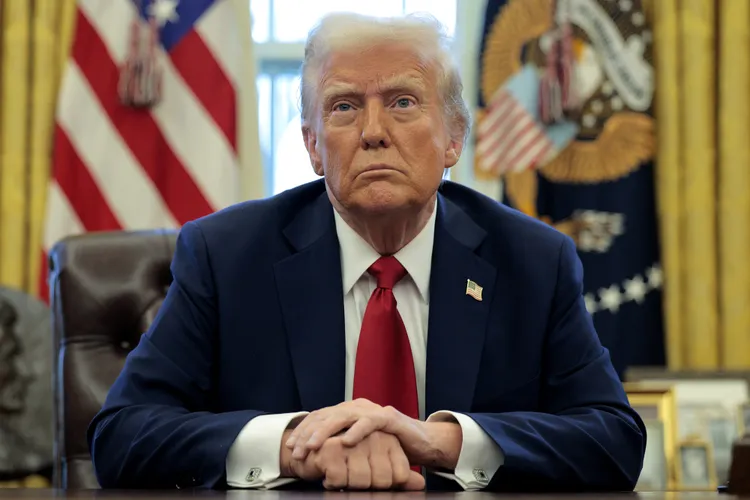

Bipartisan calls for an ethics investigation are intensifying following a massive $1.5 billion surge in futures trading that occurred just minutes before President Donald Trump abruptly de-escalated military tensions with Iran on Monday morning.
The suspicious market activity preceded a social media post from the President that walked back a weekend threat to “obliterate” Iranian power plants. The reversal triggered a predictable market rally, raising alarms over potential insider trading within the executive branch.
The $1.5 Billion “Bet”
On Saturday, while global markets were closed, President Trump threatened Iranian leaders with total infrastructure destruction unless the Strait of Hormuz was opened within 48 hours. However, shortly before U.S. markets opened on Monday, Trump pivoted, announcing “very good and productive conversations” regarding a “total resolution of hostilities.”
Financial data reveals an extraordinary spike in volume approximately 15 minutes before the announcement:
- $1.5 billion in S&P futures contracts.
- Significant positions in West Texas Intermediate (WTI) and Brent crude oil futures.
- High-leverage bets on prediction platforms Polymarket and Kalshi.
“This is corruption. Mind-blowing corruption,” stated Senator Chris Murphy (D-Conn.), who is demanding a probe into whether White House staffers or family members traded on non-public information. Senator Andy Kim (D-N.J.) echoed the sentiment, noting that “someone made a fortune” on the precise timing of the de-escalation.
A Regulatory Vacuum
The controversy arrives as federal oversight of financial markets reaches a historic low. Since President Trump’s 2025 inauguration, the Commodity Futures Trading Commission (CFTC) has significantly relaxed its posture. The agency recently dropped investigations into prediction markets Kalshi and Polymarket—both of which appointed Donald Trump Jr. as an adviser in 2025.
Similarly, enforcement at the Securities and Exchange Commission (SEC) has plummeted. Last week, the SEC’s top enforcement officer, Margaret Ryan, resigned following reported clashes with leadership over the handling of cases involving the Trump family.
The PREDICT Act
In response to the volatility, Reps. Nikki Budzinski (D-Ill.) and Adrian Smith (R-Neb.) introduced the PREDICT Act (Preventing Real-time Exploitation and Deceptive Insider Congressional Trading) on Wednesday. The legislation would bar the President, members of Congress, and senior executive staff from betting on events they have the power to influence.
“We realized a handful of traders had very precise information—perhaps information only known at a senior government level,” Budzinski said, citing the million-dollar profits seen on Polymarket following recent military strikes.
While the CFTC has declined to comment on the Monday trades, the mounting evidence of “well-timed” profits is forcing a rare bipartisan confrontation over executive branch ethics.