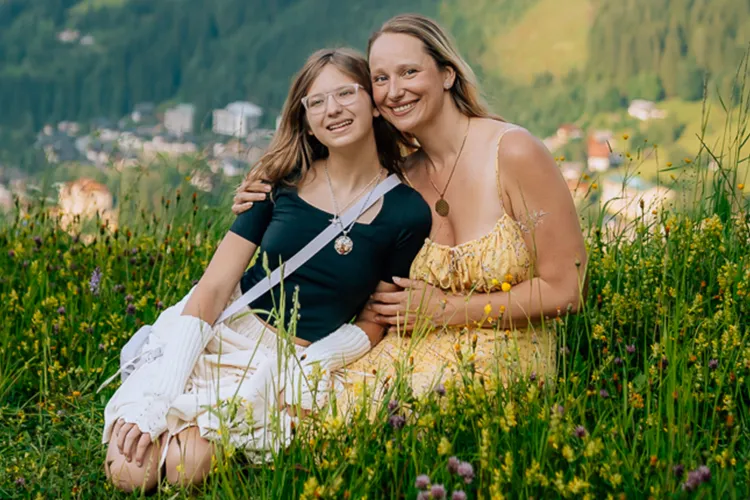

When Elena Ollick first enrolled her daughter in traditional school, she was stunned to find that her child was far ahead of what the class was covering. After spending her early years traveling the globe with her parents, Ollick’s daughter felt bored once she entered a standard classroom.
“We decided to test her and found out that she tested in the 99.9th percentile for her age,” Ollick says. “The teacher suggested putting her into a gifted program, which, unfortunately, mainly meant that she would receive more homework and more assignments rather than material more on her level.”
Ollick quickly realized the school system wasn’t going to challenge her daughter in the way she needed. When the COVID-19 pandemic hit, she built her own schedule of subjects and activities at home — and saw her daughter thrive with more freedom and autonomy.
“That’s when I went from thinking ‘no way’ I can homeschool to realizing that homeschooling doesn’t actually have to look like school! And we never looked back,” Ollick says.
Before making the transition, Ollick had heard the term “worldschooling,” but initially dismissed it. Over time, she says, her family’s travel-based learning showed her how powerful it could be — and eventually inspired her to start a company centered on the approach.
:max_bytes(150000):strip_icc():focal(734x672:736x674):format(webp)/Worldschooling-trip-4-021826-5604f79c15894aa6b75aa8ceccbbca8e.jpg)
“[Worldschooling] can look like traveling and homeschooling on the go, it can mean traveling and learning through that travel, but the original definition of worldschooling is to interweave learning into real travel experiences and learn from experiencing the places and the history, rather than just reading about them in books,” Ollick explains.
In practice, math might involve currency conversions or calculating tips, history might be explored through visiting ruins in Greece, and art could mean seeing famous works firsthand, such as the Mona Lisa in the Louvre.
Ollick says she first saw the impact through her daughter’s curiosity while traveling — from snorkeling the Great Barrier Reef to learning about marine animals in the Galápagos, visiting temples in Japan, and exploring ancient sites in Rome.
“There was no forcing of studying because she would get so lit up and excited about certain topics she was learning while traveling that it would transfer to everything she was doing at home,” Ollick says. “As a mom, I didn’t have to direct her as much or tell her what she needs to learn. She was constantly inspired by the world around her to learn more about subjects.”
Through Ollick’s company, Worldschooling Journeys, families build travel experiences around learning in a way that fits their lives. The company organizes group trips and experiences, but there’s no one “normal” way to do it.
“Some families travel full-time and move from place to place quickly. Other families travel full-time and stay in one place for a long time to really get a lot of immersion,” she says. “Some families take one big trip a year and really make it count, while [others] (which I would say is the majority) take five to six trips a year… and try to weave it into their children’s curriculum.”
Ollick describes the company as a community of families who share a similar lifestyle and gather periodically to experience different cultures together.
“We organize about 40 trips per year. Many of these are cruises from 7 days to 33 days,” she says. “Just this fall, we had 167 worldschoolers come together on a 65-day trip that consisted of three back-to-back worldschooling cruises that we organized.”
:max_bytes(150000):strip_icc():focal(784x402:786x404):format(webp)/Worldschooling-trip-3-021826-9318f41e4e61493e89c8196665a33218.jpg)
A typical day might include homeschooling from the ship, allowing families to keep up with their routines. There are also lecture days, where professionals are invited to speak — sometimes scientists or other experts — and port days, when families head out on educational excursions led by tour operators. The activities vary depending on the destination.
“But every single time, the kids walk away with a better worldview, more information on animals, nature, culture and history, and a better understanding of the world,” Ollick says.
For Ollick, the approach has helped her daughter grow in ways she believes a traditional environment couldn’t.
“For my daughter, the benefit of worldschooling is being exposed to so many different subjects, topics and ideas that it inspires her to dig deeper and research more once she gets home, or often on the trips themselves,” she says. “She’s 14, and she’s a writer, a poet and a musician, and those experiences have inspired countless ideas and stories and lyrics and music that she has created.”
Ollick also believes the experience helps children become more open-minded.
“It also makes her very tolerant and accepting of people of all races, ages and backgrounds, regardless of their ability,” she says. “As a worldschooler, she doesn’t judge people and kids based on their looks, where they came from, or their physical or mental abilities. That’s exactly what I’ve seen in other kids as well.”
:max_bytes(150000):strip_icc():focal(767x399:769x401):format(webp)/Worldschooling-trip-021826-a1c650c96a1e4499b98055ce51fa5568.jpg)
She adds that she often hears from families with children on the autism spectrum who say the community has helped their kids build confidence and social skills.
“I have countless testimonials from parents… talking about how their kids have felt embraced, normal, accepted, loved and have gone from being absolutely shy and reserved to becoming the life of the party,” she says. “I’ve seen it with my own eyes many times.”
After years of worldschooling, Ollick says she wouldn’t return to a traditional school setting.
“I feel that would be a major detriment. Our daughter tests on a college level in all subjects and has since elementary school,” she says. “Enrolling in high school now that she is of ‘high school age’ would not be beneficial.”
She also points to flexibility as a major reason her family prefers this lifestyle, arguing that the rigid pace of traditional school — early mornings, packed schedules, and repetitive homework — isn’t something they want to return to.
Ollick says some children in her community complete college degrees by 16, and she pushes back on criticism that worldschooling limits socialization.
“The amount of socialization with people all around the world from different cultures and lifelong friends that they make and bonds that they have created are so much greater than any kid could ever get in the classroom,” she says.
She adds that when worldschooling kids and traditional student groups overlap on tours, she notices a clear difference in engagement.
“The worldschooling kids are energetic and inquisitive and asking questions and excited and eager to learn,” Ollick says, “while the high school kids are usually very quiet and do not engage in anything… just waiting until the day is over so they can go.”