
A rallying cry is catching on among anti-tax crusaders: abolish property taxes for homeowners.
As home values rise, property tax bills have surged in many states. But wiping out homeowner property taxes would leave massive holes in state and local budgets—often in the billions, and in some places tens of billions—raising concerns about what happens to schools and local services that depend on that money.
Still, momentum is building in several Republican-led states.
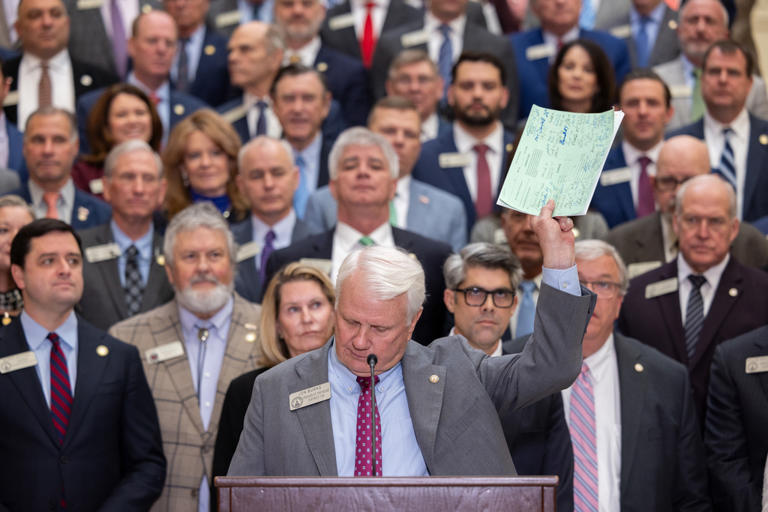
In North Dakota, officials say they’re moving toward zeroing out homeowner property taxes using oil revenue. On Wednesday, Republicans in the Georgia House rolled out a sweeping, multi-step plan to phase out homeowner property taxes by 2032. In Florida, GOP Gov. Ron DeSantis has said he wants property taxes eliminated, while lawmakers consider a proposal to phase out nonschool property taxes on homeowners over a decade. And in Texas, Republican Gov. Greg Abbott says he wants to eliminate school property taxes.
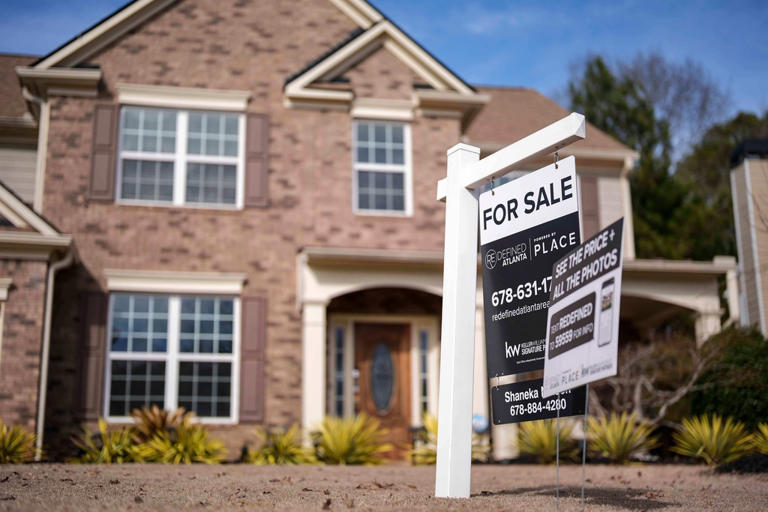
Republicans are leaning into a core argument from anti-tax activists: that property taxes—especially when governments can seize a home for nonpayment—undermine the idea of true ownership.
“No one should ever face the loss of their home because they can’t pay rent to the government,” Georgia Republican House Speaker Jon Burns of Newington said Wednesday.
An election-year tax revolt
The push could expand further through ballot measures. Similar initiatives are being discussed in Oklahoma and Ohio to eliminate all property taxes. Voters rejected a broad property tax repeal in North Dakota in 2024, and organizers in Nebraska fell short of the ballot that year—though they’re trying again. A separate effort in Michigan may also come up short.
“We’re very much in this property tax revolt era, which is not unique, it’s not new. We’ve seen these revolts in the past,” said Manish Bhatt, vice president of state tax policy at the Tax Foundation, a Washington D.C., group that is generally skeptical of new taxes.
Earlier waves of backlash produced measures like California’s Proposition 13, the 1978 initiative that capped property tax rates and restricted how quickly assessed values could rise for tax purposes.
The political appeal is personal and immediate for many homeowners, including Tim Hodnett, a 65-year-old retiree in Lawrenceville, Georgia. Hodnett said his yearly property tax bill climbed from $2,000 to $3,000 between 2018 and 2024. Because he paid off his mortgage years ago, he pays the bill in a single lump sum rather than through monthly escrow payments.
Hodnett said he is disabled and lives on $30,000 a year. He expects a major break soon because seniors in Gwinnett County are exempt from school property taxes—about two-thirds of his bill. But he would gladly see the remaining $1,000 disappear as well.
“It would be nice to be exempt from property taxes,” Hodnett said.
Where would the money come from?
The central question is what replaces the revenue: Do local governments and K-12 schools cut spending, or do they get permission to offset losses with other taxes and fees?
“I think the complete elimination of the property tax for homeowners is really going to be very difficult in most states and localities around the country, and undesirable in most places,” said Adam Langley, of Lincoln Institute of Land Policy, a Massachusetts nonprofit that studies land use and taxation.
In Florida, Chief Financial Officer Blaise Ingoglia, a Republican, has been touring the state making the case that local governments are overspending—and that they don’t actually need the $19 billion in property taxes collected from homeowners whose primary residence qualifies for the homestead benefit. Local governments have challenged those figures.
North Dakota has taken a different path, leaning on returns from the state’s $13.4 billion oil tax savings account to steadily reduce homeowner property taxes. Last year, the Republican-controlled Legislature expanded the state’s primary residence tax credit from $500 to $1,600 per year. Officials said in December that the credit wiped out property taxes for 50,000 households last year and reduced bills for nearly 100,000 more—costing about $400 million in state subsidies for the 2025 and 2026 tax years.
“It works, and we know we can build on it to provide even more relief and get property taxes to zero for the vast majority of North Dakota homeowners,” Republican Gov. Kelly Armstrong said.
The math is less straightforward in Texas, where state surplus dollars have been used to fund property tax cuts. And it’s even murkier in Georgia, where the proposal involves shifting the burden rather than simply erasing it.
From property taxes to sales taxes
Burns is proposing to eliminate $5.2 billion in homeowner property taxes in Georgia—more than a quarter of the $19.9 billion collected statewide in 2024—by steering cities, counties, and school districts toward existing or newly authorized sales taxes.
The plan faces steep political and procedural hurdles. It must pass the Republican-led Senate, then win enough support for a state constitutional amendment—requiring a two-thirds vote that would likely need Democratic backing—before going to voters in November.
There are also practical concerns. While property taxes heavily support schools, sales tax revenue doesn’t flow to schools in the same way in many communities. It’s unclear whether localities would rewrite those allocations. And even if they tried, local governments and schools would still be capped at a combined 5% sales tax rate on top of the state’s 4% rate. Some jurisdictions may not be able to raise sales taxes enough to fill the gap.
Under Burns’ proposal, Georgia would expand its homestead protection gradually—moving from shielding $5,000 of home value today to $150,000 by 2031—before abolishing most homeowner property taxes in 2032. The plan would also cap annual property tax revenue growth to 3% on other types of property.
Local governments would be allowed to bill homeowners annually for specified services like garbage pickup, street lighting, stormwater management, and fire protection. Lawmakers argue these would be service charges rather than taxes. Voters could also approve additional assessments for government or school improvements. Authors said they have not yet decided whether unpaid assessments could trigger a loss of a home.
Burns is also pushing a roughly $1 billion property tax cut for 2026, though it remains unclear whether Republican Gov. Brian Kemp will support it. A spokesperson declined comment.
Georgia lawmakers have also tried a more common approach: limiting how fast assessed home values can rise for tax purposes. But many school districts and local governments have opted out. State senators are still pursuing that route, and a Senate committee on Wednesday advanced a proposal to make the cap mandatory.